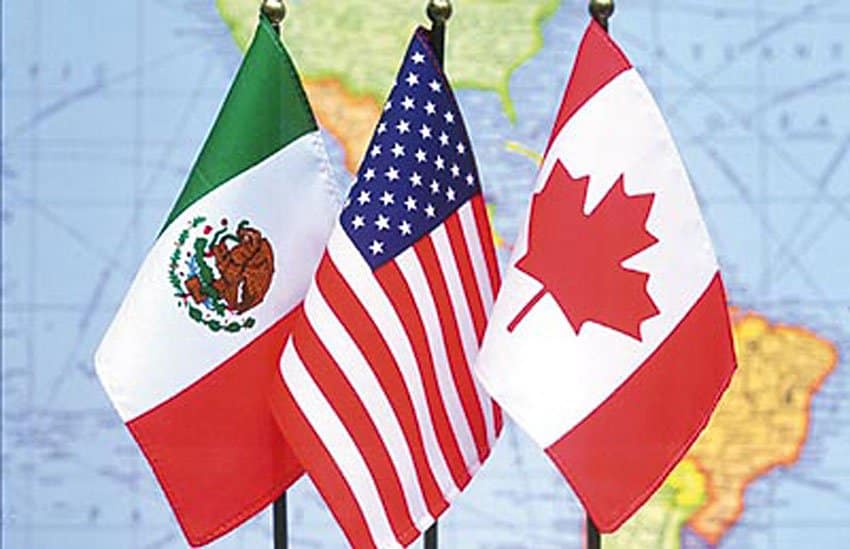
The United States and Canada reached a last-minute deal yesterday to maintain a trilateral trade accord in North America, ending negotiations that dragged on for over a year.
Under the updated pact, the United States will have greater access to Canada’s dairy market and both Mexico and Canada will be protected from any future auto tariffs that their neighbor imposes on imports up to a quota of 2.6 million passenger vehicles annually.
To be known as the United States-Mexico-Canada Agreement (USMCA) instead of NAFTA, the new accord will preserve a dispute resolution system that Canada fought to maintain to protect its lumber industry and other sectors from United States anti-dumping tariffs, Canadian and U.S. sources told the news agency Reuters.
However, United States tariffs on Canadian steel and aluminum were not lifted as part of the agreement.
The deal also requires a higher proportion of auto content to be made in high-wage areas where workers are paid at least US $16 per hour, in order for vehicles to qualify for tariff-free status.
The rule is designed to bring more auto sector jobs to the United States as it will make it harder for large manufacturers to operate cheaply in Mexico.
Its inclusion in the revised pact is seen as a big win for United States President Donald Trump, who called NAFTA “one of the worst trade deals ever made” and has pledged to return auto sector jobs to the U.S.

In a joint statement, the United States and Canada said the updated pact, which will govern more than US $1.2 trillion worth of trade between the three countries, would “result in freer markets, fairer trade and robust economic growth in our region.”
Most of its provisions, however, won’t start until 2020 after legislatures in Mexico, Canada and the United States have approved the new deal.
The announcement of the new agreement ends more than a month of uncertainty about whether Canada would join the pact that Mexico and the United States reached on August 27.
Leaders of all three countries were upbeat about the new trilateral treaty.
“The modernization of the trade agreement between Mexico, Canada and the United States ends 13 months of negotiations and achieves what we proposed in the beginning: a win-win-win agreement,” Mexican President Peña Nieto wrote on Twitter.
After a late-night cabinet meeting in Ottawa to discuss the new deal, Canadian Prime Minister Justin Trudeau told reporters “it’s a good day for Canada.”
Trump, who repeatedly threatened to terminate the 24-year-old pact, posted a glowing two-part assessment of the updated agreement to his Twitter account early this morning.
“Late last night, our deadline, we reached a wonderful new Trade Deal with Canada, to be added into the deal already reached with Mexico. The new name will be The United States Mexico Canada Agreement, or USMCA. It is a great deal for all three countries, solves the many . . . deficiencies and mistakes in NAFTA, greatly opens markets to our Farmers and Manufacturers, reduces Trade Barriers to the U.S. and will bring all three Great Nations together in competition with the rest of the world. The USMCA is a historic transaction!”
At a later press conference, Trump said that “this landmark agreement will send cash and jobs pouring into the United States and into North America.”
It’s “good for Canada, good for Mexico,” he added, praising both Trudeau and Peña Nieto who he called a “terrific person.”
Economy Secretary Ildefonso Guajardo, Mexico’s chief negotiator in the drawn-out and often-contentious talks, also took to Twitter to praise the new deal.
“The new trilateral trade agreement in North America is a state-of-the-art instrument that will bring great economic benefits to Mexico, Canada and the U.S.,” he wrote.
Jesús Seade, who participated in recent negotiations as the trade representative for president-elect Andrés Manuel López Obrador, added his support for the new deal.
“We celebrate the trilateral agreement. It closes the door on trade fragmentation in the region. NAFTA 2 will provide certainty and stability to Mexico’s trade with its partners in North America . . .” he wrote on Twitter.
Speaking in Madrid, Spain, Foreign Affairs Secretary Luis Videgaray said the inclusion of Canada in the agreement was “fundamental” in order to maintain the advantages of having a common North American market.
“It’s important for the economic relationship and competitiveness to have the same rules, in that sense it’s something we’re delighted with, we’re excited,” he said.
Videgaray also said that it was pleasing that a so-called sunset clause was not included in the new agreement.
The proposal was pushed by the United States and would have seen a modernized pact automatically expire after five years if it wasn’t renegotiated.
“This five-year idea eliminated certainty but now this [six-year] revision mechanism is good because it eliminates uncertainty,” Videgaray said.
The foreign secretary said that a deal had been reached in time for the current government to sign it but added that the ratification process would take place in the Senate next year.
He also said he was proud of having worked with Mexico’s negotiating team, including López Obrador’s representatives.
“It’s remarkable how Mexico closed ranks [to achieve] something good for the region and particularly for Mexico,” Videgaray said.
Both the Mexican peso and the Canadian dollar made small gains against the U.S. dollar on news of the updated agreement.
Source: Reuters (sp), El Economista (sp)