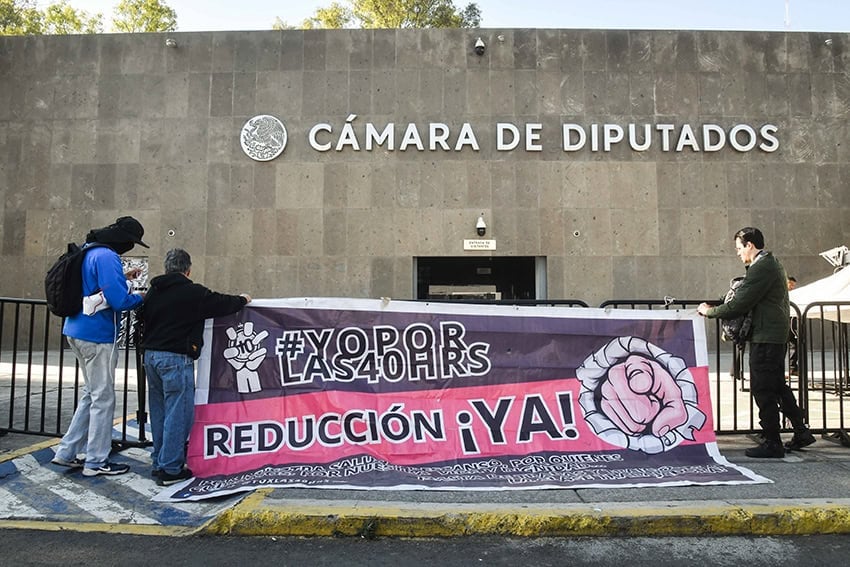
Mexico’s lower house of Congress approved on Wednesday a constitutional reform bill that will gradually reduce the standard workweek from 48 hours to 40.
All 469 lawmakers present in the Chamber of Deputies voted in favor of the bill when it was considered en lo general, or as a whole.
¡Felicidades trabajadoras y trabajadores de México! ¡La semana laboral de 40 horas será una realidad! Reconocemos el trabajo de las y los legisladores del Congreso de la Unión que ha permitido avanzar en el compromiso 60 de la Presidenta @Claudiashein. pic.twitter.com/G5NeGAg0WF
— STPS México (@STPS_mx) February 25, 2026
In a second vote held after consideration of the legislation’s individual articles, 411 deputies supported the bill while 58 opposed it.
The bill was first presented by the federal government in December and approved by the Senate earlier this month. It now needs to be ratified by at least 17 of Mexico’s 32 state legislatures in order to become law. That is expected to happen relatively quickly and the new law is slated to take effect on May 1 — International Workers’ Day.

In accordance with the legislation, Mexico’s standard workweek will be reduced by two hours annually starting next year in order to reach 40 hours in 2030, the final year of President Claudia Sheinbaum’s six-year term.
Despite the reduction in hours, the standard workweek will remain at six days, an aspect of the bill that was opposed by many opposition lawmakers.
Still, the federal Labor Ministry emphasized the significance of the legislation.
“After more than 100 years without modifications, Mexico will gradually leave behind the 48-hour work week and usher in a historic transformation,” it said on social media on Wednesday morning.
Labor Minister Marath Bolaños said in a video message that workers will have more time to rest, spend time with their families, play sports and enjoy cultural activities.
As things stand, Mexico has the worst work-life balance in the Organization for Economic Co-operation and Development, with more than 2,226 work hours per person per year, according to Reuters.
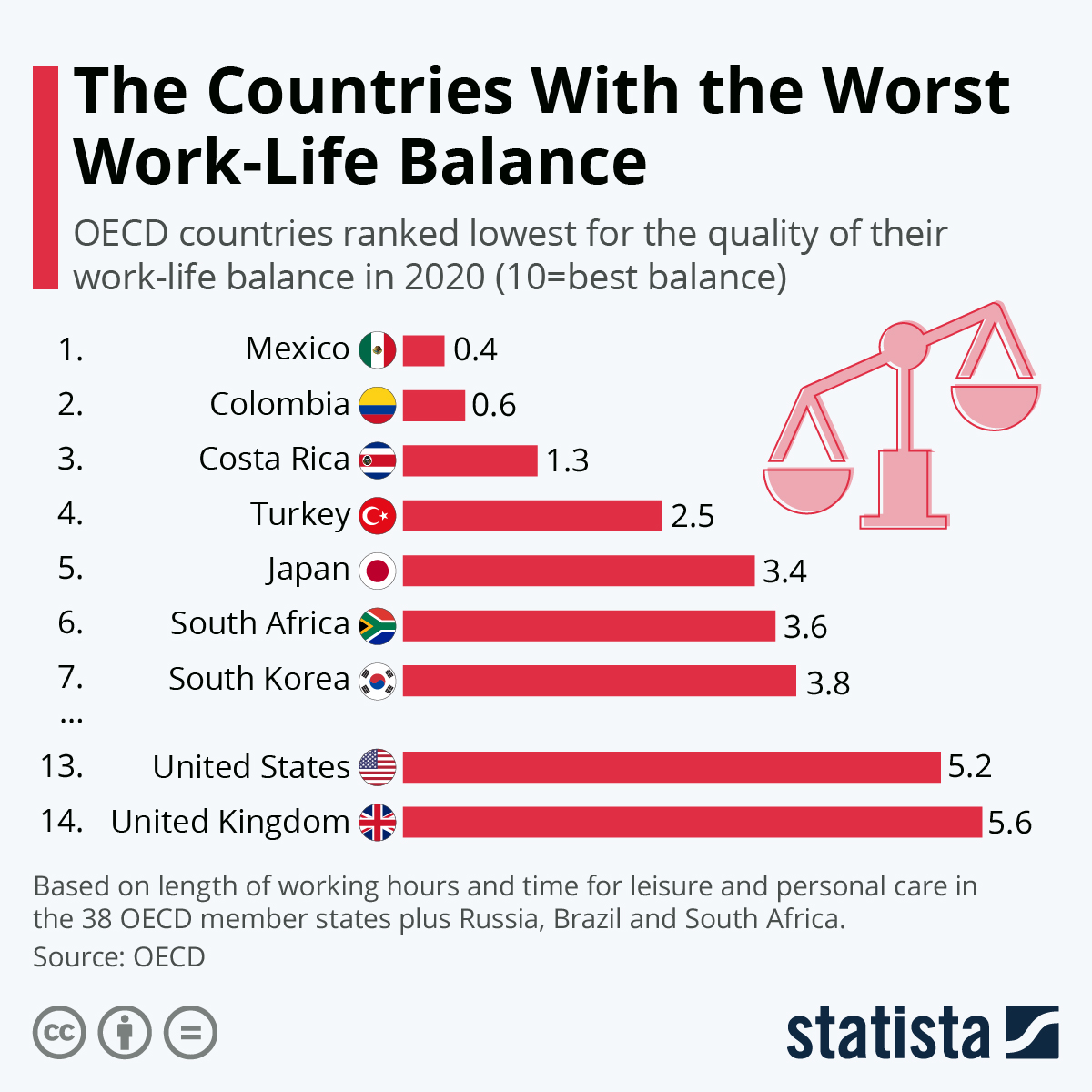 “The country, where around 55% of workers are employed in the informal sector, also has the lowest labor productivity and the lowest wages among the group’s 38 member states,” the news agency reported.
Among the other changes in the reform bill that has now been approved by both houses of Congress is an increase in the number of permitted double-time overtime hours from nine to 12. Workers will be limited to a maximum of four triple-time hours per week, meaning that a total of 16 overtime hours will be permitted. Workers aged below 18 will not be permitted to work overtime.
Employers will be prohibited from reducing workers’ salaries and benefits as the standard workweek is gradually shortened over the next four years.
A ‘labor spring’?
Mary Carmen Bernal Martínez, a deputy with the Labor Party (PT), asserted that Mexico is experiencing a “labor spring” given that the minimum wage has significantly increased and other laws benefiting workers have already been approved. They include one law that doubled annual paid leave for workers and another that gives them the right to sit down for periodic breaks during their shifts.
Citizens Movement (MC) party Deputy Claudia Ruiz Massieu rejected Bernal’s “labor spring” claim.
“While it doesn’t include an additional day of rest, this reform will fall short,” said Ruiz Massieu, a former foreign affairs minister and ex-president of the Institutional Revolutionary Party.
“It promised more than it effectively guarantees … And it is working people who will pay the cost of that false promise,” Ruiz Massieu said, adding that without the introduction of a five-day workweek, “there is no labor spring.”
Sheinbaum announces 13% minimum wage hike to 315 pesos a day
MC Deputy Patricia Flores Elizondo was also critical of the failure to guarantee workers two days of rest per week.
“In this chamber, they don’t want to talk about rest, they don’t even want to say the word,” she said, referring to deputies with the ruling Morena party and its allies, the PT and the Green Party.
“That is deeply hypocritical,” Flores claimed, “because many of those present here take six days of rest for every one they work.”
National Action Party Deputy Sarahí Gómez acknowledged that her party supported the reform bill, but nevertheless criticized it.
“What we don’t support is simulation — a pretty figure doesn’t change your life, 40 hours distributed across six days doesn’t change anything, increasing [overtime] hours cancels out the benefit,” she said.
The gradual reduction in the standard workweek “sends a very clear message — for the 4T [fourth transformation] there is no urgency,” said Gómez, referring to the government by its self-anointed nickname.
The bill was considered by Congress after consultation with workers, unions and private sector representatives.
Bolaños asserted in December that the reform “doesn’t imply greater costs for the business sector,” and claimed that some industries will see productivity gains from a shorter working week.
Some 13.4 million Mexicans who currently work more than forty hours per week will benefit from the gradual reduction in working hours.
With reports from El Economista, El Universal, EFE and Reuters