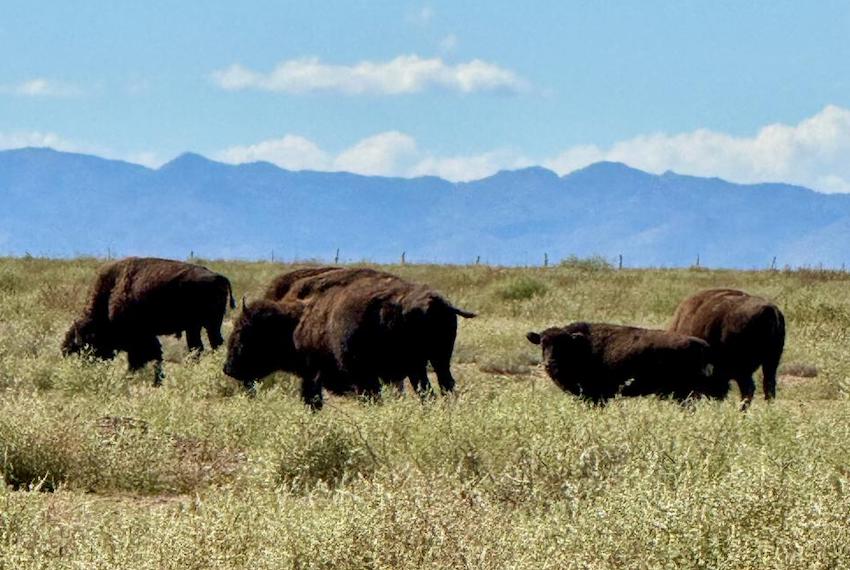
Absent from the central Coahuila desert for 160 years, the American bison has returned to the region as part of a 25-year biodiversity conservation effort in northern Mexico.
Last week, 44 bison (38 females and six males) were released into the 4,000-hectare El Santuario ecological reserve located in the Sierra de Menchaca, roughly 10 kilometers from Cuatro Ciénegas.
This marks the third time since 2009 that bison have been reintroduced to Mexico’s northern plains. Sixteen years ago, 23 bison from the Wind Cave National Park in South Dakota were released into the Janos Biosphere Reserve in Chihuahua and in 2020, a herd of 19 bison from Janos was introduced into the El Carmen nature reserve in Coahuila.
The bison project is a coordinated effort with the Mexican Fund for Nature Conservation, the Cuenca Los Ojos organization and the National Commission of Natural Protected Areas (Conanp).
This latest initiative — sponsored by the Pro Cuatro Ciénegas Foundation — aims to repopulate the valley, contribute to soil regeneration and rainwater retention and complete a cycle in the food chain that allows other species — such as the puma and the black bear — to thrive in these lands.
Bison — also referred to as “ecosystem engineers” — were once found in the states of Sonora, Chihuahua, Coahuila, Nuevo León and Durango, but are now considered an endangered species. The absence of the bison in Mexico’s northern region is primarily due to human impacts that occurred in the late 19th century: excessive hunting, agricultural and livestock expansion and habitat loss.

The Pro Cuatro Ciénegas Foundation considered the return of the large mammals known for their muscular build, humped shoulders and shaggy fur as a key step toward recovering ecological processes that had been interrupted.
“It’s not just about bringing in a charismatic animal,” said Pro Cuatrociénegas Foundation director Gerardo Ruiz Smith. “It’s about restoring critical ecosystem functions that no other species can perform.”
The return of the bison is important for the restoration of the great native grasslands of northern Mexico. Their capacity to capture CO2, equal to wetlands and boreal forests, helps restore grasslands, enhance biodiversity and shape the landscape.
The bison prune the grasses evenly, helping to increase the diversity of plants on the ground. They also assist with the regeneration of ecosystems by carrying seeds from one place to another in their digestive tract and defecating them.
Bison also contribute to the conservation of other species. Its considerable weight flattens the grassland in its path, an alteration that helps rodents such as the Mexican prairie dog, as short grass helps them keep watch for predators. The hair shed by the bison is used by birds for their nests.
The new arrivals were welcomed to their new home with a ceremony directed by the indigenous Ndé (commonly known as Apaches), who view the bison as a fundamental element of their worldview.
“The return of the bison is not only an ecological achievement; it reconnects the Ndé Nation with a brother that is part of our identity, our spirituality and our collective memory,” said Juan Luis Longoria, who is also the Director of Culture for the Pro Cuatrociénegas Foundation.
Longoria said the ceremony sought to bless the herd and give thanks for its return.
With reports from La Jornada, El País, FD Noticias and Excelsior