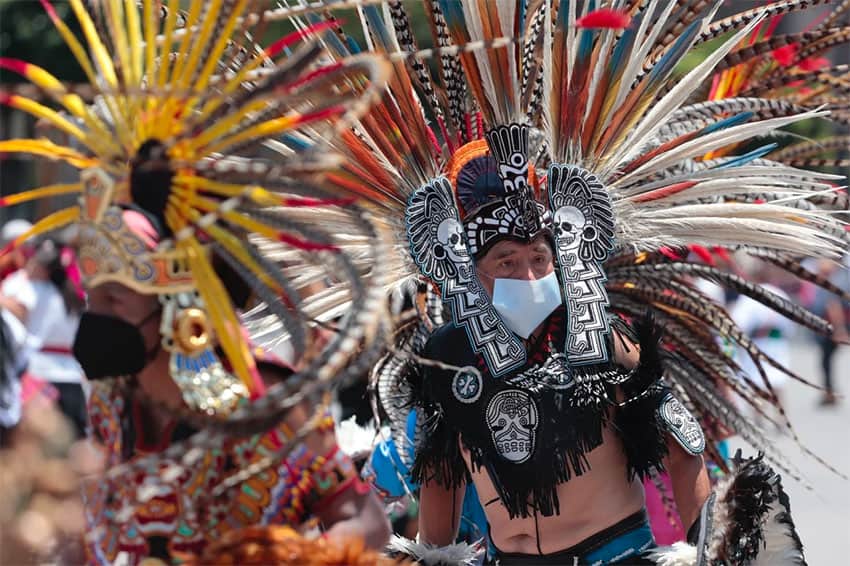
Around 2,000 dancers, musicians, singers and artists joined the annual celebration on Monday of the foundation of Tenochtitlán, the forebear to Mexico City and the capital of the Mexica people, also known as the Aztecs.
The precise date of the historic city’s foundation is debated. Most archaeologists and academics point to 1325, arguing that records indicate the pre-Hispanic year of “2-Calli,” which would make this year the 696th anniversary. However, to their ire, the government has promoted the events this year to mark “Seven Centuries of History,” which places the date at 1321 or 700 years ago.
The numeric symmetry must have been hard to resist for government planners: 2021 marks 200 years since Mexican independence and 500 years since Hernán Cortés’ victory at Tenochtitlán; 15 events are planned this year to celebrate.
However, commemorating the city’s foundation is a well established tradition. Since 1975, groups have converged on the zócalo each year on July 26 to celebrate the arrival of the first settlers.
One participant, Tonawaka Kwauhtlinxan, saw the event as an opportunity for connection. “We are celebrating this great event. It is the time of unification, the time to come back together as one great tribe. We are one tribe, the human tribe,” he said.
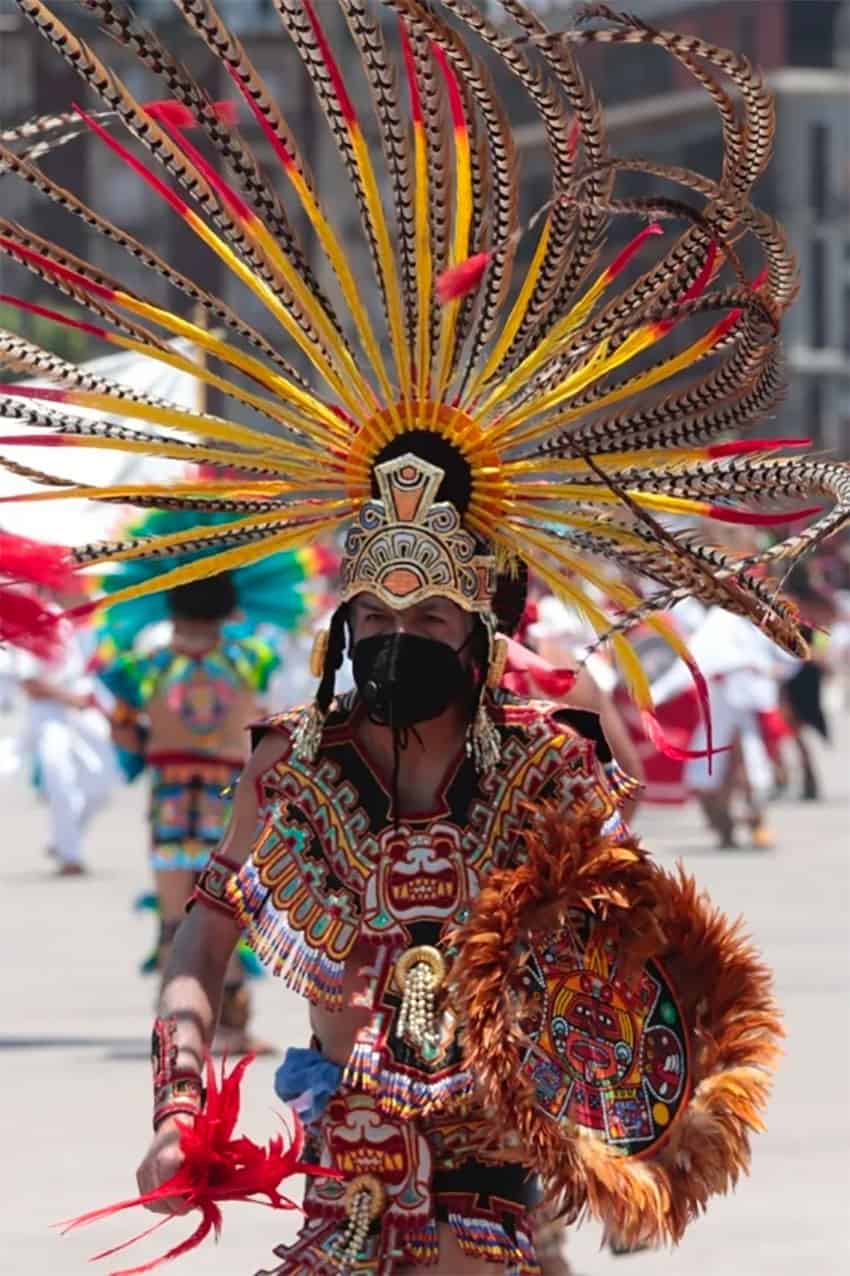
At 1:43 p.m. participants paused for the “zenith passage” when the sun reached its highest point in the day.
David Trejo, who arranged a tlalmanalli altar to marks the four elements and the deities, explained the astronomical phenomenon. “We have paused the dance to explain the astronomical pattern that is observed when the shadow disappears … the shadow of the flag [in the center of the zócalo], disappears,” he said.

Trejo added that the commemoration should be inclusive. “All Mexicans should know their roots, their culture, and be proud to be Mexicans. We always talk about September 16 [Independence Day] but there are other dates … that we continue to talk about after 500 years of the arrival of the Spaniards. Mexico is a multicultural world,” he said.
Amid offerings, dances and the “zenith passage,” there was a game of ulama, a Mesoamerican ball game.
Trejo, for one, said he was pleased with the government’s efforts to celebrate pre-Hispanic history. “We have had a lot of openness with the local government and other states. They are supporting us and promoting the rescue of the culture,” he said.
With reports from El Universal and Excélsior