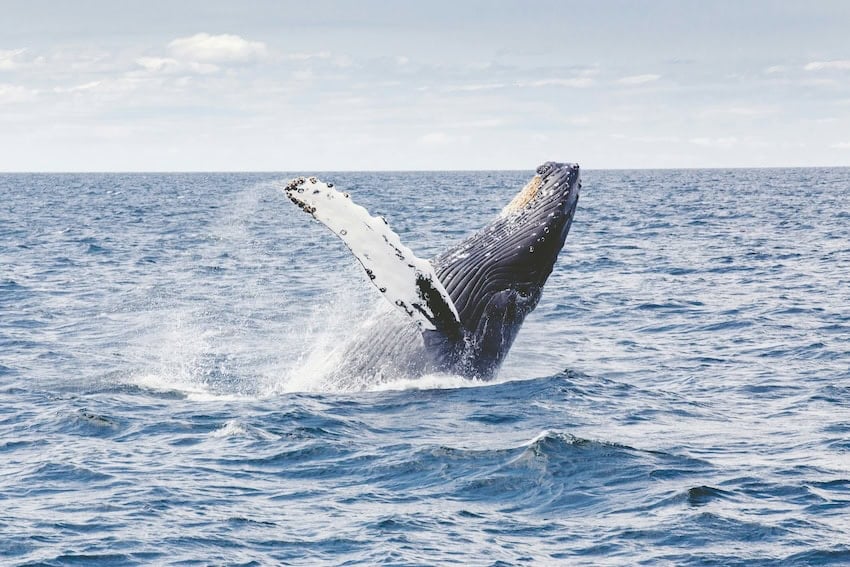
A federal judge in the northern state of Sonora has blocked mega-ship traffic in the Gulf of California tied to a planned liquefied natural gas (LNG) export terminal, giving whales at the center of a novel legal case a major — if temporary — victory.
Last fall, a coalition of organizations filed a lawsuit on behalf of Gulf of California whales, saying they deserved their right to a livable habitat and legal protections equivalent to human rights.
The suit cited Mexico’s General Wildlife Law, the Mexican Constitution and international treaties in seeking to have the area declared a “critical habitat.”
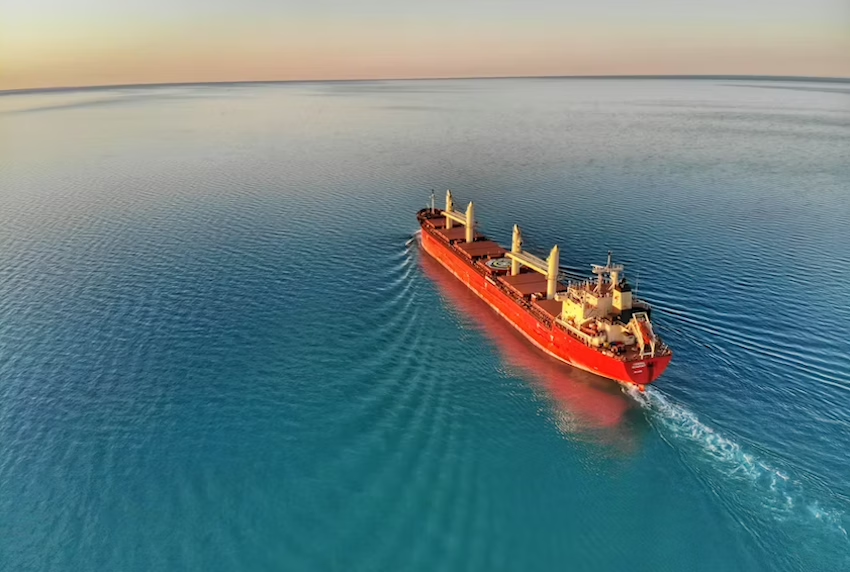
On Tuesday, the judge approved an amparo (a type of constitutional injunction) granting a suspension that blocks tankers over 300 meters long — and linked to the planned Saguaro LNG export terminal at Puerto Libertad, Sonora — from transiting the Gulf of California until a final judgment in the case is issued.
Since the plant hasn’t been built yet and there is no liquefied gas being shipped from it, the ruling — a definitive suspension that replaces a weaker provisional injunction from 2024 — is about halting future Saguaro-related ships, not stopping any current traffic.
“The whales sued and today they are winning,” lawyer Nora Cabrera Velasco proclaimed in the digital news outlet Expansión.
She is the co-founder and director of Nuestro Futuro, a Mexican youth-led environmental and climate-justice organization that has led the lawsuit on behalf of the whales and all marine mammals that inhabit, transit or reproduce in the Gulf of California.

“The number one cause of whale deaths worldwide is collisions with LNG mega-tankers,” marine mammal specialist Omar García said in the digital news outlet Infobae, adding that crews often “don’t even feel” an impact.
The LNG export terminal — planned by the private energy company Mexico Pacific — would receive natural gas piped from the United States to Puerto Libertad, liquefy it and then ship it to Asian markets. The 800-kilometer pipeline would begin in the oil-rich Permian Basin in Texas.
Mexico Pacific has said it is in the process of transitioning its headquarters from Houston to Mexico City.
Media coverage has cited the cost of the project, which would be Mexico’s largest LNG terminal, at roughly US $15 billion.
Planning documents indicate it would initially be capable of exporting more than 15 million tonnes of U.S. gas a year to Asia via the gulf, sometimes called the “Aquarium of the World.” The body of water is also known as the Sea of Cortés.
According to the Ohio-based Institute for Energy Economics and Financial Analysis, “delays, turmoil and permitting errors have stymied” the project.
In arguing for the cancellation of the proposed plant, activists, environmental groups and scientists have warned that ship strikes and noise from large vessels are a leading cause of whale deaths and can disrupt communication and migration in a region that hosts dozens of cetacean species.
With reports from El Financiero, Expansión and Infobae