The latest National Survey of Urban Public Safety, released by the national statistics agency INEGI on Thursday, shows that residents of Culiacán consider their city, the state capital of Sinaloa, to be the least safe of any urban area in Mexico.
That finding is unlikely to surprise many, given that the state has been under siege since a civil war erupted among rival factions of the Sinaloa Cartel last year. Still, even in a nation where 63% of urbanites feel unsafe in their own city (up from 59.4% of a year ago), the 90.8% who feel Culiacán is unsafe is a striking figure, and a major increase from the 44.7% who felt unsafe this time last year.
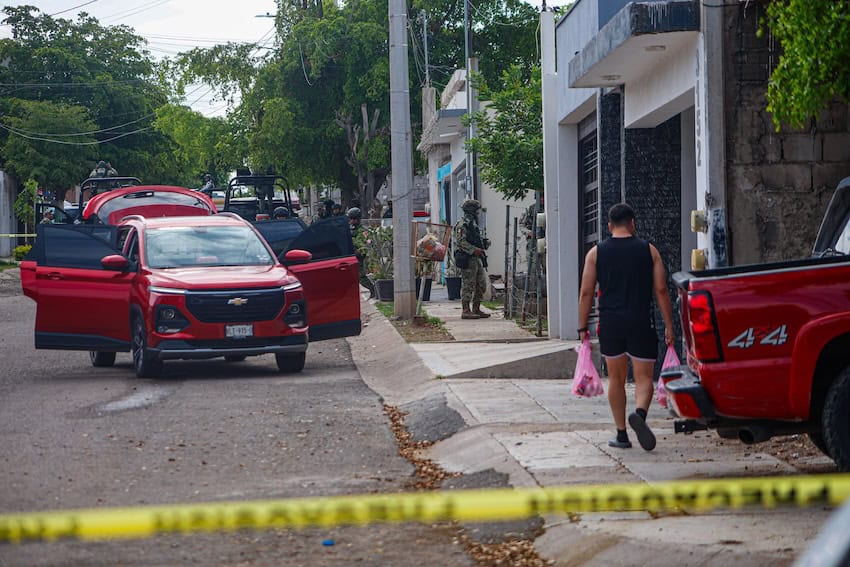
(José Betanzos Zárate/Cuartoscuro)
The current war was triggered after Sinaloa Cartel co-founder Ismael “El Mayo” Zambada was allegedly kidnapped and taken to the U.S., where he was arrested.
Zambada’s arrest escalated a long-running dispute between the “Los Chapitos” and “Los Mayos” factions of the Sinaloa Cartel. The internecine conflict — which was foreseen back in 2021 — began less than a month later, grabbing headlines after the military was targeted via a narco-blockade in a rural area north of Culiacán on Aug. 29.
Official records show that there were 50 murders officially reported in Sinaloa in July 2024 and 44 the following month. In September, that number spiked to 142 and has consistently exceeded three figures since, peaking at 207 in June.
The news website N+ reported that 2,092 people were killed across the state between September 2024 and June 30, 2025. Also, nearly 2,000 civilians have been “disappeared,” with 278 of these disappearances occurring in Culiacán since Jan. 1, according to the newspaper Infobae.
Additionally, officials received 1,794 complaints of kidnapping, arbitrary detention and sexual harassment between September 2024 and June 1, 2025. Among those kidnapped are teen-agers as young as 14 who are “recruited” by the cartel to serve as look-outs and gunmen.

A Culiacán merchant who spoke to N+ summed up the situation frankly, saying, “We are living in a war zone.”
The violence has also devastated the local economy. Since the beginning of the crisis, it is estimated that more than 1,800 businesses in Culiacán have closed and an additional 800 people have lost their jobs.
In the incident that sparked the firestorm of violence, Zambada claims he was kidnapped by Joaquín Guzmán López (son of convicted drug lord Joaquín “El Chapo” Guzmán Loera) and his associates on July 25, 2024, forced onto a private plane and flown to an airport in the U.S.
Zambada was eventually transferred to a prison in New York City and is scheduled for a hearing in U.S. federal court in Brooklyn on Aug. 25.
Although Culiacán is the epitome of unsafe cities in Mexico, it is not alone in producing high negative numbers in public safety perception.
In the INEGI survey, residents of Ecatepec de Morelos in México state (90.7%), Uruapan, Michoacán (89.5%), Tapachula, Chiapas (88.1%) and Ciudad Obregón, Sonora (88.0%), overwhelmingly reported feeling unsafe in their own cities.
On the other hand, residents of Mazatlán, Sinaloa, just 215 kilometers south of Culiacán, said they felt safer than they did a year ago. There, the negative perception fell from 75.5% in June 2024 to 64.5% this year.