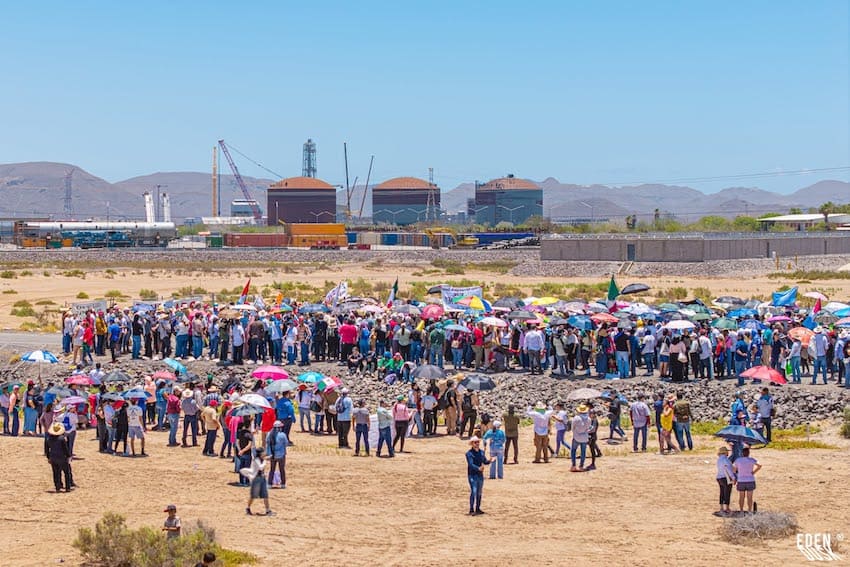
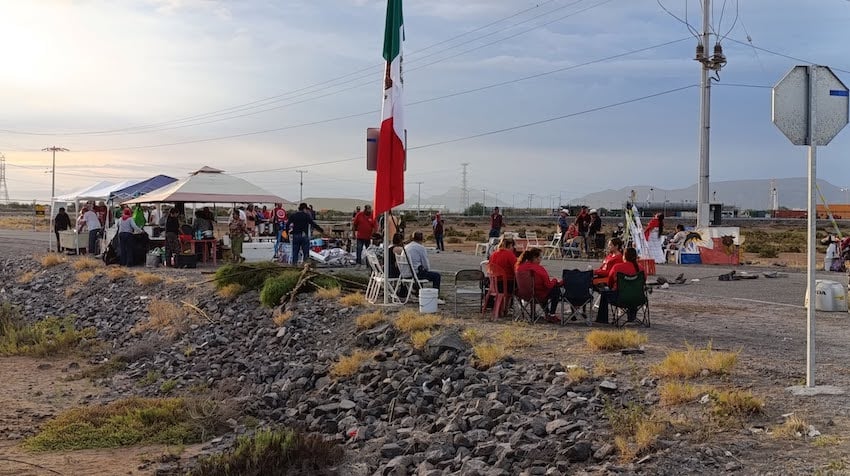
Before dawn on Monday, Indigenous activists opposing a controversial ammonia plant in the northwestern town of Topolobampo, Sinaloa, moved an encampment to block the access road leading to the facility, escalating a 12-year conflict that has grown from a local land-defense struggle into a national campaign.
Movement leaders say they will not participate in further talks with the Mexican government unless construction on the plant, being developed by Switzerland-based Proman Gas y Petroquímica de Occidente (GPO), is suspended.
The action came after weeks of intensive protests. On June 12, Environment Minister Alicia Bárcena met with community representatives in the nearby town of Los Mochis, where she announced a new environmental inspection of the project, guarantees for the right to protest and continued dialogue with affected communities.
“I know there are legitimate concerns about the possible environmental and social impacts of these projects, and I want to tell you that we are here precisely to listen,” Bárcena told community representatives.
The project lies within territory claimed by Yoreme-Mayo communities as part of their ancestral lands. “We’ve done years of dialogue …and I believe they know the subject well; they know this project is mired in major irregularities,” said Yoreme traditional governor Felipe Montaño.
Opponents say the plant, under construction since 2024, threatens the ecosystem of Ohuira Bay, the traditional Yoreme way of life and the fishing economy on which many local communities depend. The bay is part of a Ramsar-listed wetland of international importance.
Montaño also called on German development bank KfW to reconsider its support for the project. “This bank cannot finance a project that is going to cause an ethnocide and an ecocide.”

Activists said the encampment had grown to around 200 people by late Monday afternoon. Montaño said some workers had arrived at the site but did not attempt to enter the facility. He said several expressed sympathy for the protest. “The project is already 80% complete, so we have no choice,” said Montaño. “We will fight to the last consequences. If we must give our lives here, we are prepared to do so.”
Protesters mount round-the-clock resistance as Topolobampo ammonia plant nears completion
A week before, thousands joined a march from Los Mochis toward Topolobampo, ending with a symbolic “closure” of the plant. Meanwhile, solidarity demonstrations have taken place in Mexican cities including Culiacán, Mazatlán, Monterrey and Mexico City, where activists assembled in front of the German Embassy.
After 17 days encamped in the Port of Topolobampo, where they tried to block delivery of company equipment, Indigenous authorities decided to move their blockade to the plant’s entrance.
KfW IPEX-Bank, which helped finance the project, did not directly address questions about the recent protests or the Environment Ministry’s (Semarnat) intervention, instead referring Mexico News Daily to a November 2025 response to the UN human rights office defending the project’s environmental review and consultation process.
Semarnat and GPO did not respond to requests for comment before publication.
The plant originally broke ground in 2015 but was halted after Mexico’s Supreme Court ruled in 2022 that it had proceeded without proper Indigenous consultation. Construction resumed after a federal court upheld a subsequent consultation process in which the four communities closest to Ohuira Bay voted against the project, but were outvoted when seven additional, arguably less directly affected communities were added to the process.
Tracy L. Barnett is a Guadalajara-based freelance writer and the founder of The Esperanza Project.