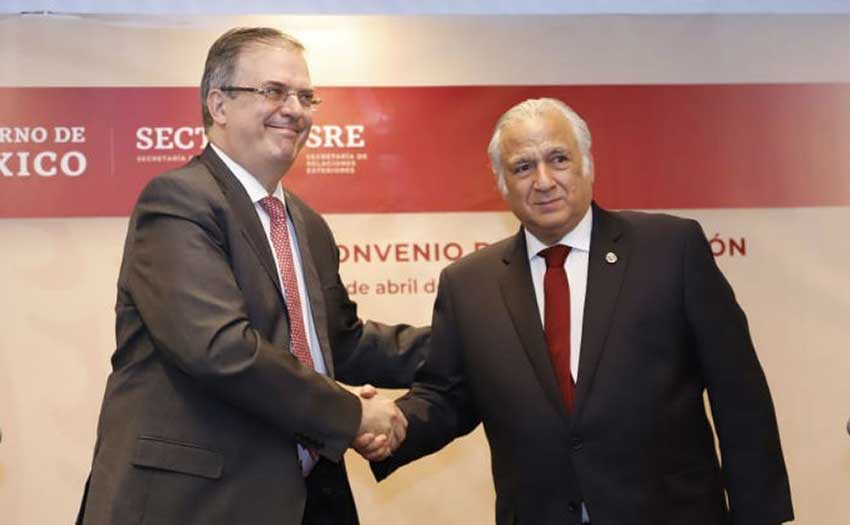
The secretariats of Foreign Affairs (SRE) and Tourism (Sectur) have signed a cooperation agreement that will train diplomatic staff in tourism promotion.
Foreign Secretary Marcelo Ebrard said that marketing the nation as a tourism destination will become a responsibility of all of Mexico’s embassies and consulates.
The announcement follows a decision by the federal government to disband the Tourism Promotion Council (CPTM) as part of its austerity policy.
The SRE-Sectur agreement will remain in force until the end of the government’s six-year term in 2024.
Diplomatic staff will undertake short tourism marketing courses that in most cases will be delivered online to avoid any detrimental effects on the day-day-day operations of overseas missions, Ebrard said.
Tourism Secretary Miguel Torruco explained that in the initial phase of the agreement, training of embassy and consulate personnel will “focus on countries that are large sources of tourists to Mexico” including the United States and Canada as well as some South American, Central American, European and Asian nations.
Ebrard explained that people undergoing training at the SRE-affiliated Matías Romero Institute in Mexico City prior to an overseas diplomatic posting will also be required to complete tourism-related subjects.

“Promoting tourism is a professional task, it requires training and knowledge . . . The Matías Romero Institute is going to establish a program with the Secretariat of Tourism to adequately prepare us, from now on, in tourism promotion,” the foreign secretary said.
“How does the tourism market work? What’s [tourism] like around the world today? What are Mexico’s priority objectives? What should we be looking to do? . . . All these questions are now going to be explored at the Matías Romero Institute,” Ebrard added.
Business and tourism sector leaders have been highly critical of the government’s decision to disband the CPTM and are taking steps to create a private marketing agency.
Pablo Azcárraga, president of the National Tourism Business Council (CNET), said Tuesday that the Mexican tourism industry is in crisis due to a lack of marketing and insecurity.
He urged the government to take action to remedy the situation, which has included a decline in international arrivals to Cancún, Quintana Roo, and a downturn in hotel occupancy rates in that city as well as other destinations.
Despite the tourism sector’s criticism of the government, and Azcárraga’s absence at yesterday’s signing ceremony, Secretary Torruco denied there was friction between the two parties.
“There’s no distance” between us, he declared, highlighting the presence of other tourism sector representatives at yesterday’s event.
Source: 24 Horas (sp), El Economista (sp)