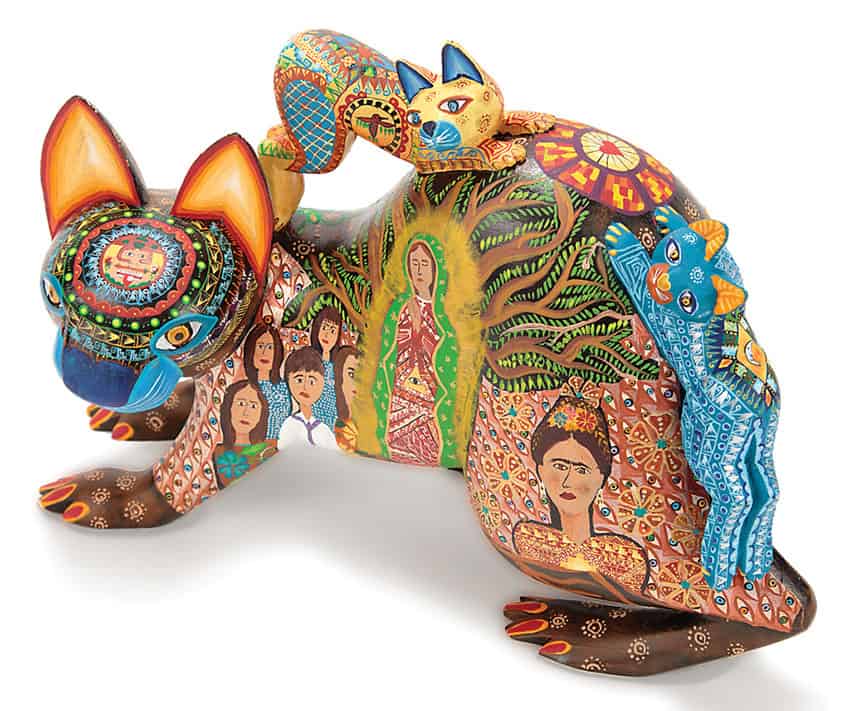
Wooden alebrijes made in Oaxaca are now protected against plagiarism in other parts of Mexico and abroad.
A geographical indication, or GI, designation for the brightly-colored sculptures of fantastical creatures was published on Monday in the federal government’s official gazette.
Published by the Economy Ministry and the Mexican Institute of Industrial Property (IMPI) on the request of the Oaxaca government, the GI designation states that authentic wooden alebrijes can only be made in five locations in the southern state: San Antonio Arrazola, San Martín Tilcajete, Unión Tejalápam, San Pedro Taviche and Oaxaca city.
The designation also protects Oaxaca-made sculptures of nahuales, supernatural beings with the capacity to metamorphose into animals, and other unique locally-made wooden carvings.
According to the Oaxaca government, the request for a GI designation it submitted to IMPI earlier this year sought to protect not just the alebrijes themselves but also the history surrounding them, the materials they’re made with and the artisanal process.
Economy Minister Juan Pablo Guzmán said in January that the GI designation would protect the wooden figurines “at the national and international levels so that they won’t be subject to plagiarism and piracy.”
He cited Chinese fakes as a particular concern to local artisans.

Guzmán also said that a GI designation, which already applies to products such as Roquefort cheese, Colombian coffee and Thai silk, will add to the commercial value of the wooden alebrijes made in Oaxaca.
He explained that the protection will prevent the export of foreign-made replicas of the sculptures just as fake tequila is blocked from entering different countries around the world.
“Tequila arrives that is made in other … countries and when it’s detected at customs, a report is sent to Mexico. [If] it’s verified that it’s not really that beverage, fines and sanctions are issued. In addition the product is destroyed,” Guzmán said.
A GI designation is similar to designation of origin status, the minister said, explaining that they both offer protection to a range of products. The former is more widely recognized in the United States while the latter is more prevalent in Europe, he said.
“They don’t compete with each other, … both seek to maintain the attributes of a product from a determined region. The difference is that in a GI [designation] not all of the elements of a product are necessarily from that place,” Guzmán said, explaining that if a gold adornment is part of an alebrije, the gold doesn’t necessarily have to come from Oaxaca.
However, all the work must be completed in the place to which the GI designation corresponds and the product must originate there, he said.
Among the Mexican products that have a geographical indication designation or designation of origin status are tequila, mezcal, talavera pottery, Morelos rice, Chiapas coffee, Olinalá wooden handicrafts from Guerrero and vanilla from Puebla and Veracruz.
Source: El Universal (sp)