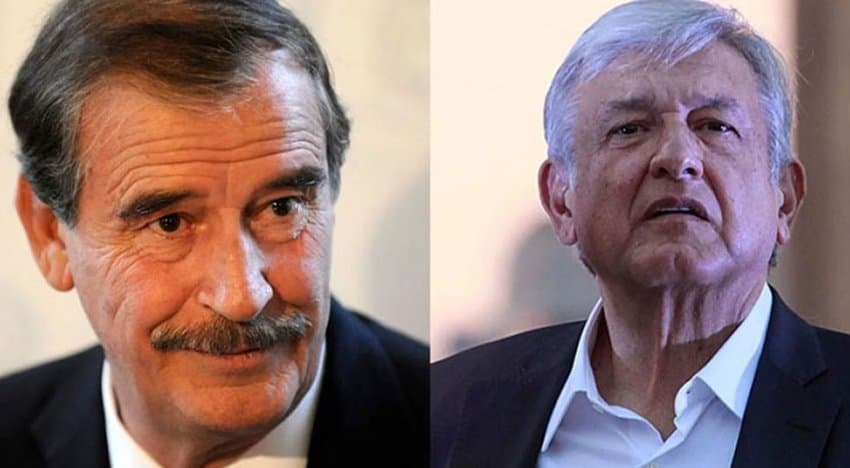
President-elect López Obrador’s opposition to hydraulic fracturing is “bad news for gas supply,” a prominent business leader claims.
Speaking at a government event yesterday, the president of the Business Coordinating Council (CCE), Juan Pablo Castañón, said that López Obrador’s stance on the controversial gas and oil extraction technique commonly known as fracking would prevent Mexico from being able to reduce its dependency on natural gas imports.
“It’s bad news for gas supply because we import 80% of the natural gas we use,” he said.
The president-elect reaffirmed his opposition to hydraulic fracturing last week, telling reporters in San Luis Potosí that there will be no fracking in Mexico during the six-year period he is in office.
Castañón, however, is adamant that Mexico has to increase domestic natural gas production and believes that it is possible to do so without harming the environment.
“There may be [gas extraction] technologies that without damaging the environment and by recycling water allow us to comply with our commitments as part of the United Nations’ 2030 agenda for sustainable development in terms of the environment and sustainable energy production,” he said.
Castañón has an ally on the issue in former president Vicente Fox, who last week posted a video to his Twitter account in which he declared that it is false that fracking has a negative impact on the environment.

“López Obrador . . . the information you have on this occasion is not correct . . . In a very short time, Mexico could be the great producer of petroleum and natural gas that it always was,” he said.
Fox claimed that with “the technologies of today” fracking can achieve two things: “generate wealth and protect the environment at the same time.”
However, many others, such as the Mexican Alliance Against Fracking (AMCF), disagree.
Among the biggest concerns about fracking is that it requires the use of enormous quantities of water.
According to the AMCF, hydraulic fracturing of a single well uses between nine and 29 million liters of water.
In addition, more than 1,000 cases have been documented in the United States in which the practice has contaminated water sources, the alliance said.
López Obrador’s opposition to fracking puts contracts already signed for exploration and extraction of natural gas at risk.
One example of a planned project that the incoming government could shut down is the exploitation of a shale gas deposit in Coahuila, for which the state oil company Pemex has signed a US $617-million contract with Texas-based Lewis Energy.
Despite his opposition to fracking, López Obrador, who will be sworn in as president on December 1, has pledged to reduce Mexico’s reliance on foreign countries for its energy needs.
While he has been an outspoken critic of the 2014 energy reform that opened up the sector to foreign and private companies, the president-elect last month assured private energy executives that their contracts will not be canceled if they meet existing terms.
That assurance as well as his plan to build a new oil refinery and upgrade existing ones are aimed more squarely at reducing dependence on foreign petroleum rather than gas.
But Juan Carlos Zepeda, president of the National Hydrocarbons Commission, believes that ensuring Mexico’s gas security is an even more pressing need, declaring in July that reliance on United States imports creates not only a “geopolitical risk” but also an “operational risk” due to the possibility of a natural disaster interrupting supply.
Source: El Financiero (sp), El Universal (sp)