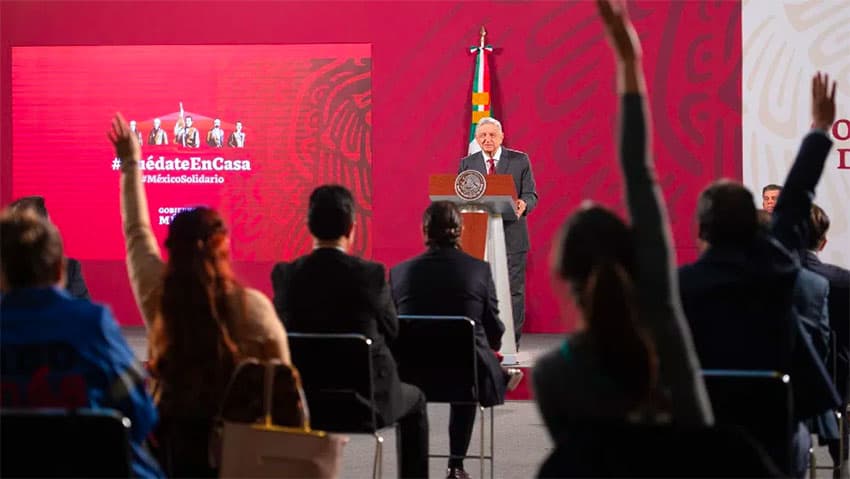
President López Obrador’s weekday press conferences constitute “a worrying instrument of misinformation,” according to a press freedom advocacy organization.
The president appears before reporters every weekday morning to respond to questions at a press briefing that sometimes lasts as long as three hours. He uses the mañanera, as his morning presser is colloquially known, to promote the government and deride his critics and political opponents, setting the daily news agenda in the process.
Reporters known to be friendly to the government are often given preferential treatment when it comes to the opportunity to query the president while those who ask critical questions run the risk of being branded as members of the “elitist” or “conservative” press.
In its 2020 annual report published Tuesday, Article 19 said that the content of López Obrador’s press conferences is little more than government propaganda.
“Over time, the mañanera has moved away from being a true space of information, transparency and accountability and become a space in which the agenda of the executive is … positioned [in a positive light] at any cost, even by sacrificing the truth about government performance,” said the report, entitled Distortion: Discourse against Reality.
“… We additionally note that it represents a worrying instrument of misinformation,” Article 19 added.
The organization also said that 2020 was the worst year ever for violence against media workers with a total of 692 acts of aggression, an increase of 13.6% compared to 2019. Article 19 partially attributed the rise to verbal attacks against the media by López Obrador and other federal officials.

Such attacks cause a “cascade effect” that leads to harassment, threats or worse, the organization said, noting that six journalists were killed last year and 17 have been murdered since López Obrador took office in late 2018.
Article 19 also criticized the government for not responding adequately to information requests made by members of the public. On 389 occasions last year, the government provided clearly incompetent responses to citizens’ questions, the group said.
“… This strategy to avoid compliance with its obligation shows that [access to government] information … is closed,” it said.
The federal government has also been criticized for its plan to dismantle the national transparency watchdog.
Six investigative journalists who spoke with the newspaper El Economista last month warned that incorporating the National Institute for Transparency and Access to Information, an autonomous body, into a government ministry or department would make accessing public information more difficult and pose a threat to their profession.
Source: Reforma (sp)