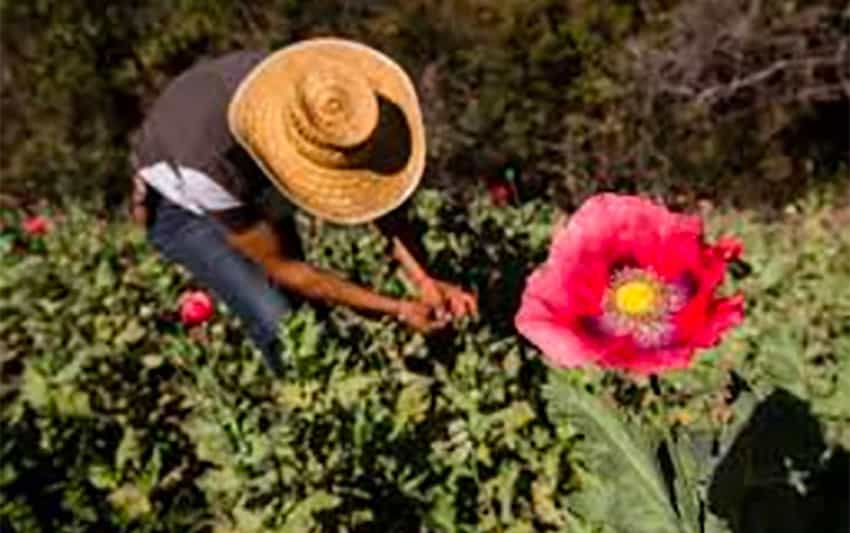
Facing increased economic hardship, poppy-growing communities in southwest Mexico want to join a state program offering alternative projects, but this would only be a first step that cannot tackle all the complex issues campesinos are facing.
Hundreds of farmers spread across 19 communities in the Sierra poppy-growing region of Guerrero state allege that they were shut out of a government program — known as Sembrando Vida (Sowing Life) — by an official because they “had not pacified the region,” the newspaper La Jornada reported.
Launched by President Andrés Manuel López Obrador in early 2019, the government program arrived in Guerrero this year. It pays local community members 5,000 pesos (around US $240) per month to plant trees and cultivate legal harvests in an effort to move away from illicit crops. The goal is to improve living conditions for those in the countryside and stop environmental degradation.
However, the program has struggled to reach everyone in Guerrero’s Sierra. The farmers, who have banded together to form the Observatory for the Peace and Development of the Sierra (Observatorio por la Paz y el Desarrollo de la Sierra — OPDS), said officials have failed to even visit certain communities in the area, according to La Jornada.
“It is time for the government to support us; everything we have done is thanks to our efforts and from our own pockets, we have defended these forests without any support from the government,” farmer Norberto Verónica Jesús told the newspaper.
Farmers in Mexico’s poppy-growing region that stretches across the states of Chihuahua, Durango and Sinaloa, as well as Guerrero and Nayarit, have been struggling lately. Most recently, this has been driven by a sharp drop in the price of opium gum — the raw ingredient cultivated to produce heroin — as well as a complex set of criminal, social and political factors.
InSight Crime analysis
No single government program alone could adequately address the difficulties poppy farmers are facing in Guerrero.

Farmers there have grown poppies for decades, but Sembrando Vida encourages them to move towards alternative crops, such as avocado and coffee, which are also ideal for the high elevation and soil type of the Sierra. But there are other roadblocks, including the logistical problems posed by the remoteness of the area.
“You have this fertile land in the Sierra, but how are you going to transport these crops? There aren’t any roads. One of the advantages of cultivating poppy is that you can transport the opium gum in a backpack, which is much easier logistically than other, legal crops,” Irene Álvarez, an investigator with Noria Research in Mexico, told InSight Crime.
Guerrero also suffers from extreme violence and is highly marginalized both socially and geographically. What’s more, political powers — whether criminal leaders or elected officials, which at times are one and the same — have historically relied on violence to establish order and maintain power, according to Romain Le Cour, the president of Noria Research.
“You can have a legal framework for certain economic activities, but you also need infrastructure to enter the market and the political will to reform power dynamics and make them less violent,” Le Cour told InSight Crime. “As we have seen in neighboring Michoacán, the avocado and lime industries are perfectly legal and highly functional, but are regulated with violence like illegal markets are.”
Indeed, the booming avocado industry has led to criminal groups extorting exorbitant amounts from farmers in Michoacán. Alternative crops set up in Guerrero could very likely face a similar response.
The Sembrando Vida program is an important first step, according to Vania Pigeonutt, a Mexican journalist and the founder and editor of Amapola Periodismo, but does not provide the long-term focus Guerrero needs.
“Communities here have cultivated poppy and marijuana for decades,” she told InSight Crime. “There is no quick fix and any proposed solution must also analyze the roots of the complex structural factors at play.”
Reprinted from InSight Crime. Parker Asmann is a writer with InSight Crime, a foundation dedicated to the study of organized crime.