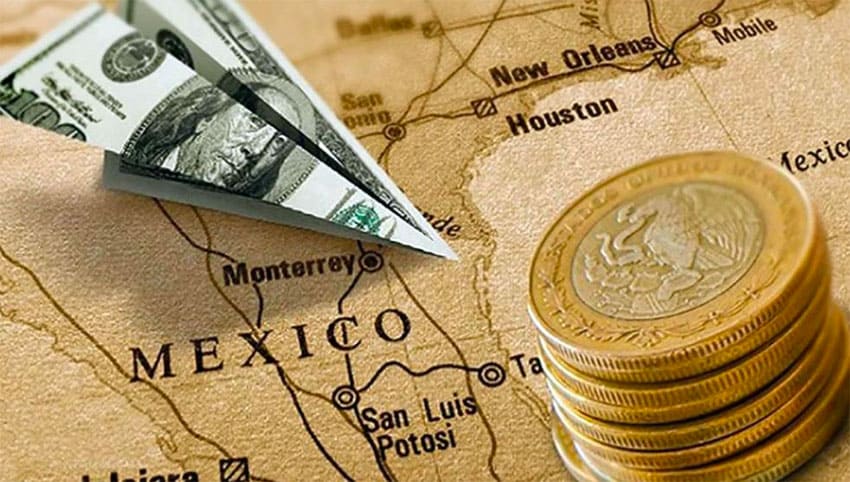
The Mexican government is highlighting a record number of remittances sent back to the country by citizens living in the United States this year amid the COVID-19 pandemic, but organized crime groups have long exploited these transfers to launder ill-gotten proceeds.
The central bank, Banco de México or Banxico, reported that more than US $28 billion in remittances has been sent from the United States during the first seven months of 2021.
The figure represents a 23% increase from the almost $23 billion in remittances sent during the same time period in 2020, according to Banxico data. By the end of 2020, Mexico received a record $40 billion in remittances from the United States, according to government data. This year is on pace to surpass that amount.
After a small drop in remittances sent in April 2020 — one month after the World Health Organization (WHO) classified the COVID-19 health crisis as a “pandemic” — those payments bounced back, according to the Pew Research Center, a non-partisan think tank based in Washington DC.
Mexico has more emigrants living in the United States than any other country in Latin America. Indeed, 97% of international migrants who were born in Mexico live in the United States, according to a Pew Research Center analysis of United Nations and U.S. government data.
InSight Crime analysis
Organized crime groups in Mexico have shown a remarkable ability to adapt amid the global health crisis, and the record number of remittances sent back to the country from the United States presents a clear money laundering opportunity.
To be sure, Mexican criminal groups have long co-opted remittances sent through U.S. banks for their own interests. In 2017, for example, the U.S. Justice Department announced that Banamex USA’s (BUSA) anti-money laundering monitoring system “issued more than 18,000 alerts involving more than $142 million in potentially suspicious remittance transactions” sent between 2007 and 2012.

Organized crime groups often use such transfers to launder money and hide its illicit origins. Yet BUSA “conducted fewer than 10 investigations and filed only nine” Suspicious Activity Reports (SARs) during that time, and didn’t file a single report on suspicious remittance transactions between 2010 and 2012, according to U.S. prosecutors.
More recently, amid financial disruptions brought on by the pandemic, Mexican crime groups have had to seek out a variety of different money laundering techniques. These include bulk cash deliveries moved over the border, “wire transfers, shell and legitimate business accounts, funnel accounts, and structured deposits with money remitters in order to move money while concealing the routing of the illicit proceeds,” according to the U.S. Drug Enforcement Administration’s 2020 National Drug Threat Assessment.
While money laundering risks in the United States are relatively low in a global context, according to the Basel Institute on Governance’s 2020 Anti-Money Laundering Index, remittances will remain a key money laundering tool for Mexican crime groups so long as U.S. banks struggle to step up controls.
Reprinted from InSight Crime. Parker Asmann is a writer with InSight Crime, a foundation dedicated to the study of organized crime.