This is my tenth “Regional Utopia” essay, and it might be the last. After more than 20 essays in this series and the previous one, I have avoided this topic. I am no expert on security. But if we really want to build a North American Regional Utopia, we cannot skip it. Security cooperation between Mexico and the U.S. has to be part of the picture. Let’s get to it.
For years, the headlines told one story: cartels running wild, drug lords everywhere and fingers pointing straight at the Mexican government. It felt like an endless episode of Narcos. But I am here to share a more optimistic view. Here comes the plot twist.
Under President Claudia Sheinbaum and Security Minister Omar García Harfuch, real results are starting to show. Things might get uglier before they get better, but the private sector is already noticing the change, U.S. attitudes are shifting from frustration to cautious hope and the big arrests keep coming. Let’s look at the numbers.
First, the view from the companies I know best.
AmCham’s 2024 Security Survey asked about 220 firms about the security situation in Mexico — half of them Mexican, most of them large players spread across the country. The headline is simple: optimism is back. The share of companies that feel more secure than the year before jumped from 17% to 39%. Those who think next year will be safer rose from 29% to 43%. This does not mean everything is fine. Insecurity is still the biggest “anti-competitiveness tax” our companies pay. 58% of them now spend between 2 and 10% of their annual budget on security! — steady from before, but with more money going into technology, crisis plans and better training. 60% still feel the impact of common and organized crime. 84% say the rule of law barely exists, and 85% feel illegality is hurting their business. Even so, the trend is turning.
Homicides in Mexico are down by half under Sheinbaum: Wednesday’s mañanera recapped

There is a particular gleam of hope coming from Mexico City. Under Sheinbaum’s time as mayor — right before becoming president — Mexico City moved away from being a leading city for crime and insecurity. Firms are even moving operations there from hotter states like Guanajuato or Michoacán. The private sector in Mexico is saying, quietly but clearly: we are not okay yet, but the signs are finally pointing in the right direction.
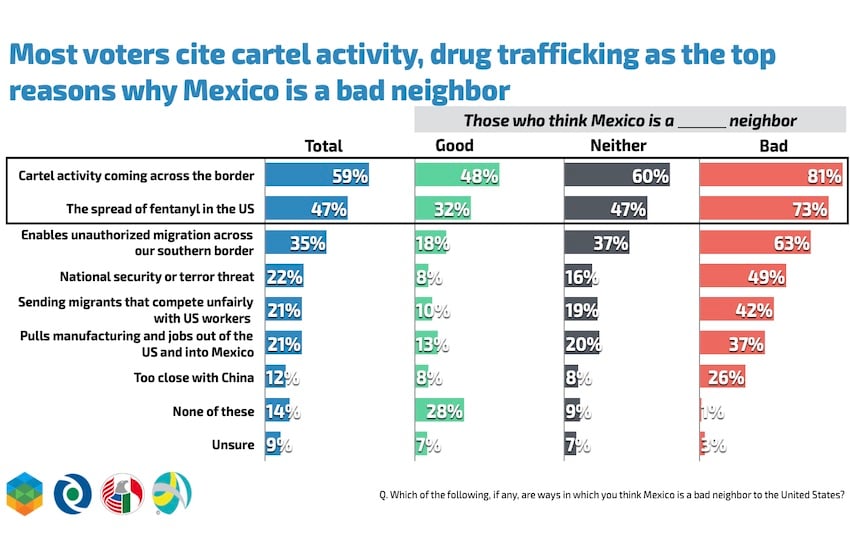
Now, let’s look north. U.S. voters have long seen Mexico as the neighborhood troublemaker, and our March 2026 survey with the U.S.-Mexico Foundation confirms why: fentanyl trafficking and cartel violence top the list of reasons they call Mexico a “bad neighbor.”

But the same poll shows something else shifting. Support for real security cooperation and law enforcement is growing, especially when people see it as a joint win against a shared problem. Voters understand that a stable Mexico is not charity — it is supply-chain insurance, energy security, nearshoring strength and, most importantly, fewer drugs reaching U.S. streets. The old zero-sum thinking no longer works. When Washington sees concrete Mexican action, attitudes warm up fast. And action is exactly what they are seeing now.

The scoreboard tells the story. The border is getting under control. Fentanyl seizures at the Southwest Border have dropped sharply, down roughly 37 to 57% year-over-year in key metrics through early 2026. At the same time, U.S. overdose deaths have fallen nationwide. Provisional CDC data through late 2025 show a 15 to 37% drop in synthetic-opioid fatalities in most states.

Credit goes to steady Mexican operations done hand-in-hand with American intelligence: clandestine labs taken down, precursor chemicals stopped and a string of major kingpin takedowns. “El Mayo” Zambada has been in U.S. custody since 2024. Rafael Caro Quintero was extradited. Several leaders of the Chapitos faction of the Sinaloa Cartel were handed over. And in February 2026, Mexican special forces killed Nemesio “El Mencho” Oseguera Cervantes in Tapalpa, Jalisco — the CJNG’s longtime boss and one of the most violent figures in recent history. This was not one lucky raid. Mexico has extradited or transferred more than 90 high-level criminals to the United States in the past year alone — in rounds of 29, 26 and 37. Labs have been burned, weapons seized and intelligence sharing with the DEA and CIA is at historic levels, according to both governments. Harfuch — known in Washington as “Batman” — has become the trusted partner. U.S. officials I have spoken with say it plainly: cooperation with Mexico under Sheinbaum and Harfuch is better than ever.
The old “hugs not bullets” policy gave the cartels breathing room. That era is over.
The state now has the momentum: intelligence-led policing, financial tracking and strong binational pressure. The 2026 World Cup co-hosting gives everyone extra reason to keep the peace.
Eduardo Guerrero, Mexico’s sharpest analyst on organized crime, put it well in his recent Nexos piece after El Mencho’s death: the CJNG will not disappear overnight. It is well organized, with strong regional bosses and steady cash flows. But steady pressure on the second- and third-tier leaders, the logistics networks and the people who protect them can slowly wear it down without sparking new chaos. Guerrero sees a real window: use better intelligence, U.S. technology and target the money. Violence may spike in some places, such as Baja, Guanajuato, or Michoacán, during the transition, but the national trend favors the government if it stays focused.
So what comes next?
AmCham’s Security Committee has a practical plan that fits perfectly with Guerrero’s thinking and with the current binational economic mood. Focus first on secure corridors — highways, ports, and border crossings — with National Guard support, cameras, drones and real input from private companies on maintenance and quick alerts. Create safer stopovers for truckers: places with fuel, mechanics and patrols so goods (and drivers) are not easy targets. Strengthen cybersecurity with a national strategy that lines up with USMCA Chapter 19 — trilateral meetings, training for small businesses, shared threat reports and clear risk rules. Improve intelligence sharing, set clear performance goals for police and prosecutors and build one simple system for reporting stolen vehicles. Most importantly, keep the conversation open between the government and business. Companies already spend heavily on their own protection; now bring them into the national plan without the old mistrust. Stable supply chains, energy flows, nearshoring factories and tourism all depend on trust.
In a conversation I had with Eduardo Guerrero earlier this week, he mentioned the need for a new Mexican proposal for deeper security cooperation with the United States. We should use this momentum. Bring in experts from every side — no matter their political preferences. We need all the brains and experience we can get, and we need a clear, forward-looking strategy, not imposed by the U.S. but based on local expertise.
People always debate cooperation versus sovereignty. My view is simple: we lost a big part of our sovereignty to organized crime many years ago. Stronger cooperation does not take sovereignty away — it helps us get it back. Sovereignty alone will not let my kid walk safely in the streets. Honesty matters. Admitting we need all the help we can get will bring faster, longer-lasting results.
We are not popping champagne yet (not even close). Cartels adapt, corruption still exists and voters on both sides are impatient. But the data, the arrests, the extraditions and the quiet optimism in boardrooms tell a different story. Mexico gave the bad guys a head start. Yet it seems we have grabbed the wheel back. Under Sheinbaum and Harfuch, we are driving toward something bigger.
A secure neighborhood is not a luxury — it is the basic ingredient for a healthier, more productive society. That is what we all want. Let’s stop pointing fingers (if it’s the U.S. fault for supplying the guns, or the Mexicans for sending out the drugs) and keep working together for the safety of our communities on both sides of the border.
Pedro Casas Alatriste is the Executive Vice President and CEO of the American Chamber of Commerce of Mexico (AmCham). Previously, he has been the Director of Research and Public Policy at the US-Mexico Foundation in Washington, D.C. and the Coordinator of International Affairs at the Business Coordinating Council (CCE). He has also served as a consultant to the Inter-American Development Bank. Follow his Substack here.