Sheinbaum’s mañanera in 60 seconds
- 🏥 Healthcare update takes center stage: Mexico’s Deputy Health Minister Eduardo Clark returned to the mañanera two months after unveiling his ministry’s plan to add over 9,000 public hospital beds during the government’s six-year term, this time with a progress report on the 181-billion-peso (US $10.4 billion) investment.
- 🛠️ 30 hospital projects already completed: Clark said 1,474 beds have been added since October 2024 across seven IMSS, 19 IMSS Bienestar and four ISSSTE hospitals, through new builds, replacements and expansions.
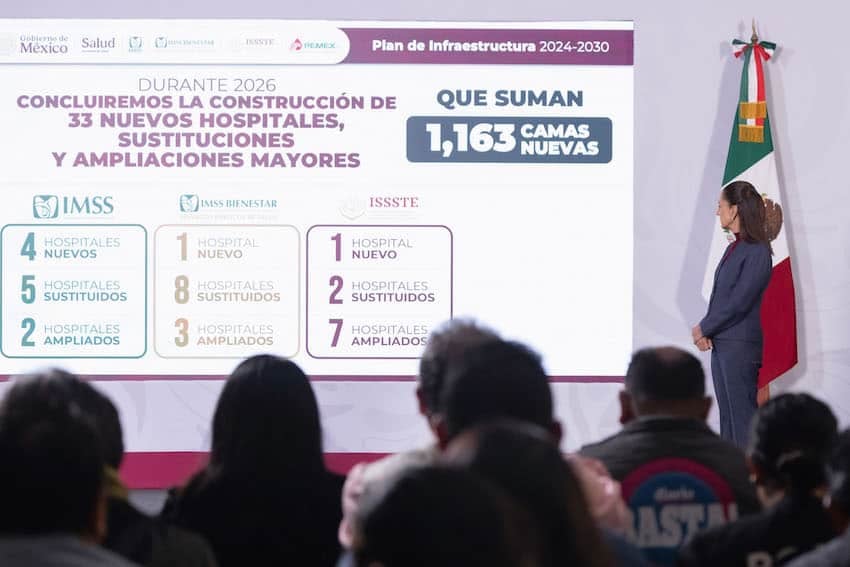
- 📅 33 more projects due this year across Mexico: Another 1,163 beds are set to be added in 2026, six from new hospital construction and 27 from replacements or expansions, with Clark stressing investments are underway “in all the federal entities.”
- ⚖️ No personal opinion on El Mayo’s life sentence: Asked about Ismael “El Mayo” Zambada’s life sentence handed down in Brooklyn, Sheinbaum said she had “no personal opinion about that.”
- ☮️ Sheinbaum agrees with Zambada’s anti-crime message: On Zambada’s courtroom message urging young people to avoid crime, Sheinbaum indicated she agreed, although she declined to explicitly endorse his words. The president spoke about her government’s efforts to address the root causes of crime.
- 🥬 Government says Mexican lettuce not the source of US Cyclosporiasis outbreak: Sheinbaum said a suspected link between the U.S. cyclosporiasis outbreak and Guanajuato lettuce had been ruled out, and Health Minister Kershenobich confirmed just three “ordinary” cases in Mexico.
Why today’s mañanera matters
Two months after announcing that the federal government is aiming to increase the number of public hospital beds in Mexico by more than 9,000 during its six-year term (October 2024 to September 2030), Deputy Health Minister Eduardo Clark returned to the mañanera to provide an update on the 181-billion-peso (US $10.4 billion initiative).
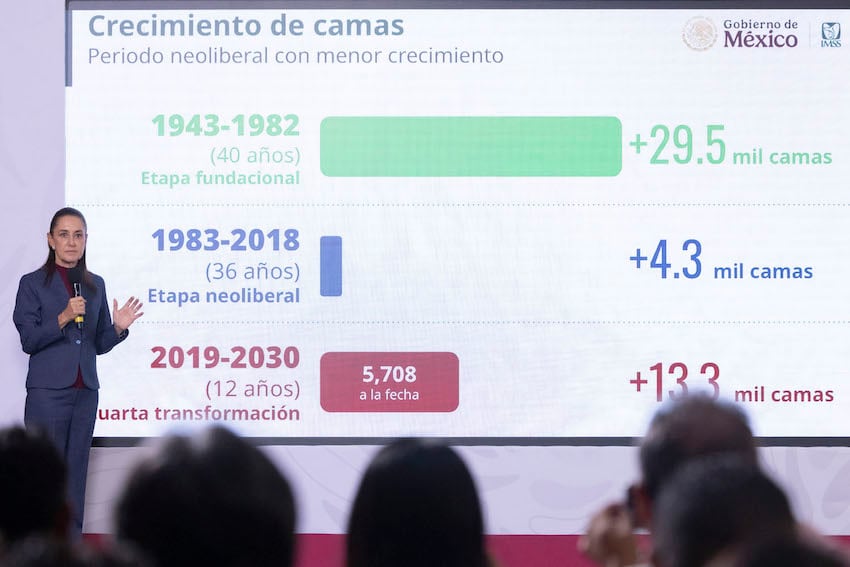
Federal officials have highlighted that the “fourth transformation” (4T) administrations led by ex-President Andrés Manuel López Obrador (AMLO) and President Claudia Sheinbaum added — and are adding — significantly more beds to public hospitals than governments during the so-called “neoliberal period” between 1982 and 2018. Sheinbaum reiterated that point on Tuesday morning.
Today’s mañanera was also significant as the president indicated that she agreed with a message Sinaloa Cartel kingpin Ismael “El Mayo” Zambada conveyed in U.S. court on Monday before he was sentenced to life imprisonment.
In addition, Health Minister David Kershenobich spoke about the presence in Mexico of cyclosporiasis, the intestinal illness that has recently sickened thousands of people in the United States.
33 hospital projects scheduled for completion in 2026
Deputy Minister Clark told reporters that 30 public hospital projects have been completed since the current government took office in October 2024. Those projects include the construction of new hospitals and the “replacement” and expansion of existing ones.
Clark said that the 30 projects added 1,474 beds across seven IMMS hospitals, 19 IMSS Bienestar hospitals and four ISSSTE hospitals.
The deputy minister said that 33 additional hospital projects are slated for completion this year. Those projects, Clark said, will add 1,163 beds to IMMS, IMSS Bienestar and ISSSTE hospitals.

Six of the 33 projects entail the construction of new hospitals. The other 27 projects are hospital replacements or expansions.
Clark stressed that hospital projects have been completed, and are being completed, across the entire country.
“In all the federal entities, we have hospital projects,” he said.
Sheinbaum says she has no ‘personal opinion’ about El Mayo’s life sentence
A reporter asked the president her opinion about Zambada’s life imprisonment sentence, handed down by Judge Brian Cogan in a U.S. federal court in Brooklyn, New York.
“There is no personal opinion about that,” Sheinbaum said. “It is what it is.”
The reporter noted that Zambada, in court, urged young people to steer clear of a life of crime.
Asked to offer her opinion about that advice, Sheinbaum said that “obviously coming from who it comes, it is difficult to quote him.”
“But, that’s the work we’re doing, … it’s attention to the [root] causes [of crime],” she said, referring to the government strategy of providing increased work and education opportunities to young people as a way to discourage them from joining criminal groups.
The attention to the root causes of crime via the provision of educational scholarships, employment programs and welfare schemes is essentially the “hugs” aspects of the so-called “hugs, not bullets” (abrazos, no balazos) security strategy implemented by AMLO’s government.

Attention to the root causes of crime is one of the four core tenets of the Sheinbaum administration’s security strategy. Compared to the López Obrador administration, the current government has been more proactive in combating organized crime, an approach that has resulted in the arrest of almost 60,000 alleged perpetrators of serious crimes since Sheinbaum took office.
Health minister: 3 cyclosporiasis cases in Mexico
Asked whether it was true that the outbreak of cyclosporiasis in the United States was linked to lettuce from Guanajuato, Sheinbaum said that hypothesis had been ruled out.
Health Minister Kershenobich subsequently said that only three cases of cyclosporiasis had recently been detected in Mexico.
“Those cases are usual. In other words, they are not beyond ordinary epidemiology,” he said.
“Therefore, we don’t have an outbreak of cyclosporiasis,” Kershenobich said.
“In relation to the lettuce plant in Guanajuato, … a sample was taken that returned positive [for the parasite Cyclospora cayetanensis], but the [U.S.] Food and Drug Administration retracted, saying it was a false positive,” he said.
Kershenobich said that Mexican authorities have also taken lettuce samples from Guanajuato as part of their own investigation. To date, he said, there is no evidence that the cyclosporiasis outbreak in the U.S. stems from lettuce grown in Guanajuato.
By Mexico News Daily chief staff writer Peter Davies (peter.davies@mexiconewsdaily.com)