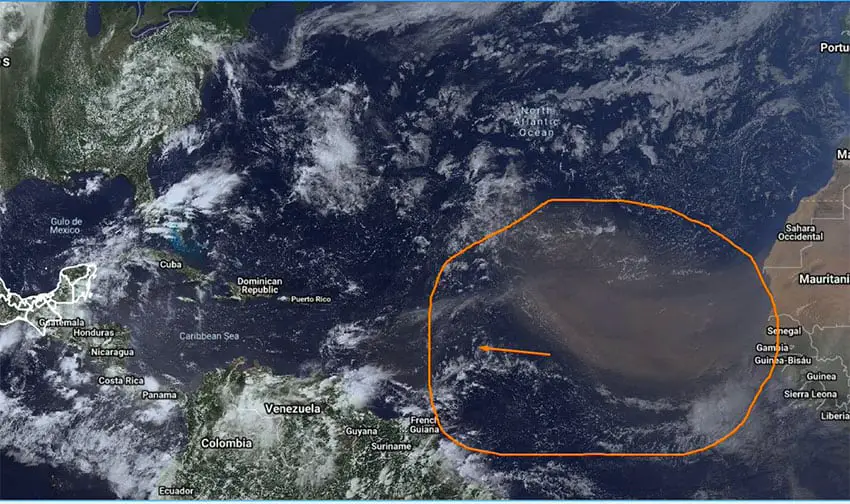
A massive dust cloud from northern Africa’s Sahara Desert is on its way to Mexico and is expected to reach the Yucatán Peninsula next week.
Large amounts of yellow-colored Sahara dust arrive annually in Mexico, carried by eastern trade winds across the Atlantic Ocean to the Americas. Satellite images show that the huge dust cloud, considerably larger than those seen in recent years, is currently making its way across the ocean.
More than 100 million tonnes of desert dust are picked up by storms in Africa and blown across the Atlantic every June.
Researchers have found that the dust – made up of particles of iron, silicon, mercury and phosphorus, among other chemical elements – has an impact on air pressure above the Atlantic Ocean and can help to suppress the intensity of hurricanes.
The dust also act as a natural fertilizer and has been found to play a key role in restoring minerals to depleted rainforest soils in South America’s Amazon basin.
However, research also shows that it may be harmful to coral reefs if it descends into the ocean before reaching land. One study found that the dust can trigger toxic algae blooms, also known as red tides, that have the capacity to kill large numbers of fish, shellfish, marine mammals and birds.
As it reaches the Yucatán Peninsula, the dust is likely to create spectacular, brightly-hued sunrises and sunsets. Meteorologists say its arrival could be accompanied by torrential rain.

The dust is not considered particularly harmful to human health but can cause irritation in the eyes and throat, trigger allergies and aggravate respiratory conditions such as asthma.
Yucatán Peninsula residents are advised to limit outdoor activities while it is present in the region’s air.
Source: Xataka (sp), Noticieros Televisa (sp)