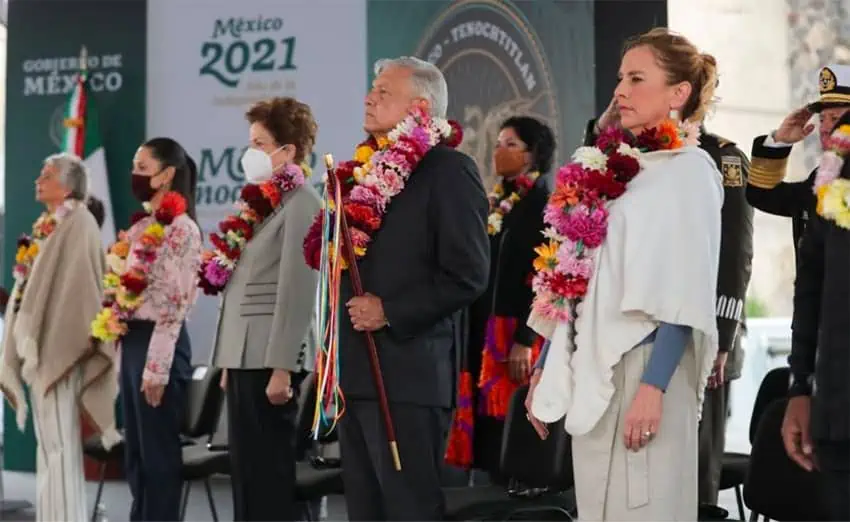
The government is manipulating historical fact for political gain by commemorating Tenochtitlan’s foundation on the wrong date, according to archaeologists and other academics.
But despite the critics, a ceremony to mark Mexico-Tenochtitlán “and more than seven centuries of history” was held on Thursday.
Experts in the field maintain that no historical source points to 1321 as the date of the foundation of Tenochtitlán, which later became Mexico City, and that the majority believe that 1325 is the more likely date.
But the numeric symmetry must have been hard to resist for government planners: 2021 marks 200 years since Mexican independence and 500 years since Hernán Cortés’ victory at Tenochtitlán, and 15 events are planned this year to celebrate.
The president first made the claim about Tenochtitlán’s foundation in September last year. “We are working together so that this year will be known as the Independence and Greatness of Mexico, 2021, because it coincides with the foundation of Mexico-Tenochtitlán,” he said.
Mexico City Mayor Claudia Sheinbaum, who was charged with organizing the events, repeated the claim. “Mexico-Tenochtitlán, our home, meeting place, place of freedom and rights is getting ready to celebrate its more than seven centuries of greatness,” she said.
Their comments sparked objections from archaeologists, anthropologists and historians who said there was no evidence that the Mexica people founded the city in 1321, arguing that records indicate the pre-Hispanic year of “2-Calli,” coinciding with 1325.

Archaeologist and anthropologist Eduardo Matos Moctezuma, who directed excavations at the capital’s Templo Mayor, was succinct in his criticisms. “It’s an absurdity to commemorate a year that does not appear in any written source or ancient document, as several researchers have already pointed out … It’s really poor that without foundation they have begun to make propositions for a political purpose. It is a clear way to manipulate history…” he said.
“Now they have become historians, [and] they are trying to amend the dates. There is always a way to discuss and make criticism, but scientifically speaking not with people who are improvising. I do not want to imagine what the textbooks are going to say about the topic,” Matos added.
Fellow academics treated the president’s and Sheinbaum’s opportunism with equal disdain. “I prefer scientific history,” said historian Alfredo López Austin.
“Archaeologists are scientists, not tailors who produce dates to measure,” said archaeologist Leonardo López Luján, current director of the Templo Mayor Project.
Matos said the historical manipulation is more than political opportunism, but part of a wider mistreatment of indigenous groups. “One of the parts of history that has been forgotten is that of the indigenous. Sometimes [those in power] have acted in a patriarchal manner,” he said.
Sources: El Economista (sp), Infobae (sp), El País (sp)