Artist stirs controversy by urinating on petroglyph, taking bum imprint

A piece of performance art by Argentine-Mexican artist Mercedes Aquí is attracting criticism from many who say it shows a lack of respect for Mexico’s cultural heritage.

Titled Ancla, the piece is a photographic record of a performance by Aquí in which she is seen urinating on a petroglyph in General Cepeda, Coahuila, in order to dilute natural pigments and make a print of the petroglyph on her buttocks.

The photo series was exhibited in the Museum of Graphic Art in Saltillo from May 30 to June 1 of this year.

Aquí staged her performance in El Gavillero, where there is nothing stopping visitors from touching the ancient petroglyphs.

In a Facebook post, Aquí wrote that the piece “speaks about identity, memory, roots, the body and territory,” and said she was not aware of any requirement to get official permission for her project.
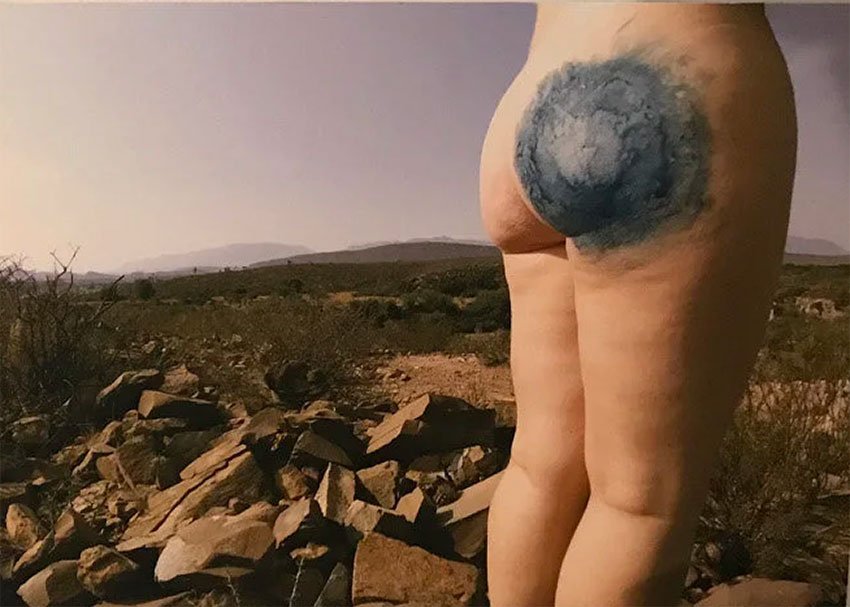
The imprinted petroglyph on the artist's derriere.
The imprinted petroglyph on the artist’s derriere.

But not everyone agreed. In an interview with Milenio, art critic Avelina Lésper blasted the piece, calling the artist a vandal and an exhibitionist.

“What she did isn’t art,” said Lésper. “It’s the same thing that always happens with these artists, that their arrogance and despotism makes them feel entitled to commit vandalism and disguise it as art with their explanations.”

Francisco Aguilar Moreno, delegate of the National Institute of Anthropology and History (INAH) in Coahuila, told the newspaper Vanguardia that the INAH is investigating whether Aquí damaged the petroglyphs to decide whether to file a formal complaint against her.

“I’m not against art projects, what I am against is vandalism and damage to our heritage,” he said.

Aquí welcomed an investigation, saying that the natural inks she used could not have damaged the petroglyph. She also said that many of the criticisms directed against her are products of sexism and xenophobia.

“Marking a territory with liquid is usually associated with men, not women,” she wrote. “Exhibiting an apparent urination has provoked violent reactions.”

Born in Argentina, Aquí has lived in Mexico since 1978.

Source: Vanguardia (sp), Milenio (sp), El Universal (sp)

CORRECTION: The artist as pictured in the previous version of this story was someone else altogether. Sorry for the error.

Have something to say? Paid Subscribers get all access to make & read comments.
Manzanillo, Colima, México, 13 de marzo de 2026. La doctora Claudia Sheinbaum Pardo, presidenta Constitucional de los Estados Unidos Mexicanos en conferencia de prensa matutina, “Conferencia del Pueblo” desde Colima. La acompañan Indira Vizcaíno Silva, gobernadora Constitucional del Estado de Colima; Omar García Harfuch, secretario de Seguridad y Protección Ciudadana (SSPC); Raymundo Pedro Morales Ángeles, secretario de Marina (Semar); Bulmaro Juárez Pérez, divulgador de lenguas originarias, presentador de la sección “Suave Patria”; Ricardo Trevilla Trejo, secretario de la Defensa Nacional (Sedena); Jesús Antonio Esteva Medina, secretario de Infraestructura, Comunicaciones y Transportes; Bryant Alejandro García Ramírez, fiscal general del Estado de Colima; Fabián Ricardo Gómez Calcáneo; Rocío Bárcena Molina, subsecretaria de Desarrollo Democrático, Participación Social y Asuntos Religiosos de la Secretaría de Gobernación; Efraín Morales López, director general de la Comisión Nacional del Agua (Conagua); Marcela Figueroa Franco, secretaria ejecutiva del Sistema Nacional de Seguridad Pública (SESNSP) y Guillermo Briseño Lobera, comandante de la Guardia Nacional (GN). Foto: Saúl López / Presidencia

Mexico’s week in review: Congress deals Sheinbaum her first legislative defeat

1
The week of March 9 in Mexico was marked by standoffs between allies in Congress and adversaries at the airport. Here's what you missed.
A soldier displays seized handguns

The US and Mexico, growing together and growing apart: A perspective from our CEO

1
From a historic drop in homicides to opposite bets on electric vehicles, Mexico News Daily's CEO breaks down where the U.S. and Mexico are converging — and where they're not.
Veracruz Gov.

Veracruz governor blames private vessel for 200-kilometer Gulf Coast oil spill

1
The spill, which has spread to over 200 kilometers of Mexico's Gulf Coast beaches, has been traced to a private oil tanker off the coast of Tabasco.
BETA Version - Powered by Perplexity