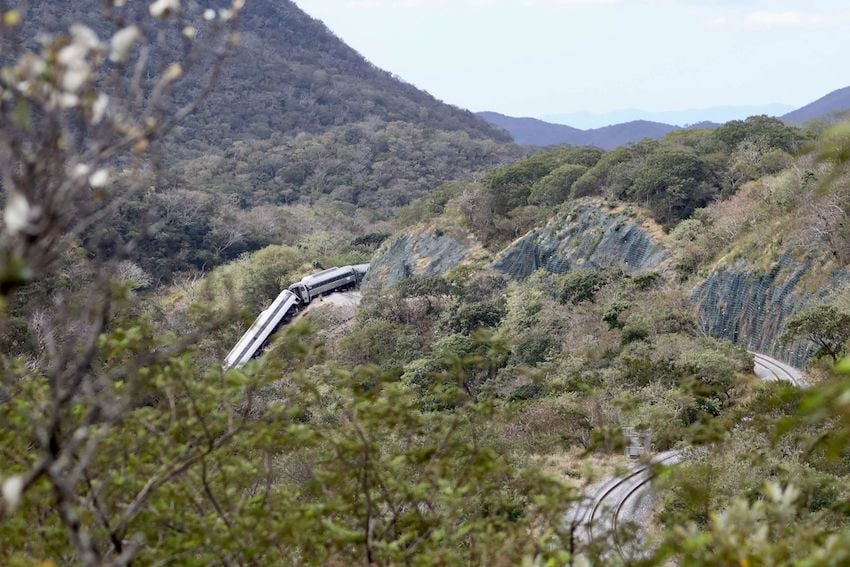
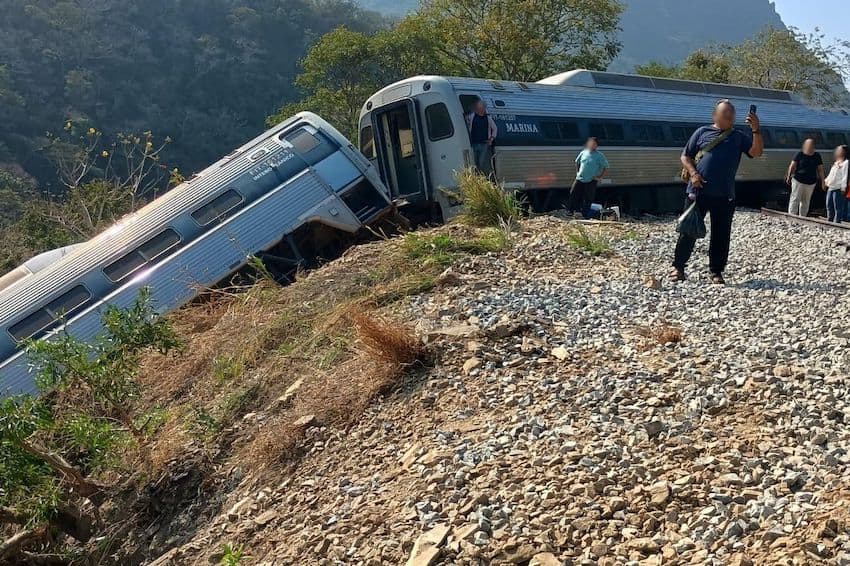
Excessive speed was the cause of the Interoceanic Train crash that claimed 14 lives in southern Mexico in late 2025, Attorney General Ernestina Godoy said Tuesday.
In a video message, Godoy said that when the train crashed, it was traveling at 65 kilometers per hour (km/h) on a curve where the maximum “authorized speed” is 50 km/h.
She said that the speed the train was traveling when it derailed in the state of Oaxaca on Dec. 28 was determined via information obtained from the black box, which was located in one of the train’s two locomotives.
In addition to the 14 fatalities, almost 100 people were injured in the crash, which occurred near the small Oaxaca town of Nizanda.
The driver of the train was arrested in Palenque, Chiapas, on Monday. He faces charges of culpable homicide and causing injuries due to his allegedly negligent driving.
Godoy said that the train was inspected after the accident and no defects that could have placed its operation at risk were found.
View this post on Instagram

On stretches of railroad that the train passed before the accident occurred, it “reduced its speed, which allowed us to know that the braking system was working properly,” she said.
Godoy also said that no damage was found on the tracks.
She noted that a range of experts across fields, including topography, mechanical and electrical engineering, telecommunications and “industrial safety” contributed to the investigation carried out by the Federal Attorney General’s Office (FGR).
The attorney general said that investigations will continue to determine whether any other factors contributed to the accident, but as things stand, excessive speed has been established as the sole cause.
The train traveled at excessive speed during a period of more than 1 hour before the accident occurred
The Interoceanic Train was traveling across the Isthmus of Tehuantepec from Salina Cruz, Oaxaca, to Coatzacoalcos, Veracruz, when the accident occurred.
Citing information obtained from the black box, Godoy said that the train, prior to the derailment, reached speeds of 111 km/h on straight stretches of railroad, 41 km/h above the “authorized limit.”
She said that the train rounded the six curves before the accident location at a speed of 52 km/h, slightly above the authorized limit.
Godoy stressed that “speeding on a train is much more dangerous than in a conventional vehicle” due to a train’s weight and mass as well as the radius of the curves it passes through. Consequently, she said, the “centrifugal force increases — that is the force that pushes the vehicle away from its center of rotation, which causes it to leave the tracks and overturn.”
The train that crashed on Dec. 28 — made up of two locomotives and four passenger cars — weighed approximately 400 tonnes and was transporting around 250 people.
Citing the investigation carried out by the FGR, the newspaper Reforma reported that the train traveled at excessive speed during a period of over an hour, but the driver wasn’t warned about his speeding or “stopped.”
“… Godoy didn’t say why, on the route [the train] covered before the accident — where there were two stops at stations — no alert or automated system was activated to make [the driver] reduce his speed,” Reforma wrote.
Carlos Barreda, a railroad expert, told Reforma that the trains that run on the interoceanic route have speed alert systems and speed control mechanisms. However, he questioned whether they were working.
The previous federal government modernized the railroad across the Isthmus of Tehuantepec as part of an ambitious trade corridor project. Former president Andrés Manuel López Obrador inaugurated the line in late 2023.
“Authorities, kings, politicians and rulers have been dreaming” about connecting the Pacific Ocean and the Gulf of Mexico for “centuries,” he said at the time.
Cargo unloaded at the ports in Salina Cruz and Coatzacoalcos can be transported across the isthmus by freight trains before being reloaded onto a ship to complete its journey to its final destination.
“It’s an exceptional project — it provides an alternative to the Panama Canal,” President Claudia Sheinbaum said in March 2025, referring to the Interoceanic Corridor of the Isthmus of Tehuantepec, which includes the modernized railroad between Salina Cruz and Coatzacoalcos.
With reports from Reforma, El Financiero, El Universal, López-Dóriga Digital and Milenio