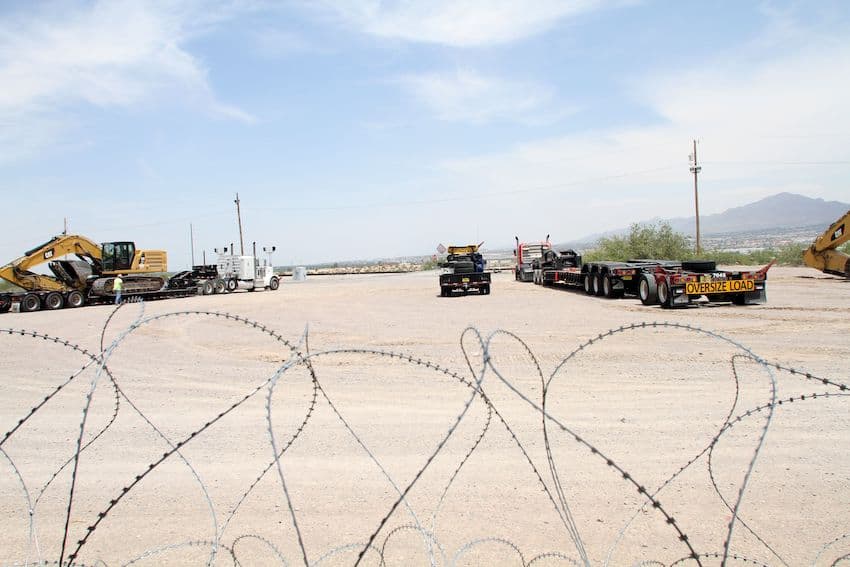
A border wall construction project in Big Bend National Park in West Texas began last week, with a separate, nearby access road threatening the archaeological landscape of Porvenir, the site of a 1918 massacre of ethnic Mexican villagers.
Contractors began work Thursday on 17 miles of low, noncontiguous barrier fences and patrol roads, with conservationists reporting bulldozers clearing native vegetation.
One new access road appears to cut directly through Porvenir, which was a small farming community along the Rio Grande over 100 years ago.
On Jan. 28, 1918, Texas Rangers, local ranchers and apparently U.S. Army soldiers removed 15 unarmed ethnic Mexican residents (13 men and two teenage boys) from their homes and executed them, according to a lengthy report in Texas Monthly last week.
The location remains a sacred place for descendants and an archaeological site. A 2015 excavation found military-issued cartridge casings, evidence that challenged the historical narrative that the killings were carried out solely by vigilantes and Texas Rangers. The Texas Historical Commission erected a marker in 2018 after descendants campaigned for recognition.
Archaeologist David Keller told Texas Monthly that a newly built access road about 16 feet wide crosses the eastern third of the archaeological area and has been traversed by heavy machinery.

He said contractors and local officials indicated the route could eventually be widened to 100 or 120 feet.
The Department of Homeland Security (DHS) is managing the project through Customs and Border Protection (CBP).
The CBP said the barriers, though low and not connected, are intended to prevent off-road vehicles from traveling to and from the Rio Grande, adding that the Porvenir access route is not finalized and public feedback will be considered.
DHS awarded a US $1.7 billion contract in May for the work, which has drawn widespread bipartisan opposition.
Even supporters of President Donald Trump have opposed the project for using billions of taxpayer dollars to build low fencing in a rugged, remote part of Texas where few illegal crossings have been recorded.
Podcaster Joe Rogan, who endorsed Trump in 2024, called the plan “B.S.” on his podcast, the San Antonio Current reported.
“This is the most heinous attack on an American national park in generations,” Laiken Jordahl, national public lands advocate for the Center for Biological Diversity, said in a statement posted to Instagram.
The Current reported that it was the first time in U.S. history that the federal government waived such a broad set of environmental protections for construction inside a national park.
With reports from Texas Monthly, AZFamily, San Antonio Current and Texas Standard