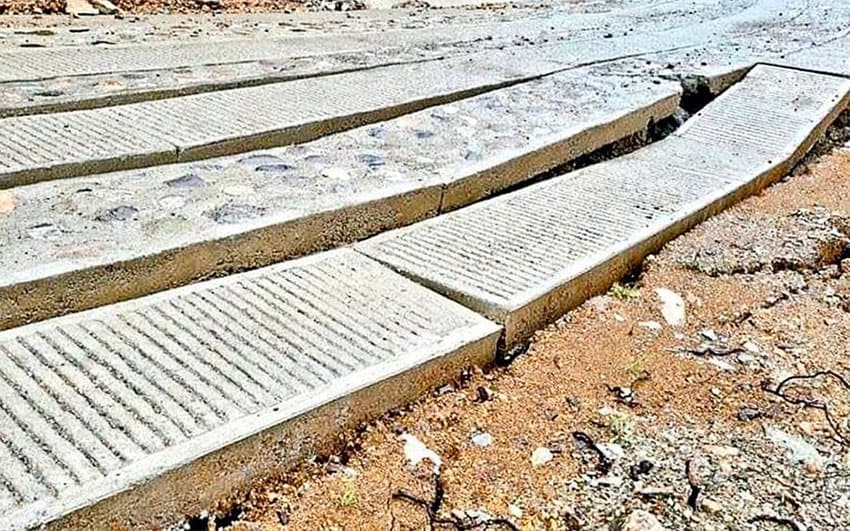
The federal government has detected deficiencies in 22 community-built roads in the same number of municipalities in Oaxaca.
The Ministry of Communications and Transportation (SCT) conducted an audit of 22 of 45 roads whose construction was authorized by the government in 2019 and found that all of them had shortcomings. Poor-quality construction materials were used in many cases and there were violations of government building codes, the audit found.
“It was determined that the quality control in the construction of the roads is deficient,” the SCT said in a report.
The ministry also detected irregularities in spending on the projects — budget for the 22 roads was 563.6 million pesos (US $27.29 million) — and found that there was a lack of supervision during their construction.
SCT project officials did not supervise the quantities of aggregates used in the production of the hydraulic concrete, the report said.
The SCT said there were questions over spending in all 22 municipalities it visited and that the use of millions of pesos was not properly documented. It also said that rock was removed from rivers for road construction without environmental approval and that some workers were not paid properly and/or denied benefits to which they were entitled.
The findings are at odds with remarks made by President López Obrador when he inaugurated the first roads built as part of the scheme, intended to provide jobs for residents of poor communities in Oaxaca and avoid the use of large, private contractors, whom the president has accused of corruption.

“This concrete road was built by the people, we just helped them with the delivery of the budget. They managed the money with honesty,” he said in the municipality of San Antonio Sinicahua on January 17, 2020.
“What they did are works or art, it’s something extraordinary,” López Obrador said the next day in Santos Reyes Yucuná, another Mixtec region municipality where a new road was built.
One of the deficient projects is that in Santiago Laxopa, a municipality northeast of Oaxaca city in the northern Sierra region. Sections of the road buckled and sank late last year before it was even opened, while a safety barrier was also broken, the newspaper Reforma reported.
One of the leaders of the committee in charge of the project said there was little assistance from the SCT, explaining that a ministry official only inspected the construction a few times.
“It’s sad. … One part [of the road] was done well and another part wasn’t. I don’t know if it’s a geological fault, human error or bad luck,” Erasto Robles said.
Another recently built road that has not fared well is a stretch of highway that connects the northern Sierra municipality of San Pedro Yolox to the rest of the state.
The National Institute of Indigenous Peoples said in January that at least 30 meters of the 9-kilometer hydraulic concrete road was collapsing due to a geological fault. It opened just fourth months prior to the appearance of the problem.
López Obrador has pledged to provide funds for the construction of 350 stone and concrete roads in marginalized municipalities in Mexico. In 2019 and 2020, 58 roads were built by residents in Oaxaca under the initiative but a significant percentage of them will need to undergo repairs before they can be safely used.
The president has said the program would show there was no “great science” in building a road. But what little science may be required seems to have been in short supply.
Source: Reforma (sp)