Authorities in Jalisco cremated 1,581 unidentified bodies between 2006 and 2018, acts described as “totally criminal” by the director of one of the organizations that discovered them.
A study entitled Cremations of Unidentified Bodies in Jalisco, Crimes without Justice, also tells of cases in which authorities attempted to intimidate family members of missing persons into accepting ashes, even though there was no genetic evidence to indicate they belonged to their loved ones.
The Center of Justice for Peace and Development (Cepad), a non-governmental organization, and the Heinrich Böll Foundation, a public policy think tank, presented the study yesterday.
Family members who attended the presentation say they have been deprived of the opportunity to find out the truth about what happened to their sons and daughters and to seek justice.
“I’ve arrived at the conclusion that the moment when we can’t find our children is not the only time they disappear. When they don’t identify the bodies, in one way or another, they disappear again,” said María del Rosario Cervantes, the mother of a missing child.
Rosario Hernández said that a state police officer threatened her with a gun when she refused to accept the ashes that authorities said belonged to her son.
“I told him, ‘I can’t accept the ashes if there’s no body, I want to see the body . . . because I didn’t authorize the cremation of my son.’ And he asked me, ‘what do you want us to do? Isn’t it enough what you have? You have the photos, the fingerprints, everything, it’s your son,’” she said.

“When I didn’t want to accept the ashes . . . He tried to intimidate me so that I would accept them out of fear . . . It was all a lie, it was all a ploy. Those people did a lot of damage to me,” Hernández added.
Cepad director César Pérez described the cremations carried out by successive state governments as “totally criminal.”
He said that thousands of families had been left with the uncertainty of not knowing if their missing relatives were among the unidentified bodies that were cremated.
The possibility of recovering a loved one’s body and being able to say goodbye in accordance with their traditions and beliefs was taken away from families forever, Pérez said.
Ana Karolina Chimiak, a lawyer for Cepad, rebuked authorities for trying to publicly justify their actions.
“They said that it was all regulated and in accordance with the law, that the cremations had to be carried out for health reasons . . . that it was more honorable to cremate a body than send it to a mass grave,” she said.
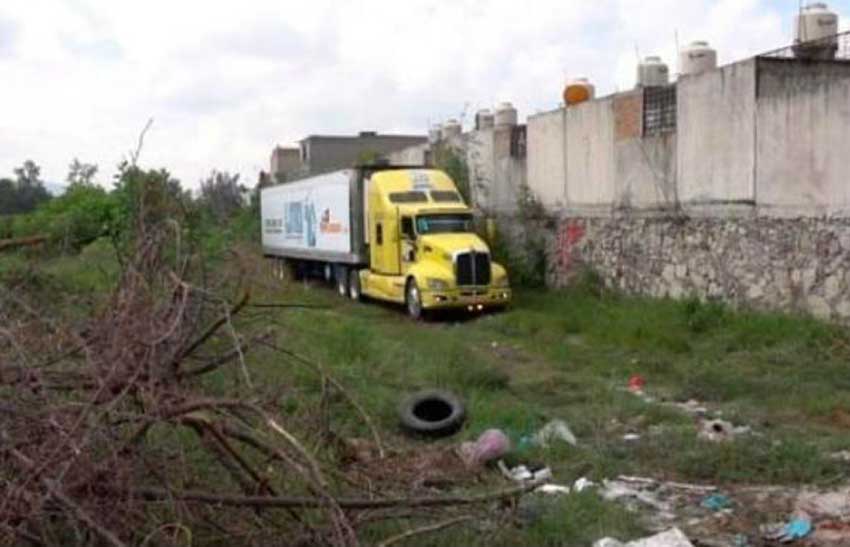
Chimiak said it was never too later for justice and called on authorities to respond to the seriousness of the situation to ensure that there is no repeat of “another human tragedy” such as last year’s case of unclaimed bodies being stored in refrigerated trailers.
Pérez said it was possible that authorities in Jalisco had acted the way they did due to complicity with organized crime gangs such as the Jalisco New Generation Cartel (CJNG).
“We don’t know the extent of these relationships, the depth with which authorities and organized crime are complicit.”
For that reason, he said, his organization intends to ask for the intervention of the United Nations.
Source: Milenio (sp)