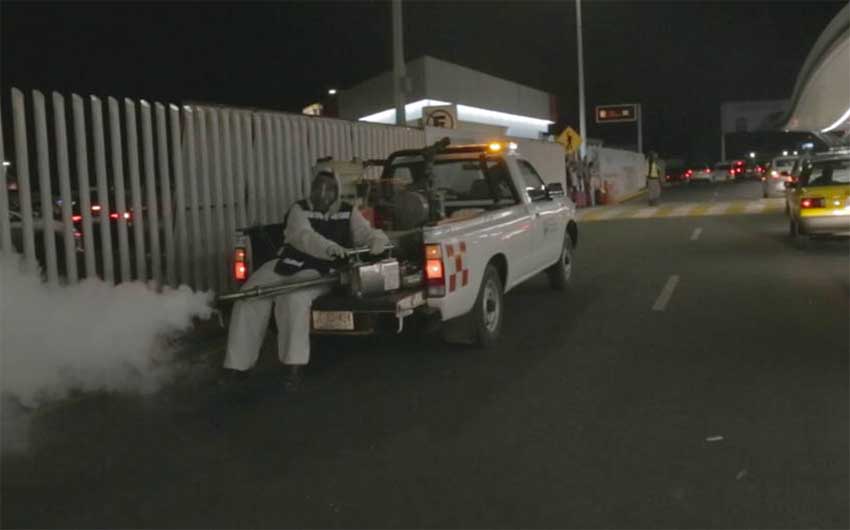
The Guadalajara International Airport (AIG) has a serious mosquito problem but health authorities in Jalisco say that they don’t have enough money to deal with the issue.
Hordes of the insects have invaded the airport’s bathrooms, waiting rooms, baggage carousels, runways and, on occasions, even made their way inside aircraft.
Airport management recognizes that there is a problem but admits that it’s at a loss to know what to do to get rid of the mosquitoes, although it is aware that they are attracted by the presence of nearby bodies of water.
Meanwhile, the state health secretary has made it clear that the government won’t step in to help.
“We would have to outlay a quantity of money that isn’t available and [spending it] wouldn’t be justifiable . . .” Alfonso Petersen Farah said.
He added that the type of mosquitoes at AIG are culex which, he said, “don’t represent a risk to health, don’t represent an epidemiological risk [and] therefore the SSJ [Jalisco Health Secretariat] is never going to be able to take care” of the problem.
Raúl Revuelta, CEO of Grupo Aeroportuario del Pacífico — which operates 12 airports in Mexico including the one at Guadalajara — said the airport would contract with universities to carry out a biological study to come up with a sustainable, long-term solution.

Speaking before Petersen made his remarks, he also said the support of local, state and federal government would be required to attend to the problem.
With a map in hand, Revuelta pointed out that the airport is surrounded by around 100 bodies of water, some of which contain untreated sewage.
He also said that 100% of captured specimens have been examined and it has been established that they are not vectors of transmittable diseases such as dengue fever or the zika and chikungunya viruses.
Terminal manager Francisco Martínez Mira said the airport would strengthen measures that it has adopted in recent weeks to combat the large numbers of bugs.
They include spraying larvicide in breeding grounds and covering open-air canals located near the airport.
Martínez said that over the past five years the airport has spent 15 million pesos (US $786,000 at today’s exchange rate) to combat its mosquito problem but still hasn’t been able to eliminate it.
To date, 50 passengers have made official complaints about the pesky insects.