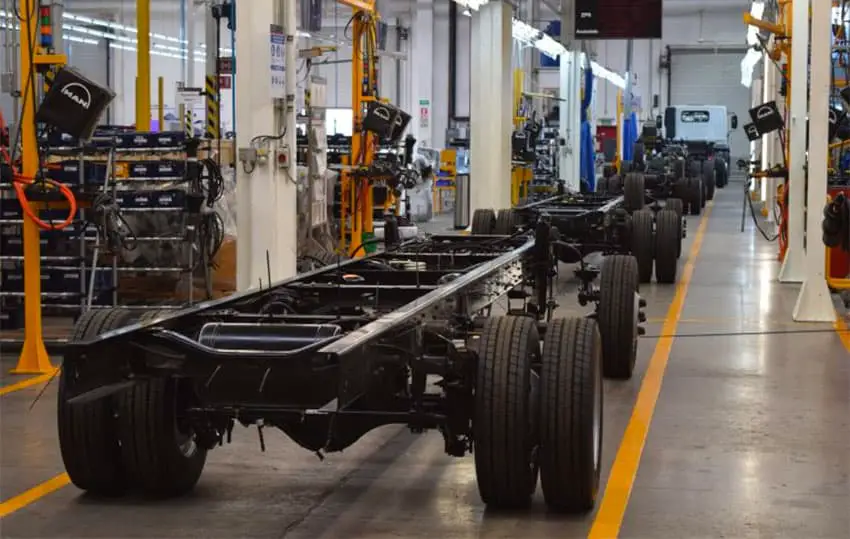
The auto parts industry halted investment of 18 billion pesos (US $958 million) in the second half of last year as a result of the government’s decision to delay mass production and widespread distribution of ultra-low-sulfur diesel (ULSD) while demanding that new heavy vehicles be manufactured with environmentally-friendly technology.
The Energy Regulatory Commission (CRE) voted in December in favor of postponing for five more years the implementation of a rule requiring Pemex to produce, distribute and sell ULSD across the country. The postponement followed a deferral of the rule in late 2018.
According to the CRE resolution, the state oil company can only continue marketing ULSD in the country’s three largest cities – Mexico City, Guadalajara and Monterrey – and along the northern border.
Alberto Bustamante, foreign trade director of the national auto parts industry association, INA, who cited the 18-billion-peso figure at a press conference on Thursday, said that if the government continues to demand that heavy vehicles be made with clean technology even though ULSD is not widely available, an additional 2 billion pesos in investment will be lost in the first half of 2020.
Jobs could be lost in the auto parts sector as a result of the decline in investment, he said.
Miguel Elizalde, president of the National Association of Bus, Truck and Tractor Manufacturers, said that if ULSD is not available, companies won’t buy new heavy vehicles that were built to run on it and emissions levels won’t fall as a result.
He called on the Secretariat of the Environment to put an end to the requirement for new heavy vehicles to be built with EPA10 and EURO VI clean fuel technology until the production and widespread availability of ULSD is guaranteed.

Elizalde said last year that “we need to have total availability of ultra-low-sulfur diesel so that these clean technologies can be put to work.”
The president of the National Chamber of Trucking, Enrique González, pointed out Thursday that people are putting off the purchase of new heavy vehicles because they know that there is no obligation to supply ULSD to 81% of municipalities across the country.
Source: El Universal (sp), El Heraldo de México (sp)