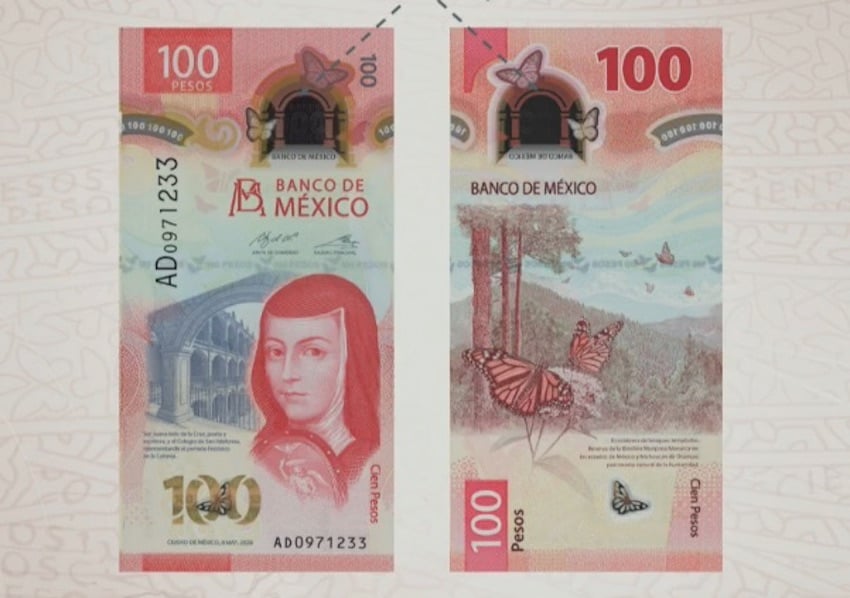
A new 100-peso banknote, the third in a new family of bills, was placed in circulation Thursday by the central bank.
Featuring the likeness of 17th century feminist poet and nun Sister Juana Inés de la Cruz on one side and an image of monarch butterflies in a pine, oak and fir forest on the other, the predominantly red-colored note is made of polymer rather than paper.
“It has a vertical format and unique security elements,” Bank of México Governor Alejandro Díaz de León told a press conference.
Among them: embossing perceptible by touch on the Sor (Sister) Juana side, a transparent window similar to those on the existing 20-peso and 50-peso banknotes, a multicolor denomination and fluorescent ink.
Presenting the new note, Díaz described Sor Juana as an “erudite and combative writer who fought to overcome the obstacles that limited women’s access to culture.”
She became “one of the most important protagonists of Spanish-American literature in the 17th century,” he said.
While speaking about the reverse side of the note, Díaz said that forests cover 16% of Mexico’s territory and play an important role in supporting Mexico’s biodiversity. The monarch butterflies featured on the note migrate to forests in México state and Michoacán from Canada and the United States every year.

The new 100-peso note replaces a paper bill featuring the likeness of Nezahualcóyotl, a ruler of the city-state of Texcoco in the 15th century. That note remains legal tender but will be gradually withdrawn from circulation.
The release of the new banknote comes two years after a new 500-peso bill featuring images of former president Benito Juárez and a gray whale entered circulation and one year after a new 200-peso note was introduced.
The face of Sor Juana appeared on the old 200-peso note but was removed in favor of independence heroes Miguel Hidalgo and José Morelos on the new one. The other side of the new 200-peso bill features an eagle flying over the Sonoran desert.
The fourth and fifth members of the new family of notes will be 1,000-peso and 50-peso bills.
The new 1,000-peso note will feature the 33rd president of Mexico, Francisco I. Madero, Revolution-era feminist Hermila Galindo and revolutionary Carmen Serdán. A jaguar will stalk its reverse side next to an image of the ancient Mayan city of Calakmul.
The axolotl, a species of salamander endemic to Mexico City’s Lake Xochimilco, will be featured on one side of the new 50-peso bill, while gracing the other will be an image commemorating the founding of Tenochtitlán, the capital of the Aztec empire at the time of the Spanish conquest.
Source: El Financiero (sp)