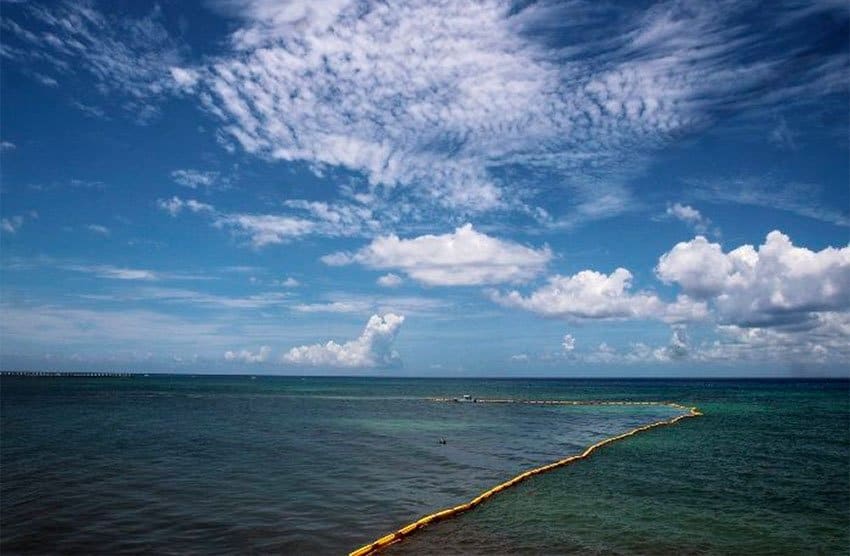
In the face of potential economic disaster, local authorities erected a 2.5-kilometer-long barrier to prevent sargassum from continuing to wash up on the shores of Playa del Carmen, Quintana Roo.
With the approval of the Navy Secretariat, officials from the municipality of Solidaridad — of which Playa del Carmen is the seat — contracted with the company Ar.Co to build the barrier and carry out other sargassum prevention and cleanup jobs.
Ar.Co was also hired last year to build a barrier to protect Playa’s beaches from the sargassum invasion but with limited success. So much seaweed accumulated that it frequently washed over the barrier and on to the beach.
Mayor Laura Beristain Navarrete said the local hotel association, which supported the decision to contract Ar.Co, has invested 30 million pesos (US $1.5 million) to combat the problem, though she added that no definitive solution had yet been found.
“It isn’t a nice topic, and I don’t mean the sargassum but rather the amount [we’re receiving] this year; we don’t have a comprehensive solution. Everything is trial and error, but we’re working so that this summer is a good one for us.”
She added that in addition to the barrier, administrative employees of the federal office of maritime land zones (Zofemat), hotel owners and residents are working together to clean Playa del Carmen’s beaches of the accumulated sargassum.
Much is at stake. In a May report, the federal government warned that Quintana Roo beaches, including Playa del Carmen, could see a colossal drop in tourism if efforts fail to halt the predicted 1.56 million-tonne tide of the brown macroalgae.

Cancún and Puerto Morelos Hotels Association president Roberto Cintrón said the state and national economies could be put at risk by the sargassum invasion: 50% of foreign tourists travel to Mexico exclusively to visit Quintana Roo’s white sand beaches.
Additionally, a report published on June 15 as part of a study by scientists from various Mexican institutions found that 78 marine species, mostly fish and crustaceans, were fatally affected by the enormous amounts of decomposing sargassum on the Caribbean coastline in 2018.
As predicted, this year is shaping up to be worse for sargassum quantities.
Cleanup crews in Playa del Carmen are removing 100 tonnes of sargassum daily — nearly four times what was collected last year.
Playa del Carmen is not the first beach town in the state to install a barrier against sargassum. Puerto Morelos constructed two kilometers of barriers that convey the seaweed into waiting vehicles, which then bury it in designated areas.
However, the local government did not erect barriers along the remaining 17.7 kilometers of beach in Puerto Morelos, and hotel owners have largely been left to fend for themselves or construct their own barriers.
In an interview with the newspaper El Universal, Puerto Morelor Mayor Laura Fernández Piña said she expects the newly-installed barriers to halt approximately 65% of the incoming sargassum.
Source: El Universal (sp), Jorge Castro (sp)