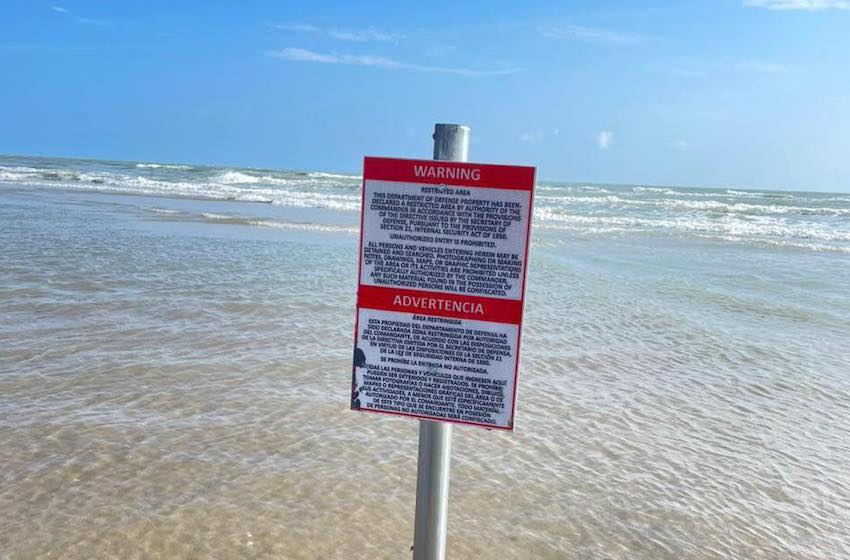
The Mexican Navy reported that it has removed six warning signs planted on Mexican territory in the border state of Tamaulipas warning that anyone found on what the signs called “National Defense Area III” would be “detained and searched.”
The United States government later acknowledged that it had arranged to have the signs put up, according to President Sheinbaum.
In her daily press conference on Tuesday morning, Sheinbaum confirmed the location of the signs. “Boundary signs were put up on a section of Playa Bagdad (Baghdad Beach),” Sheinbaum said.
Playa Bagdad is located where the Rio Grande meets the Gulf of Mexico. The river, which originates in south-central Colorado in the United States and is called the Río Bravo on the Mexican side, forms the border between the two countries for a long stretch.
Reports of unidentified men arriving at the beach by boat to install signs prompted the response from Mexico’s Naval Ministry (Semar).
The signs reportedly stated in Spanish and English that the area was Department of Defense property and a “Restricted Area” by order of “the commander.” They also said that “unauthorized entry is prohibited,” as are photography or drawings, and stated, “If you are found here, you may be detained and searched.”

Sheinbaum said her government was communicating with U.S. authorities in order to get an explanation.
“First, the consulate was consulted, then the embassy,” she said. “They hadn’t issued an official report, so the signs were removed. Later, a U.S. government agency stated that a company had indeed been hired to put them up.”
The Pentagon said in a statement that contractors would work with “appropriate agencies to avoid confusion in the future.”
National Defense Areas (NDAs) are U.S. military zones along the U.S. side of the country’s southern border, managed by the U.S. Defense Department. On May 1, the U.S. established a new 418-km NDA along the southern border of Texas with Mexico.
In the past, said the statement, changes in water depth and topography have altered the perception of the international boundary’s location, suggesting the possibility of a location mistake.
Mistake or not, the warning signs appeared as threats of a unilateral U.S. incursion into Mexico roil the bilateral relationship. U.S. Secretary of State Marco Rubio has declared that no such plans exist while President Donald Trump continues to make provocative remarks, suggesting he would be “proud” to launch strikes in Mexico to stop the flow of illegal drugs.
With reports from Al Jazeera, El Financiero and El Universal