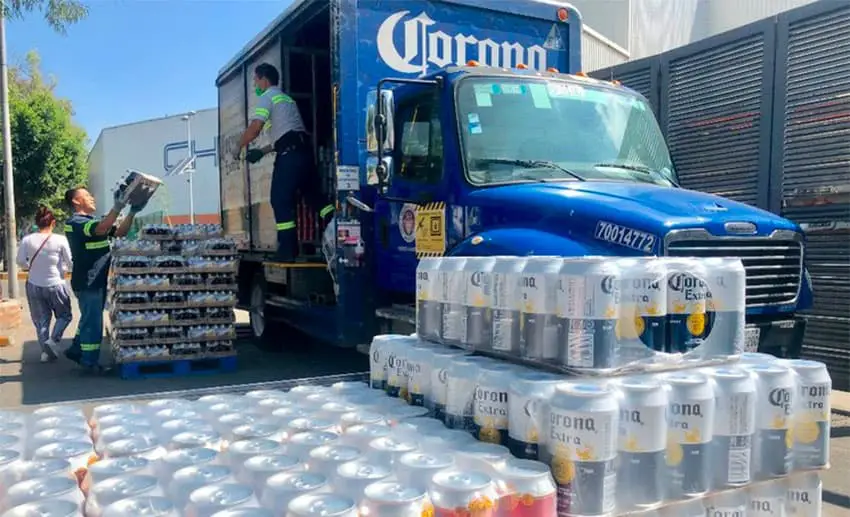
Friday is International Beer Day and it’s an event that Mexicans can celebrate: the beer industry is recovering after it was shut down during April and May due to the coronavirus pandemic.
According to Cerveceros de México, the national brewing industry association, exports are currently at 70% of 2019 levels, production is at 80% and distribution is at 90% of what it was last year.
Beer’s production chain, which has 55,000 direct and 600,000 indirect employees, was disrupted during the coronavirus lockdown as it was considered a nonessential business and was ordered to close down, leading to beer shortages across the country and skyrocketing prices of existing stock.
Despite the shutdown, all 55,000 employees have remained on the job, said Karla Siqueiros, director of Cerveceros de México.
However, faced with a slow reopening of restaurants, bars and sports activities, the Mexican beer industry expects a staggered recovery, she said, as it struggles to make up for lost time amid the current economic crisis.

“Our challenge is to meet our international commitments as an export power, to maintain production,” Siquieros explained, adding that the industry represents 1% of Mexico’s gross domestic product and 25% of agro-industrial exports.
Beer is, indeed, a major industry in the country. The largest exporter and fourth-largest producer of beer in the world, Mexico produced 124.5 million hectoliters of beer in 2019, of which 40 million were exported to 180 countries.

Judging by the near panic that broke out in some regions of the country as beer supplies withered and black-market beer smuggled in from the United States sold for 300% more than pre-pandemic prices, beer is an important product for Mexicans, although not an essential one in the government’s eyes.
According to market researcher Kantar Media, Mexicans consume between 22 and 23 liters per capita each year.
In the first quarter of this year, before the coronavirus hit, production was up 7% and the industry is hopeful it can regain that momentum and end the year at pre-coronavirus levels.
“Yes, the pandemic had a strong impact; we are trying to return to normality as soon as possible, to the capacity, production [and] the numbers that we were driving … and if we do not achieve it we hope to be close to what we obtained in 2019,” Siquieros stated.
Source: Milenio (sp), El Universal (sp), La Jornada (sp)