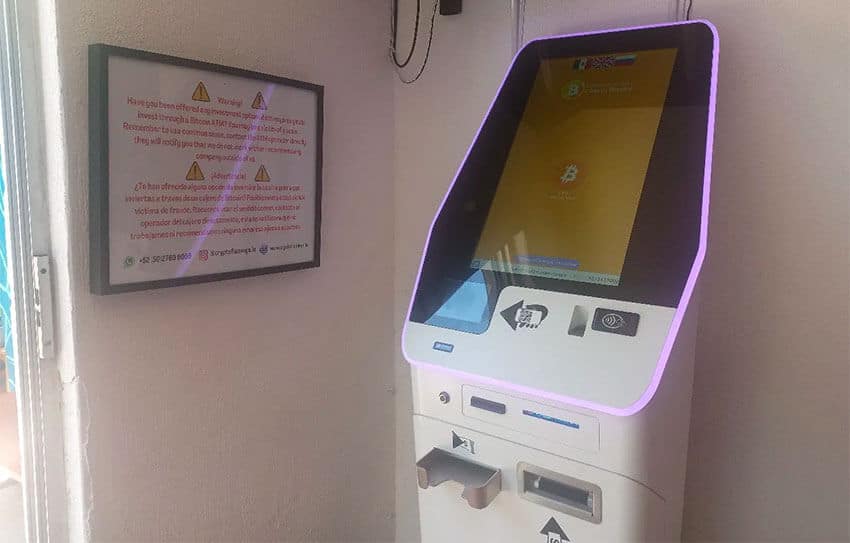
A Bitcoin ATM has been installed in Cancún, Quintana Roo, triggering concerns that it could facilitate money laundering, especially given that Mexico lacks cryptocurrency regulations.
Installed in a downtown youth hostel a few months ago, the ATM allows users to buy and sell the cryptocurrency and withdraw cash by tapping into their bitcoin wallets. It was installed by a fintech company despite an absence of a regulatory framework to govern the operation of crypto ATMs in Mexico, where cryptocurrencies are not legal tender.
Financial authorities have warned that their use can facilitate money laundering and advised in a statement last year that “the country’s financial institutions are not authorized to carry out and offer operations to the public using virtual assets.”
The newspaper Por Esto! visited Hostal Venado 8 in central Cancún to learn more about the operation of the Yucatán Peninsula’s only Bitcoin ATM. It discovered that it was installed by an independent company called Crypto Flamingo, which claims to have “the most reliable cryptocurrency ATM network in Mexico.”
Por Esto! contacted the Mexico City-based company and spoke with Pablo, one of its partners. “We’re expanding. We have one [ATM] in Mexico City, one in Cancún, and we’ve just installed another in Guadalajara. … We’re growing quite well,” he said.
Por Esto! questioned Pablo about the source of cash for the ATM, asking whether it was supplied by a bank. He responded that the cash’s source was a confidential matter about which he couldn’t provide any information. The newspaper also asked the Crypto Flamingo partner whether the company had been approached by any financial authority given that bitcoin is not legal tender in Mexico. In addition, Por Esto! inquired as to whether the fintech had obtained a permit to install its ATM in Cancún.
“Send me these questions and I’ll respond to those … [I can]. Of course I’m not going to share [answers] to specific questions such as those you’re asking me, due to matters of confidentiality,” Pablo told a Por Esto! reporter.

The newspaper sent its questions via WhatsApp but didn’t receive a response. Por Esto! also reported that it couldn’t find any evidence that Crypto Flamingo is overseen by the National Banking and Securities Commission (CNBV), a financial sector regulator.
“We looked at the CNBV website to see whether Crypto Flamingo is supervised by that authority, but it doesn’t appear among the companies with a license to operate as an Institution of Electronic Payment Funds or as a collective funding institute or as a ‘new [financial] model,’” the newspaper said.
It noted that bank customers can go to the National Commission for the Protection and Defense of Financial Services Users – Condusef – if they have an ATM-related problem that isn’t resolved by the bank, but in the case of crypto ATMs there is no certainty about which authority, if any, can provide assistance to a person who didn’t get the money they should have received.
“Until now there is no regulation that protects [cryptocurrency users],” Por Esto! said, adding that the installation of a Bitcoin ATM in Cancún is not a minor matter given the high number of international tourists the Caribbean coast city welcomes.
“Let’s remember that Cancún and the Riviera Maya have become areas where different criminal groups operate, [including international ones], and consequently the use of digital assets could be a convenient strategy that allows them to launder money by converting bitcoins into legal tender bills, far from the gaze of tax, financial and monetary authorities,” the newspaper said.
The owner of the hostel where the ATM is located said in March that the service had been well received by foreign visitors.
With reports from Por Esto!