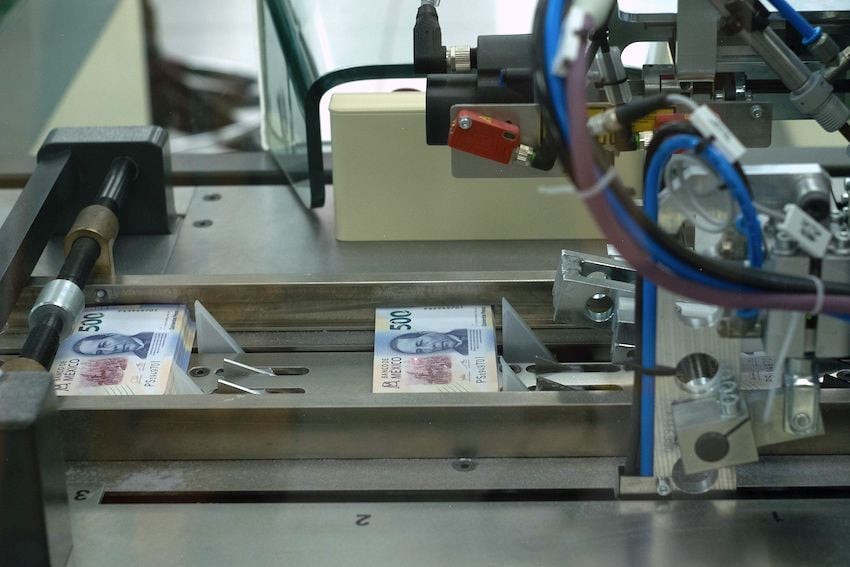
Almost 292,000 fake banknotes were detected in Mexico in 2025, according to the country’s central bank, the highest figure since 2022.
Bank of Mexico (Banxico) data shows that 291,673 phony bills were taken out of circulation last year, a 1.65% increase compared to 2024.
The figure is the highest since around 351,000 fake banknotes were detected in 2022.
The production of counterfeit money has long been a problem in Mexico. According to the newspaper El Universal, the first counterfeits of Banxico-issued banknotes were detected in Mexico City in 1934.
What is Mexico’s most counterfeited banknote?
Around 51% of the fake banknotes taken out of circulation last year were bogus 500-peso bills.
While the 500-peso note remained Mexico’s most counterfeited bill last year, the total number of forged five-hundreds detected declined from 176,587 in 2024 to 148,652 in 2025, a reduction of 15.8%.
Seizure of fake 100-peso bills surges 212%
Mexico’s second most counterfeited banknote last year was the 100-peso bill.

According to Banxico, 73,875 fake 100-peso notes were taken out of circulation in 2025, an increase of 212% compared to 2024.
Mexico’s third most counterfeited note in 2025 was the 200-peso bill, of which 56,153 were detected, a decrease of 14.1% compared to 2024.
The fourth most counterfeited note last year was the 1,000-peso bill, of which 6,770 were taken out of circulation, an increase of 1.8%.
The fifth most counterfeited note was the 50-peso bill, of which 5,797 were detected in 2025, a 59.7% decrease compared to the previous year.
With regard to 20-peso bills, 426 fake ones were detected last year, a 91.9% increase compared to 2024.
Coins are counterfeited too
Banxico data shows that 1,091 fake Mexican peso coins were taken out of circulation last year, a reduction of 33.3% compared to 2024.
Almost 90% of the phony coins detected were 10-peso ones, while most of the remainder were 5-peso coins.
How to recognize a counterfeit note
The website Mexperience recently updated an article headlined “Tips for Spotting Counterfeit Mexican banknotes.”
Mexperience notes that in “the latest series of Mexican banknotes, the three lowest denominations — the $20, $50 and the $100 peso notes— are printed on polymer, a special type of plastic paper.”
“The other three — $200, $500 and $1000 peso notes — are printed on traditional banknote paper, which has that same crisp and distinct feel of genuine banknotes issued in all countries,” the article states.
“… When you’re handling Mexican banknotes, be sure to feel the paper,” the article continues.
“It should feel the same as, for example, US or Canadian dollars, British pounds, or euros. If the note doesn’t ‘feel’ right — paper used for counterfeit notes is often thicker than genuine banknote paper — check for additional security features.”
Read the full article here.
On its website, the Bank of Mexico says it offers “training to identify security features in Mexican banknotes for financial institutions, legal authorities, government institutions, companies, and the general public.”
The training (Spanish only) can be completed in person in Mexico City or online. More information is available here.
What should you do if you think you have a fake bill?
According to Banxico, “if you have a banknote or coin that you suspect to be counterfeit, do not use it to make payments.”
“Making payments with counterfeit money is a federal crime punishable by up to 12 years in prison,” the central bank says.
“You must take the suspected piece to any commercial bank branch, where it will be sent free of charge to Banco de México for analysis.”
Banxico also says that “if, during a transaction, you are told that one of your banknotes or coins appears to be counterfeit, ask for it to be returned to you.”
“Only banks are authorized to retain presumably counterfeit items. In exchange, the bank must provide you with a form known as Receipt for the Retention of Presumably Counterfeit or Altered Banknotes and Coins, also known as Annex 6,” the central bank says.
“… The financial institution has 20 banking business days to deliver the piece to Banco de México. … If the piece is found to be authentic, the bank that retained it will reimburse you the corresponding amount. If the piece is determined to be counterfeit or altered, it will remain under Banco de México’s custody and you will not recover its value.”
With reports from El Universal and Expansión