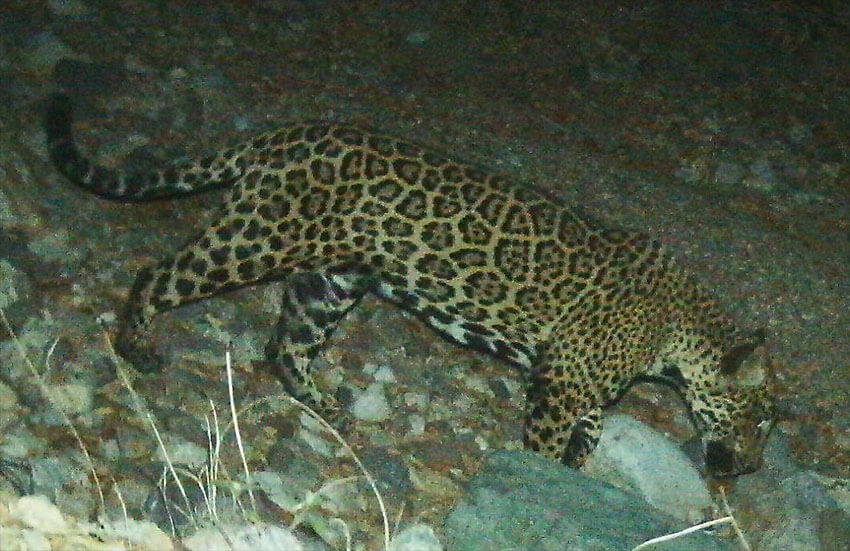
His name is “El Jefe” and he crosses the U.S.-Mexico border at will. Not only that, but his arrival sometimes sparks a celebration — be it in Arizona or in Sonora. Doesn’t matter. People love him on both sides.
His age is believed to be 12 years, maybe older.
And he doesn’t mind being photographed.
“El Jefe” is a jaguar who comes and goes as he pleases, infiltrating a border lined partially by a wall and other infrastructure to stop drug traffickers and migrants. He was first photographed in 2011 by a hunter southeast of Tucson, Arizona, after which he gained celebrity status as the only known U.S. jaguar. A local school named him “El Jefe” (“The Boss”), and he even has his own Wikipedia entry.
Motion sensor cameras captured the same jaguar again in 2012 and 2015 (a jaguar’s spots serve as a unique indicator), and now he’s believed to be one of the oldest jaguars on record along the border area. The average lifespan for such an animal falls between 12 and 15 years.
Conservationists don’t know how many jaguars there are in the Sierra Madre Occidental, which runs through northwestern and western Mexico and along the Gulf of California.
But 176 have been identified over two decades by the Northern Jaguar Project — and only two others besides “El Jefe” are known to have crossed the border.

That’s according to Juan Carlos Bravo of the Wildlands Network which, along with NJP and six other groups, is part of Borderlands Linkages, a binational initiative working for the conservation of this species, the northern jaguar.
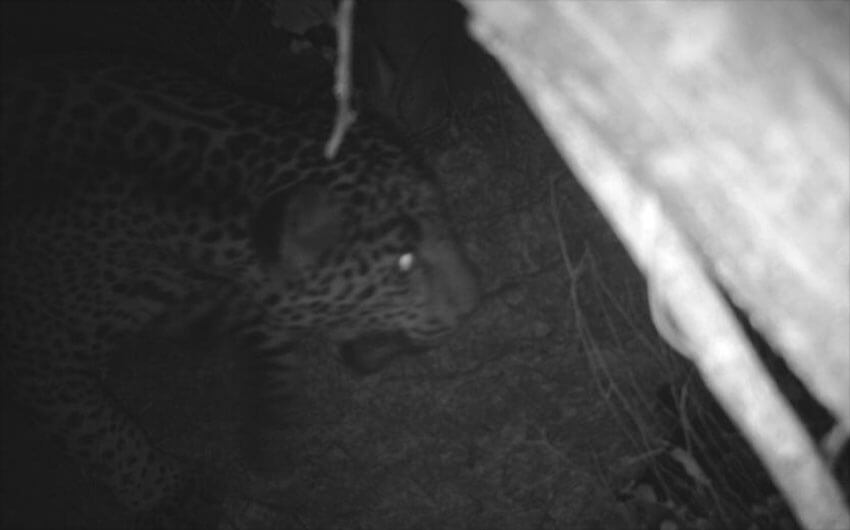
In November 2021, another group in the coalition, Profauna, took a picture of a jaguar in Sonora that was later confirmed to be “El Jefe.” It was approximately 200 kilometers (120 miles) away from where his photos had previously been taken.
Conservationists reportedly were stunned.
The discovery meant not only that jaguars could still cross the border after the Trump administration’s reinforcement and expansion of the wall, but that jaguars that hadn’t been seen for a while could still be alive.
Northern jaguars were thought to have disappeared from the United States toward the end of the 20th century, having been hunted in the Southwest for rewards offered by the government to promote cattle ranching,
These days, jaguar populations are concentrated on Mexico’s Pacific coast, southeastern Mexico, Central America and central South America. A sighting of jaguars in the U.S. in 1996 prompted studies that found a reproductive point in the center of Sonora (where “El Jefe” was photographed nine months ago).
In recent years, non-governmental organizations on both sides of the border have banded together to track the big cats, create sanctuaries, understand more about them and seek the support of landowners to protect them, Bravo said.
Motion-sensor cameras have been placed in various areas, but this isn’t always easy for conservationists on the Mexican side due to drug cartels.
“There is a presence of armed groups and drug traffickers” who pass through the same isolated areas as the jaguars, Bravo said. “It is important to move carefully [and] work with the people in the communities that tell us where not to go. … All of this [makes it] very, very complicated.”
And then there’s the border wall, along with light towers and roads used by the Border Patrol, all of which are impediments not only for jaguars but also the American antelope, the black bear and the Mexican wolf, Bravo said.
Jaguar, by the way, is a cognate — a word that is the same (or very similar) in two languages. It’s spelled “jaguar” in both idiomas, though the pronunciation in Spanish (ha-gwar) is different than in English (jag-wahr, or sometimes jag-wire).