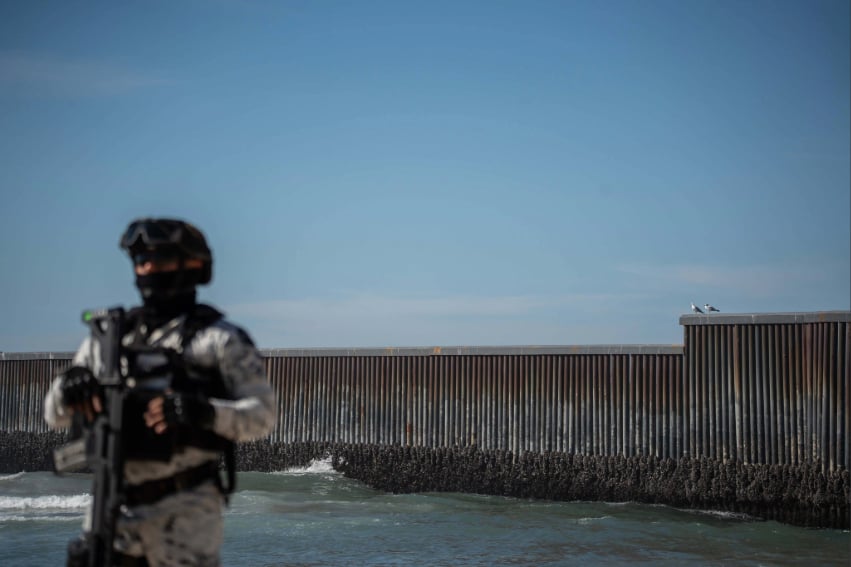
After receiving information from U.S. officials, the Mexican Army successfully deactivated a drone that crossed the border into Tijuana and arrested the operator in Mexican territory.
The Defense Ministry (Defensa) on Thursday provided details of the Monday operation, explaining that the drone was being used by a criminal group to monitor human trafficking routes.
En Tijuana, Baja California, como parte de la “Operación Águila Alta” y mediante el intercambio de información con autoridades de Estados Unidos, elementos de @Defensamx1 detectaron e inhibieron un dron utilizado por un grupo delictivo para vigilar rutas destinadas al tráfico… pic.twitter.com/xiRtDrlljY
— Gabinete de Seguridad de México (@GabSeguridadMX) September 18, 2026
The drone operator was apprehended and found to be in possession of a handgun, ammunition and the aircraft control system.
Defensa said the Tijuana operation resulted from information-sharing with U.S. Customs and Border Protection (CBP) after its representatives met with CBP agents in the border city.

On Friday, Defense Minister General Ricardo Trevilla confirmed that four drones have been disabled as a result of Operation High Eagle, a joint, binational anti-drone security operation being carried out in the Tijuana-San Diego border area, with each force operating within its own territory.
The current deployment featuring approximately 800 military personnel from both countries encompasses a 5-kilometer area. It relies on ground patrols and the use of anti-drone equipment capable of inhibiting these types of aircraft within a 3-kilometer radius.
Trevilla said representatives from both countries met on Tuesday to assess the results of Operation High Eagle, which was organized after U.S. officials said its agents had shot down more than 300 drones linked to organized crime in the past year.
Defensa said coordination with U.S. authorities aims to strengthen border security under principles of reciprocity, shared and differentiated responsibility, mutual trust and respect for the sovereignty and territories of both countries.
The second phase of the operation, which began on Sept. 7, is scheduled to end on Sept. 21.
On Wednesday, U.S. President Donald Trump acknowledged Mexico’s security efforts but called for greater commitment.
“Mexico’s current investments in its security forces are insufficient to sustain and expand its campaigns against narcoterrorists, their finances and their criminal networks,” Trump said, adding that Mexico must do more to “expose corrupt public officials who have aided and abetted the cartels and betrayed their own country’s security and sovereignty.”
Also Wednesday, Trump sent a document to the U.S. Congress, blaming Mexico for the illicit substances entering the United States.
President Claudia Sheinbaum responded by saying she would like to see a report about what the U.S. government is doing to reduce drug use in its own country and combat drugs and weapons trafficking.
With reports from El País, LópezDóriga.com and El Mañana