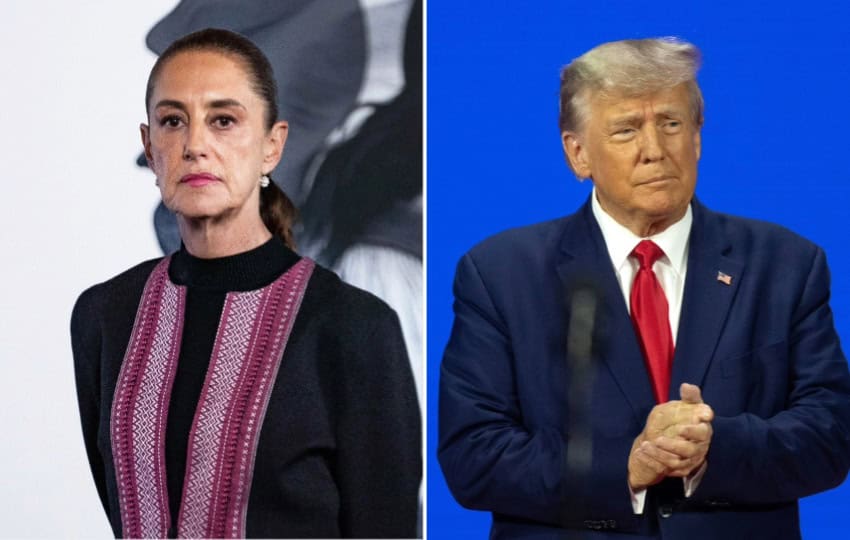
Mexico doesn’t need to be judged “from the outside,” President Claudia Sheinbaum declared Thursday, two days after U.S. President Donald Trump said that “Mexico must take additional action” against drug cartels and arrest “the many corrupt public officials” who have colluded with them.
Responding to a “presidential determination” submitted to the U.S. Congress on Tuesday, Sheinbaum also said she would like to see “a report about what the U.S. government is doing in the United States” to reduce drug use and combat drug trafficking.
La Presidenta @Claudiashein fue contundente: “Podemos cooperar y colaborar, pero las decisiones las toma el pueblo de México y su gobierno, no un país extranjero.
La memoria es el alma de los pueblos y el escudo… Defender nuestra independencia y soberanía es defender a México”. pic.twitter.com/HeNSEpXDwQ— Jesús Ramírez Cuevas (@JesusRCuevas) September 17, 2026
Trump’s remarks on Mexico in the document titled “Presidential Determination on Major Drug Transit or Major Illicit Drug Producing Countries for Fiscal Year 2027” are part of a sustained pressure campaign by the U.S. government aimed at getting the Sheinbaum administration to ramp up the fight against cartels.
Just last week, U.S. Secretary of State Marco Rubio asserted that Mexico isn’t doing “nearly enough” to combat drug cartels, even though he also said, “The Mexicans have done more than they’ve ever done before to go after these groups.”

Rubio suggested that the United States could act unilaterally against such criminal organizations in Mexican territory.
Since Trump began his second term in January 2025, the U.S. government has designated eight Mexican cartels as foreign terrorist organizations. On numerous occasions, the U.S. president has demonstrated his eagerness to combat them with U.S. force, but Sheinbaum is vehemently opposed to any kind of U.S. intervention in Mexico.
Trump urges ‘additional action’ against ‘narcoterrorist organizations that dominate vast areas’ of Mexico
In his presidential determination, Trump identified 23 nations as “major drug transit or major illicit drug producing countries.”
Among those he named were Mexico, China, Colombia, India, Panama and Venezuela.
Trump said that while his administration “has successfully secured our borders from invasion, Canada and Mexico need to do far more to stop the flows of deadly drugs into our country.”
The U.S. president wrote that the United States recognizes the Sheinbaum administration “for seizing greater volumes of drugs, dismantling clandestine laboratories, and deploying additional law enforcement and military resources to our shared border.” He also noted that “United States-Mexican security cooperation has helped eliminate some of the world’s most notorious cartel bosses, including ‘El Mencho.'”
“However,” Trump added, “Mexico must take additional action against the narcoterrorist organizations that dominate vast areas of its territory and continue to threaten the American people.”
Trump also said that “Mexico needs to bolster supply chain integrity by soliciting greater private industry participation and significantly increasing inspections at its ports of entry” — among which are Pacific coast seaports, where Chinese precursor chemicals used to manufacture fentanyl are known to enter the country.
“Canada and Mexico need to do far more to stop the flows of deadly drugs into our country.”https://t.co/4WlUMSoEbM
— Gabriela Siller Pagaza (@GabySillerP) September 16, 2026
“Additionally, Mexico’s current investments in its security forces are insufficient to sustain and expand its campaigns against narcoterrorists, their finances, and their criminal networks,” he wrote.
“This includes exposing, arresting, and prosecuting the many corrupt public officials that have aided and abetted the cartels and betrayed their own country’s security and sovereignty.”
Among the officials U.S. authorities would like to see arrested is Sinaloa Governor Rubén Rocha Moya, who is accused by U.S. prosecutors of drug trafficking in league with the Sinaloa Cartel.
Rocha is on leave as governor, but remains a free man, having thus far avoided arrest and extradition to the United States. Mexican authorities say that U.S. prosecutors have not provided evidence that warrants the arrest of the governor, a representative of the ruling Morena party.
Sheinbaum: ‘We know what Mexico’s problems are’
Asked about Trump’s “presidential determination” at her Thursday morning press conference, Sheinbaum’s initial response was to say that she would like to see “a report about what the U.S. government is doing in the United States” to reduce drug use.
“What’s being done about [drug] use?” she asked.
“… From our point of view, it’s a public health issue,” Sheinbaum said.
She acknowledged that her government has to work to combat the production of drugs in Mexico and their illegal shipment to the United States, but stressed that U.S. authorities also have a responsibility to combat drug use and narcotics distributors in the U.S.
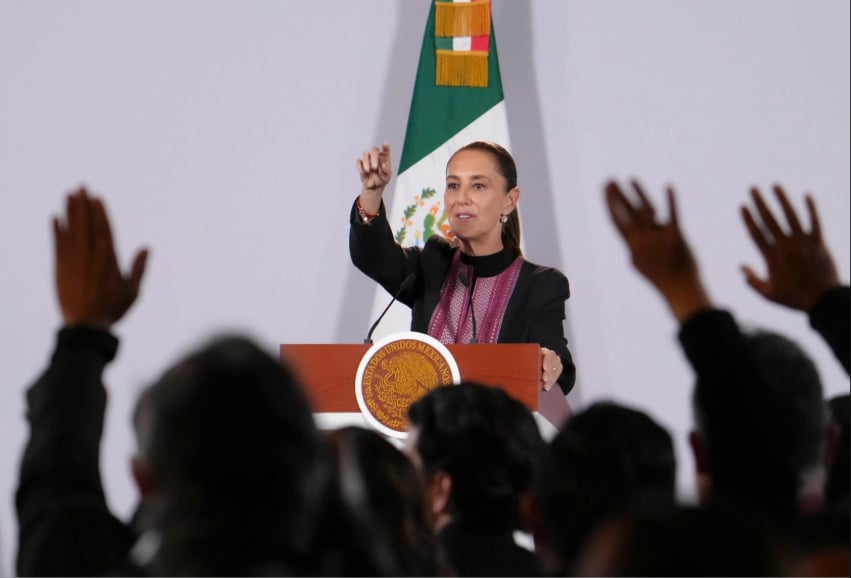
“Where is the effort being made to stop drug cartels and distributors in the United States? What’s going on with money laundering in the United States?” asked Sheinbaum, suggesting that the U.S. government should do more to combat criminal threats in its own territory.
“… In Mexico, we’re acting,” she said.
“… But what’s happening on the other side? … What’s happening with the weapons that come to Mexico from the United States? Yes, there have been arrests, there have been seizures [of firearms], but you couldn’t explain the firepower of organized crime in our country without [talking about] the illegal transit of weapons from the United States to Mexico,” Sheinbaum said.
She went on to say that “we don’t need to be judged from the outside” — a barb directed at Trump and other U.S. officials.
“We know what Mexico’s problems are and we act [against them] every day,” Sheinbaum said.
“… We’re subject to public scrutiny every day and we provide results every day,” she added.
“But what’s happening over there? I would like to see a report from the [U.S.] government itself about the results over there and what they’re doing,” Sheinbaum said.
In February 2025, Trump said he had spoken to Sheinbaum about Mexico’s anti-drugs advertising campaign, which specifically warns against fentanyl use, and pledged that the U.S. government would launch its own anti-drugs campaign “with $100 million and then another $100 million initially.”
An advertising campaign titled “Make America Fentanyl Free” was subsequently launched, but it was funded privately rather than with public money. In late 2025, the U.S. Drug Enforcement Administration — which often reports on drug seizures and drug-related arrests — launched a separate “Fentanyl Free America” initiative, described as “a comprehensive enforcement initiative and public awareness campaign aimed at reducing both the supply and demand for fentanyl.”
By Mexico News Daily chief staff writer Peter Davies (peter.davies@mexiconewsdaily.com)