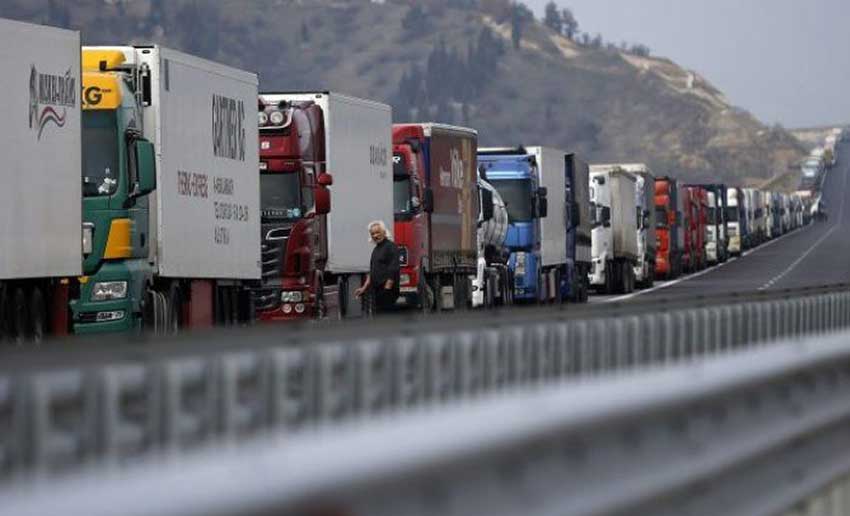
Trucks and cars continue to face excruciatingly long wait times at border crossings between Mexico and the United States despite the implementation of measures aimed at easing the congestion.
There have been long delays at most ports of entry over the past week following a decision by United States Customs and Border Protection (CBP) to reassign 750 border officials to deal with a massive influx of migrants.
United States President Donald Trump repeatedly threatened to close the border completely if Mexico and the U.S. Congress didn’t act to respectively stem migration flows and enforce tougher security measures at the border.
Although Trump pulled back on the threat Thursday, stating that he was giving Mexico “a one-year warning” to stop drug and migration flows, Mexican companies are still rushing to get cargo into the United States “in case of a shutdown,” the news agency Bloomberg reported.
The resultant surge in traffic has also contributed to the long delays at the border as have more exhaustive vehicle inspections by United States officials.
“The shippers try to push as much freight as possible and, at the same time, you have fewer officers,” said Ben Enriquez, senior vice-president of Transplace, a Texas-based provider of transport management services.
“So, it’s not a good combination,” he explained.

Wait times at border crossings in Nuevo Laredo, Tamaulipas, and Tijuana, Baja California, among other locations, have been as much as 10 hours longer than usual, Bloomberg said, while the newspaper Reforma reported delays as long as 20 hours between Ciudad Juárez, Chihuahua, and El Paso, Texas.
In Tamaulipas, the World Trade International Bridge, a commercial traffic-only crossing that connects Nuevo Laredo to Laredo, Texas, is now opening half an hour earlier than normal but the measure has failed to prevent long lines of trucks from forming.
Diverting traffic to the nearby Laredo-Colombia Solidarity and Rio Grande City-Camargo International bridges has done little to ease congestion either, truck drivers say.
Re-routing trucks at other congested ports of entry across the 3,145-kilometer-long border between Mexico and the United States is not currently worthwhile because almost all crossings are facing similar situations.
President Trump acknowledged Saturday that the redeployment of CBP agents was causing “commercial and traffic delays” at the border, writing on Twitter that they will continue “until such time as Mexico is able to use its powerful common sense immigration laws to stop illegals coming through Mexico into the U.S.”
He added: “Until Mexico cleans up this ridiculous and massive migration, we will be focusing on border security, not ports of entry.”
While the United States has not yet seen a significant shortage of imports from Mexico, prices for one of the most popular products – Mexican avocados – have soared amid Trump’s border shutdown threats.
Thousands of trucks have been stranded at the border since early last week, generating multi-million-dollar losses daily for Mexican companies.
Unable to make timely deliveries to clients in the United States, some firms have begun sending their goods by air.
The Ciudad Juárez branch of the National Chamber for Industrial Transformation (Canacintra) said in a statement that businesses have begun using air charter services to transport goods from Ciudad Juárez to Santa Teresa, New Mexico – a distance of less than 40 kilometers.
The average cost per pallet is US $2,000, Canacintra said, meaning that contracting a Boeing 737, in which up to 25 pallets can fit, costs up to US $50,000.
Other companies have decided to make use of the border crossing between Palomas, Chihuahua, and Columbus, New Mexico – around 150 kilometers west of Ciudad Juárez – but doing so is risky due to the presence of criminal groups in the area that extort or attack the trucks, Canacintra said.
If the delays at the border continue, there will be “grave consequences” for the economy, the organization warned, adding that an interrupted supply of medical products to the United States could even place people’s lives at risk.
President López Obrador has largely avoided responding to Trump’s threats but last week he said that “the closure of borders is not in the interest of anyone” and pledged to continue to cooperate with the United States to stop large flows of migrants traveling through Mexico to the northern border.