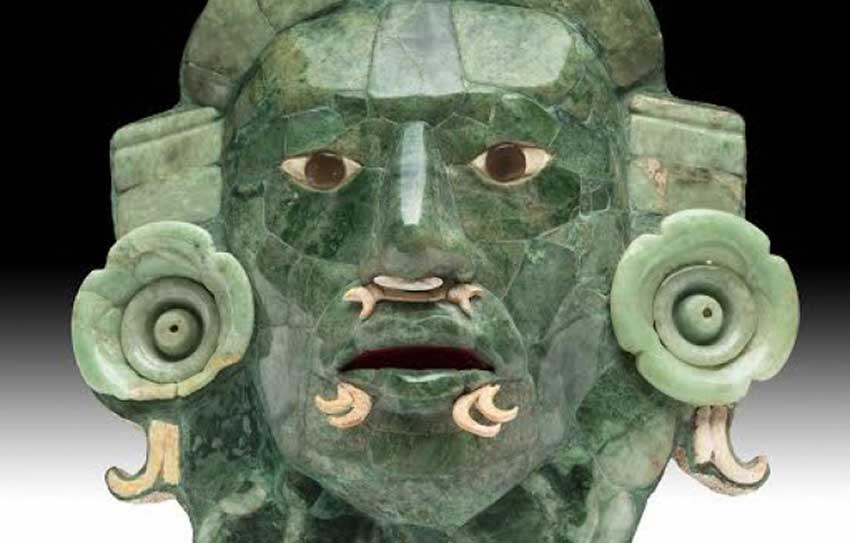
The Calakmul jade mask, an iconic and representative object of the Mayan culture, has returned after 14 years to Campeche, where it will be on permanent display.
The jade mosaic mask had spent the last eight years traveling around the world as part of an exhibit of Mayan artifacts, and as an ambassador of Campeche and Mexico.
During the previous six years it was on loan to other cultural institutions.
“The mask had been on loan for 14 years in places around the world, and it finally is back in Campeche,” said Claudia Escalante Díaz, director of museums in Campeche for the National Institute of Anthropology and History (INAH)
First discovered in 1984, the jade mask was part of the offerings left in the richest burial area in Calakmul, dedicated to King Yuknoom Yich’aak K’ak’, the last Mayan warrior king.
It was one of a set of 10 found in the tomb, along with other offerings that included jade ear ornaments, shell and bone beads, spiny oyster shells, eccentric obsidian blades, fine ceramics and the remains of wooden objects.
The burial of the king has been dated to the eighth century AD, and the presence of jade items has allowed archaeologists to theorize about the trading relationships the people had at that time.

The well-traveled mask is to be permanently displayed in the Museum of Mayan Architecture, housed in the Baluarte de la Soledad, an 18th-century fortification and the most important on the four gateways of the walled city of Campeche, called Puerta de Mar.
Source: Noticieros Televisa (sp)