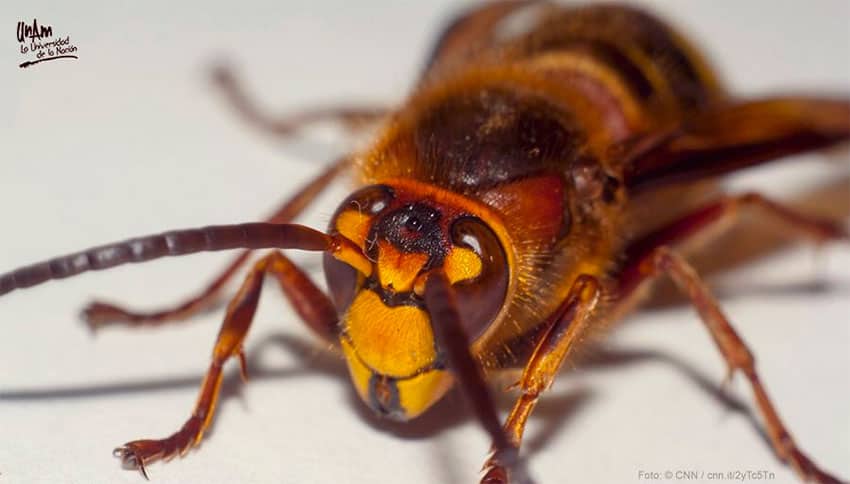
The killer hornets that have been sighted in the western United States and Canada will not make their way to Mexico, according to a biologist at the National Autonomous University (UNAM).
Entomologist Alejandro Zaldívar Riverón said that the insect has not even established itself in the two countries to the north, and there is reason to fear it might come down to Mexico.
“It’s ridiculous to suppose that it would travel south and arrive in Mexico,” said the hornets, bees, wasps and ants specialist.
He said the reports of killer hornets in the United States were mere isolated incidents of specimens that made their way across the Pacific in merchandise shipped from Asia.
Alarm arose when a nest of killer hornets was found on Vancouver Island, Canada, but it was immediately destroyed, and Zaldívar called the fears of its proliferation unfounded, as are any that it could migrate hundreds of miles south.
“We must not forget that every animal and plant species has certain ecological requirements, and according to the environmental characteristics of the areas where this hornet is naturally distributed, it’s unlikely that it will establish itself in Canada or the northern United States, and later cross arid zones and deserts before arriving in our territory,” he said.
This particular species, like the over 20 other species in the genus Vespa, is naturally distributed in subtropical zones in Asia and a few in Europe.

One note in news reports has been that the large hornets are predators that appear to have a sweet tooth for honeybees, which are the primary pollinators in most ecosystems.
Zaldívar called for people not to panic and, above all, not to kill regular honeybees out of unfounded fears of killer hornets.
Source: Reporte Índigo (sp)