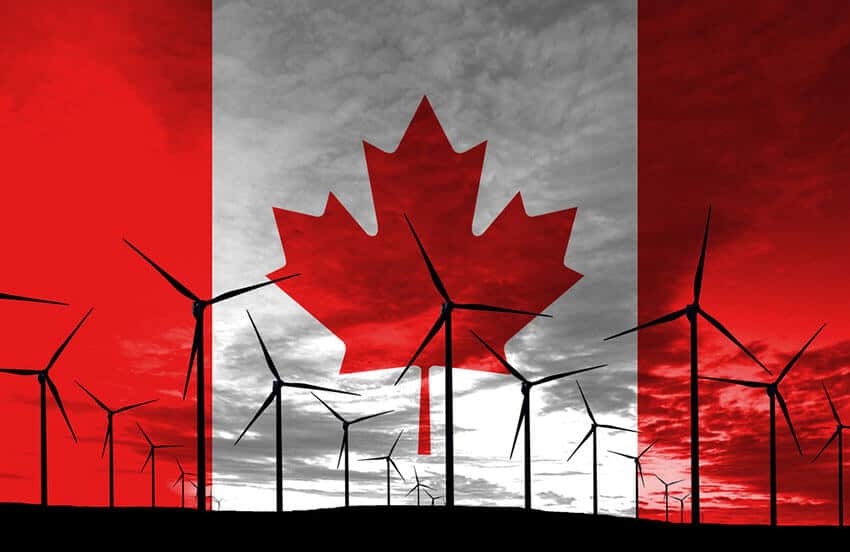
Canada has joined the United States in seeking dispute settlement consultations with Mexico over its energy sector policies that favor state-owned firms over private and foreign companies.
United States Trade Representative Katherine Tai announced Wednesday that the U.S. had requested consultations under the United States-Mexico-Canada Agreement (USMCA), the free trade pact that took effect in 2020.
“We have repeatedly expressed serious concerns about a series of changes in Mexico’s energy policies and their consistency with Mexico’s commitments under the USMCA,” she said.
Later on Wednesday, Canada’s International Trade Ministry told Reuters that it too was launching energy consultations with Mexico and “supporting the U.S. in their challenge.”
“Canada has consistently raised its concerns regarding Mexico’s change in energy policy. We agree with the United States that these policies are inconsistent with Mexico’s USMCA obligations,” Alice Hansen, a spokeswoman for International Trade Minister Mary Ng, said in a statement.
Both the United States and Canada are particularly concerned about the Electricity Industry Law (LIE), which gives power generated by the state-owned Federal Electricity Commission (CFE) priority on the national grid over that produced by private and renewable energy companies.
Mexico’s Economy Ministry (SE) on Wednesday acknowledged that it had received consultation requests from both the U.S. and Canada. In a statement, the SE said that Canada’s request related to the LIE. “The consultations [requested] constitute the non-litigious stage of the general dispute resolution … [in] USMCA,” it said.

The SE noted that there is a 75-day window to reach resolution during that stage and that if a “mutually satisfactory agreement” isn’t reached, Canada could seek the establishment of a dispute panel. “The consultations request presented by the government of Canada contains certain common elements with the request presented by the United States,” the ministry said, adding that Mexico will “seek to maintain a coordinated process with both USMCA trade partners.”
“… The government of Mexico expresses its willingness to reach a mutually satisfactory agreement during the consultation stage,” the SE said. If an agreement isn’t reached with Canada and the United States, those countries could impose tariffs on Mexican imports.
President López Obrador, who on Wednesday mocked the United States’ challenge by playing a popular song called Oh, How Scary, said Thursday that the challenges launched by Mexico’s North American trade partners could be politically motivated. “It’s a kind of political sanction, we’ll defend ourselves,” he told reporters at his regular news conference.
“I have evidence that this has to do with vested interests because they dedicated themselves to looting Mexico and as they were stopped they started to do work in the United States and they achieved this. But if there’s no reason [for the challenge], we’re not going to remain with our arms crossed,” López Obrador said. “I sense that it’s a political issue.”
The president, a staunch energy nationalist, stressed that Mexico has the right to define its own energy policies. “We can have trade relations but we define [domestic] policies in Mexico,” López Obrador said. “We’re not going to put Mexico’s control over [its own] oil up for negotiation,” he added. AMLO stressed that Mexico wouldn’t allow the United States and Canada to impose the policies they want to benefit companies from those countries.
“We establish the agenda now, we govern according to the development plan we sent to Congress and which was approved by the legislative power,” he said, asserting that the government doesn’t act on the recommendations of the International Monetary Fund, the World Bank or “any foreign government.” He also told reporters that he had asked former trade negotiator Jesús Seade – currently Mexico’s ambassador to China – to assist Mexico’s defense of its energy policies, which are largely designed to bolster the CFE and state oil company Pemex.
In addition, López Obrador took the opportunity to rail against the previous government, which opened up Mexico’s energy sector to private and foreign companies. The government led by Enrique Peña Nieto put Mexico’s oil on the negotiating table, completely destroyed the CFE and handed over the electricity market to private companies, he said.