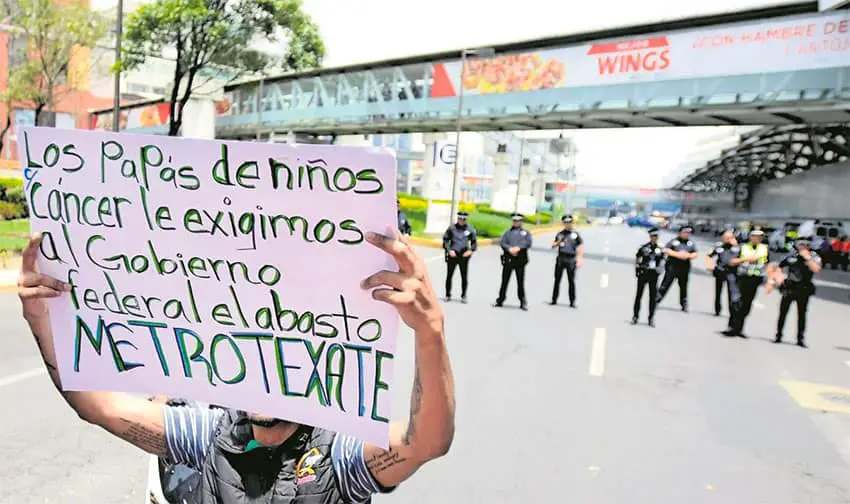
Parents of children with cancer have rejected President López Obrador’s claim that the federal government has brought an end to shortages of medications in the public health system.
The president said on Monday that his administration has bought medications in foreign countries whereas it wasn’t able to do so when he took office in late 2018.
“Medications have been bought abroad. … This decision was taken because when we came into the government, there were 10 companies that monopolized all sales of medications to the government, 10 companies. I remember there were three [companies] that sold about 80 billion pesos [worth of medications] to the government, … distributors; they weren’t even pharmaceutical companies, [they were] companies that were closely linked to politicians that dedicated themselves to selling medications at extremely high prices,” López Obrador told reporters at his morning news conference.
“Medications couldn’t be bought abroad. There were decrees, laws that prevented it. We resolved that in order to buy medications in any country of the world, only making sure that they were good, high-quality medications at a good price and that there was no corruption,” he said.
“We established an agreement with the United Nations, with UNOPS [the United Nations Office for Project Services], so that this institution would help us with the brokering with the world’s large pharmaceutical companies in order to make the purchases. … And now contracts have been signed, and we’re buying medications in better conditions.”
López Obrador went on to claim that there is a reliable supply of medications thanks to the collaboration with the UN.
“We went through very difficult situations because those who controlled the sale of medications, these monopolies linked to politicians, carried out actions of sabotage and a media campaign against the decisions we took. But it was the only way to guarantee that there was no shortage of medications, the only way,” he said.

“… [It was] a very painful situation. Imagine facing up to complaints from parents with children who are sick with cancer, to accusations that we weren’t attending to them and that there were no medications. In effect, there was a shortage of medications at the start [of my government] because there was sabotage,” López Obrador said.
Later on Monday, two associations of parents of children with cancer and the Cero Desabasto (Zero Shortage) collective, a group that monitors the availability of medications in the public health system and pressures the government to keep up the supply, issued a statement challenging the president’s claim that shortages have come to an end.
The shortages are well-documented on the Cero Desabasto website, the statement said. The collective’s most recent report, delivered to the federal government at the start of the year, clearly documents “the serious problem of the shortage of medications” in the public health system, it added.
The parents of cancer patients rebuked López Obrador for refusing to meet with them despite their repeated requests.
“Mr. President, you have never listened to us. You have never deigned to set foot in a hospital where children with cancer are treated. On the contrary, you have used all the power of the state to defame us and intimidate us; for this reason, with active indignation, we say to you that you lie … by asserting that everything is OK with respect to the supply of medications,” the statement said.
“First of all, Mr. President, we say to you that the victims are our children, who have been left without medicines,” the parents said, adding that the consequences for many young cancer sufferers have been “grave.”
Parents of children with cancer have protested on numerous occasions against the shortage of essential drugs and the deaths of some young cancer sufferers have been attributed to the lack of supply.
The newspaper Reforma reported in late March that medication shortages were still plaguing Mexico eight months after the government signed the agreement with UNOPS to collaborate on the international purchase of medicines, medical supplies and vaccines. Cero Desabasto said at the time that there were supply problems with one of every four medications the government purchased in 2020.
Source: El Universal (sp)