



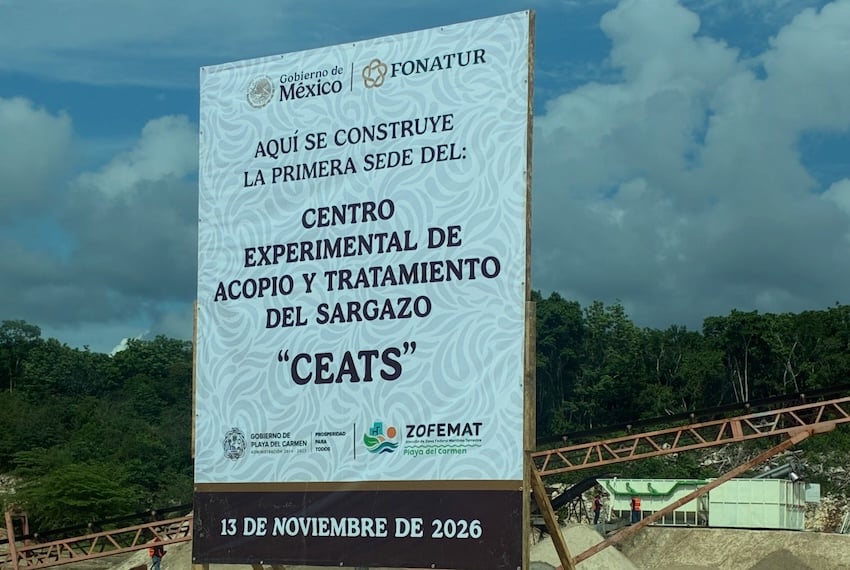
Mexico’s first Experimental Center Sargassum Collection and Treatment (CEATS) will be developed in the Caribbean beach town of Playa del Carmen in Quintana Roo, with the aim of finding innovative ways to tackle increasing arrivals of sargassum in high-tourism-value areas.
Playa del Carmen’s mayor, Estefanía Mercado, announced that CEATS will be developed by the National Fund for Tourism Development (Fonatur), in coordination with the Quintana Roo State Government and the Playa del Carmen City Council, with operations expected to commence in the first half of 2027.
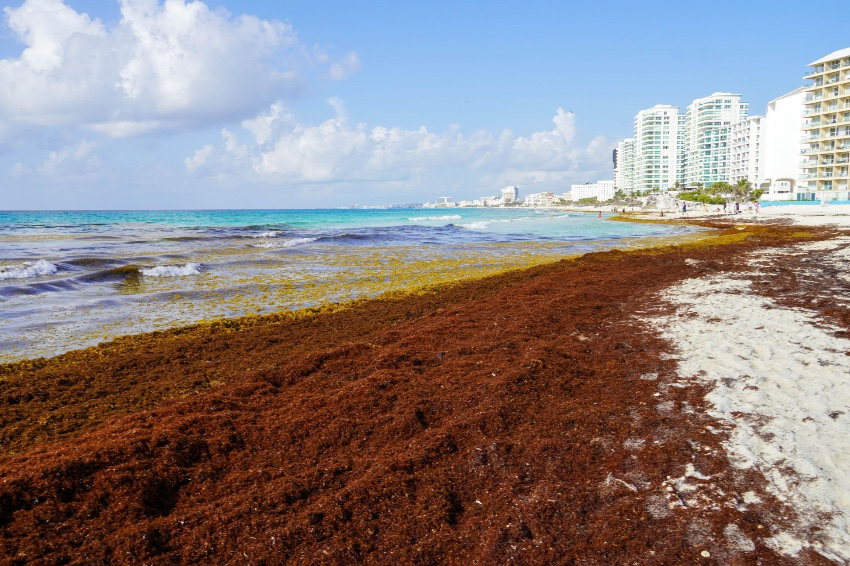
The federal government has earmarked more than 2.6 billion pesos (US $135.8 million) to confront the problem, with part of the funding going toward the development of the center. The investment follows a record season in which 162,226 metric tonnes of sargassum were cleared from Quintana Roo’s beaches between April and November, more than double the 85,000 tonnes recorded in 2025.
The center will study the collecting, separating and processing of the algae to explore alternative uses. Authorities say the goal is to limit environmental damage and prevent the loss of sand that results from conventional cleanup methods along the state’s coastline.
Mercado emphasized that the initiative was the result of coordination between President Sheinbaum and the Governor of Quintana Roo, María Lezama Espinosa. She said that if CEATS proves to be successful, the technologies and solutions could be deployed in other sargassum-prone areas.
This year, in Playa del Carmen alone, officials collected 55,378 tonnes of sargassum. Local media sources reported that around 4.3 billion pesos (US $231 million) were allocated to cleanup efforts across the state, carried out by hoteliers and all three levels of government.
“Protecting our beaches also means protecting the livelihoods of thousands of families and the future of Playa del Carmen,” Mercado wrote on her official social media pages on Nov. 16.

With reports from Quadratín Quintana Roo