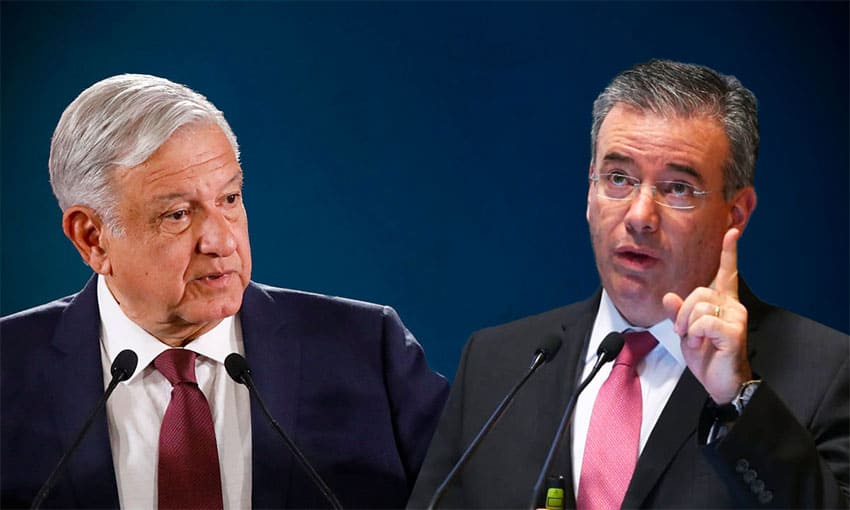
The governor of the central bank has rejected an insinuation by President López Obrador that he approved a suspicious, potentially corrupt loan while head of the state-owned development bank Bancomext.
López Obrador on Wednesday called for an investigation into loans that Bancomext and the development bank Nacional Financiera provided to Pemex during the previous government.
The president said the loans partly financed the state oil company’s US $635-million purchase in 2015 of a fertilizer plant in Lázaro Cárdenas, Michoacán. The Federal Auditor’s Office concluded last year that the price Pemex paid to the plant’s owner, Grupo Fertinal, was excessive.
López Obrador said the purchase was made when Bank of México (Banxico) Governor Alejandro Díaz de León was the director of Bancomext.
But Díaz said at a press conference on Wednesday that he wasn’t director of the development bank when the loan was approved in October 2015, pointing out that he joined Bancomext a month later.
“Those are things that were approved by the Bancomext governing body prior to my arrival at that institution,” he said while presenting the central bank’s latest quarterly report.
Díaz told a Bloomberg reporter that he appreciated the question about López Obrador’s remarks “because it allows me to clarify this.”

Several leading financial figures also defended the Banxico chief, including Gerardo Esquivel, a member of the central bank board, who described Díaz’s explanation as a “very important clarification.”
Gerardo Rodríguez, a BlackRock portfolio manager and former deputy finance minister, wrote on Twitter, “In all of Mexico, you won’t find a more honorable official than the current governor of Banxico.”
Díaz’s predecessor at Bancomext was Enrique de la Madrid, who left the bank in August 2015 to take up the role of federal tourism minister.
López Obrador also mentioned his name when calling for an investigation into the Bancomext and Nacional Financiera loans.
The president rebuked former Pemex CEO Emilio Lozoya, currently awaiting trial on corruption charges, for not providing information about the purchase of the Fertinal plant in a document he submitted to the federal Attorney General’s Office (FGR) earlier this month.
Lozoya, extradited from Spain last month, has agreed to cooperate with authorities and has been afforded protected witness status.
In an August 11 submission to the FGR, he accused three ex-presidents as well as former government ministers and federal lawmakers of corruption, much of which was allegedly linked to the payment of bribes by Brazilian construction conglomerate Odebrecht.
López Obrador said Wednesday that it was “inexplicable” that Lozoya remained silent on the Fertinal plant purchase given the excessive price that was paid.
“They [Pemex] paid about 9 billion pesos. … Do you know who gave them the loans? The Nacional Financiera and the Exterior Commerce Bank [Bancomext],” he said.
López Obrador charged that the purchase of the fertilizer plant is a worse example of corruption than Pemex’s acquisition of another fertilizer plant in Veracruz, for which it also allegedly paid an inflated price.
The FGR needs to get to the bottom of the matter, he said.