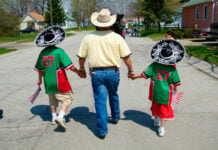
Children – the vast majority of whom have not had access to vaccination against COVID-19 in Mexico – will be exempt from a United States rule requiring incoming travelers to be fully vaccinated.
Starting November 8, all foreign adults seeking to enter the United States must provide proof that they are fully vaccinated with a vaccine approved by the World Health Organization (WHO).
People aged under 18 are among a range of groups that are exempt from the rule, the U.S. government said Monday. Others include people who couldn’t be vaccinated for medical reasons and nationals of about 50 countries where access to vaccines is extremely limited.
About four in five Mexican adults have received at least one vaccine dose, but the federal government hasn’t offered shots to most youths aged 12–17, even though the Pfizer vaccine is approved for use with that age group. It has, however, begun inoculating adolescents with underlying health conditions that place them at risk of serious COVID-19 illness. The government has also vaccinated minors who obtained injunctions ordering their vaccination.
Foreign adults seeking to enter the United States from November 8 will be required to show proof of their vaccination in digital or paper form, according to White House officials cited by the newspaper Reforma. For Mexicans, that will mean presenting their government-issued COVID-19 vaccination certificate, provided they were vaccinated with a WHO-approved vaccine.
Five of the seven vaccines that have been used in Mexico are WHO-approved, but the Sputnik V and CanSino shots are not. President López Obrador last week criticized the WHO for its tardiness in approving those two shots, describing the organization as inefficient and indolent.
On the same day that the United States’ new entry requirement takes effect, the country’s northern border will open to nonessential travelers. People crossing into the U.S. by land will also have to be fully vaccinated, but unlike air travelers, they won’t have to show proof of a negative COVID test result obtained in the previous 72 hours.

In other COVID-19 news:
• The Health Ministry reported 1,121 new cases and 150 additional COVID-19 deaths on Monday. Mexico’s accumulated tallies are currently 3.78 million and 286,96, respectively. Estimated active cases number 26,719.
• More than 117.2 million vaccine doses have been administered in Mexico after almost 780,000 shots were given Monday. Deputy Health Minister Hugo López-Gatell said on Twitter that the vaccination of adults will conclude on Friday.
• López-Gatell told the president’s morning press conference on Tuesday that coronavirus infections among children have not increased since schools reopened at the end of August. Case numbers among minors have in fact been going down, he said.
“We have a sustained reduction [in case numbers] as we’ve had for the entire population,” the deputy minister said.
He also said that outbreaks have only been detected in 0.15% of schools. “In general they have impacted just one group [of students] without the disease COVID-19 spreading to the rest of the school,” López-Gatell said.
“In schools local control [of the spread of the virus] has been shown to be possible with timely actions,” he wrote on Twitter.
With reports from El Universal and Reforma