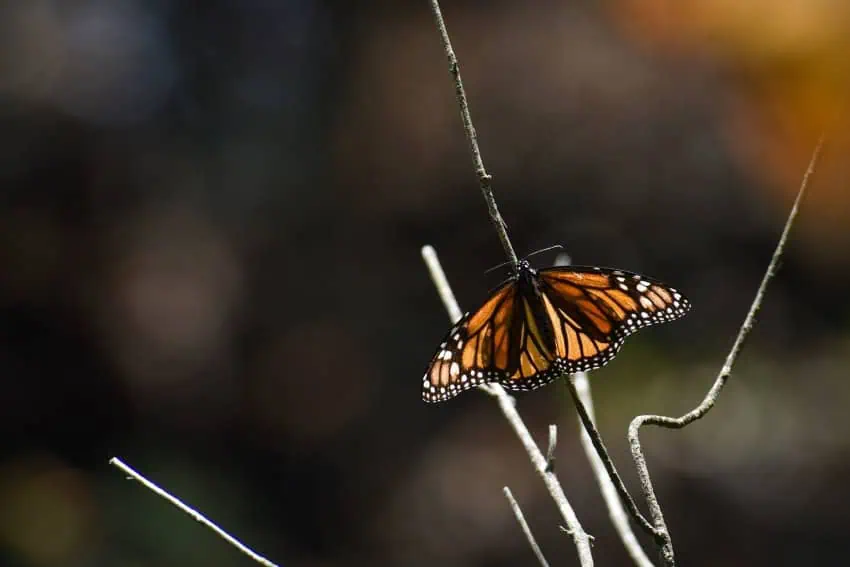
The community organization Alas Mayas (Mayan Wings) has detected a new migratory route for the monarch butterfly that crosses the Yucatán Peninsula, reaching Quintana Roo.
In collaboration with the researcher Dr. Cristina Dockx, Alas Mayas conducted community monitoring for six years, during which they found that the monarch butterfly not only transits but also breeds in the northeast of the peninsula. This was particularly noteworthy on Isla Mujeres, where monarch butterflies have been observed at all stages of development: egg, larva, chrysalis and adult.
During this time, the group recorded more than 300 specimens in San Juan del Río, Yucatán, and nearly 100 in Cacao, Quintana Roo, supporting the hypothesis that this region is part of a new migratory route connecting the United States, Cuba and southeastern Mexico.
The group also revealed they successfully tracked a monarch butterfly with a transmitter for the first time in the Ría Lagartos Biosphere Reserve.
Unlike the forest sanctuaries in Michoacán, where the monarch butterfly migrates annually to hibernate, researchers believe Quintana Roo functions as a natural bridge: butterflies arrive in Florida, cross the Caribbean islands and enter the Peninsula following a route that has been little explored until now.
This Caribbean connection demonstrates that their migration is much more extensive and complex than previously believed.
Northern states welcome first waves of migrating monarchs

“The topic of the monarch butterfly here on the Yucatán Peninsula is a novel one that can help raise awareness, so people can learn about them, observe them and wait for them,” Dockx said. “And in the case of Isla Mujeres during the breeding season, learn about them, protect them, conserve them and get people involved, even potentially triggering a (sighting) season like that of the whale shark or the tern,” she said.
As part of their research strategies, the scientists used traditional tagging methods alongside tiny solar-powered transmitters for Bluetooth tracking.
These findings have led to the establishment of the Monarch Butterfly Community Monitoring Network in the Yucatán Peninsula, which aims to continue studying this new migration route.
Alas Mayas has called on the general public to engage through citizen observations, photographs and reports on the iNaturalist platform, where data has been collected since 2021 on the Yucatán Peninsula.
With reports from Por Esto!, La Jornada Maya and Heraldo de México