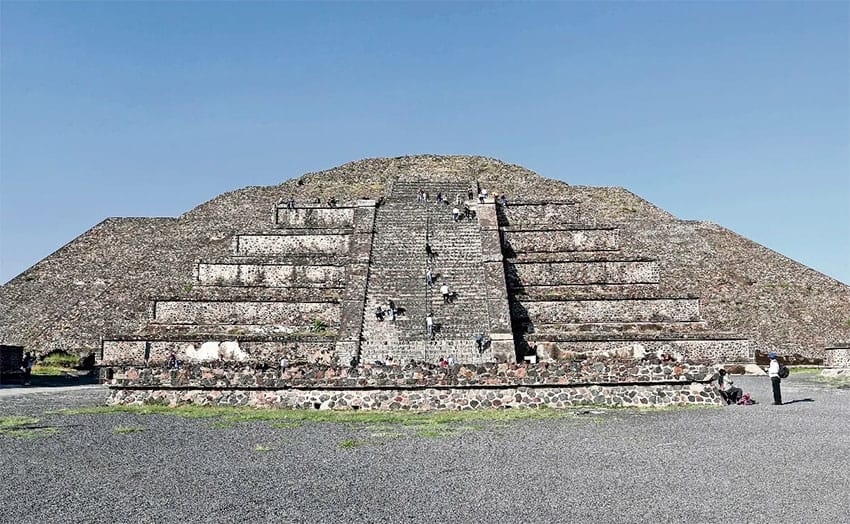
Despite orders to stop illegal construction projects on an outlying section of the Teotihuacán archaeological site in México state, the work continues.
And now the site, renowned for its two large pyramids, is at risk of losing its UNESCO World Heritage designation, according to the International Council on Monuments and Sites (ICOMOS).
In March, the National Institute of Anthropology and History (INAH) suspended projects being built on private land in Oztoyahualco, an area of the archaeological site that is known as the “old city” because it is believed that the Teotihuacán settlement began there.
Just over a month ago, INAH filed a complaint with the federal Attorney General’s Office against the illegal construction projects, one of which is believed to be an amusement park.
But construction work with heavy machinery continues, according to reports by the Reforma and El Universal newspapers.
Now, the Mexico branch of ICOMOS has written to federal Culture Minister Alejandra Frausto and México state Governor Alfredo del Mazo to demand urgent action to stop the work.
Teotihuacán site director Rogelio Rivera Chong said last month that there are bases of some 24 pre-Hispanic structures in the Oztoyahualco area that haven’t been excavated. All construction in zone B of the Teotihuacán site, of which Oztoyahualco is part, is prohibited.

Saúl Alcántara, president of ICOMOS-México told Reforma that if the construction work isn’t stopped, Teotihuacán – Mexico’s most visited archaeological site – could lose its World Heritage status.
In its letter, ICOMOS not only appealed to authorities to “stop the destruction” but also to prosecute those who are responsible for the “destruction and looting of relics of national heritage.”
“It’s very regrettable what’s happening at Teotihuacán, especially in the 21st century when everyone agrees with protecting pristine tangible heritage,” Alcántara said in an interview with El Universal.
He said that if the authorities fail to respond to the ICOMOS letter, the council will ask UNESCO to carry out a “technical mission” to determine whether Teotihuacán should be placed on the list of endangered world heritage sites, which could prompt government action.
“But first we have to exhaust the national authorities,” Alcántara said.
Source: El Universal (sp), Reforma (sp)