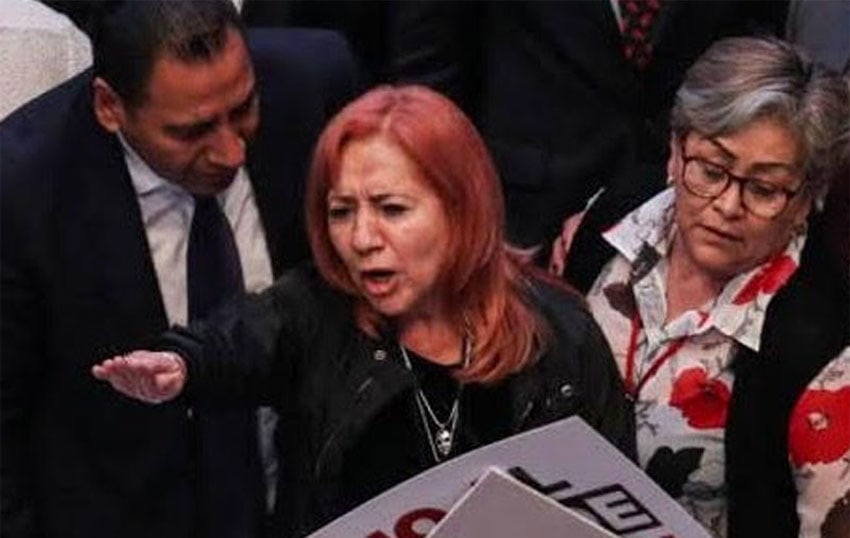
After accusations of a rigged vote and claims that the new head of the National Human Rights Commission (CNDH) would be a puppet of the government, yet more controversy surfaced Tuesday when Rosario Piedra Ibarra indicated she was unaware that any journalists had been murdered this year.
After she was sworn in as CNDH president, Piedra was asked by a reporter about violence against journalists in Mexico.
“This year has been the worst for journalists,” the reporter said to the new rights chief.
“Have journalists been killed?” Piedra asked.
“Haven’t you heard about the murder of journalists?” the reporter responded.
“. . . No, look, I’ve seen what happened in past presidential terms and it’s something terrible,” Piedra said.
According to Periodistas Desplazados México (Displaced Journalists Mexico), 13 journalists have been killed since President López Obrador took office in December.

The NGO announced on Twitter on Wednesday that it had filed a complaint with the commission over which Piedra now presides “for her regrettable responses” about the “grave problem” of murders of journalists in Mexico.
Her remarks are a violation of the human rights of the families of journalists who have been murdered, Periodistas Desplazados said in its complaint.
“[Piedra’s] response provokes a feeling of vulnerability,” the group said, adding that her “ignorance of such a difficult reality . . . generates uncertainty and fear in those who have been victims of attacks . . .”
The organization also said that data shows that Mexico is the most dangerous country in the world for journalists.
Since 2000, 131 have been killed and more than 99% of the murders have gone unpunished, according to the human rights group Article 19.
Periodistas Desplazados said on Twitter that its complaint extended to the Senate for appointing a candidate to the role of CNDH chief who is “clearly not informed about extremely important issues.”
The NGO stopped short of calling for Piedra’s resignation but urged her to offer a public apology and commit to undertaking training about freedom of expression and violence against the press.
Jan-Albert Hootsen, Mexico representative for the Committee to Protect Journalists, said on Twitter that Piedra’s comments were “deeply troubling,” adding that Mexico needs a human rights agency that fully defends the right of journalists to do their job without fear of reprisals.
“I hope that the new chief, Rosario Piedra Ibarra, recognizes the depth of the crisis,” he wrote.
Piedra faced staunch opposition to her election as CNDH president from opposition lawmakers.
National Action Party (PAN) senators charged that the commission’s autonomy would be lost under its new chief, claiming she would be acting under the orders of President López Obrador.
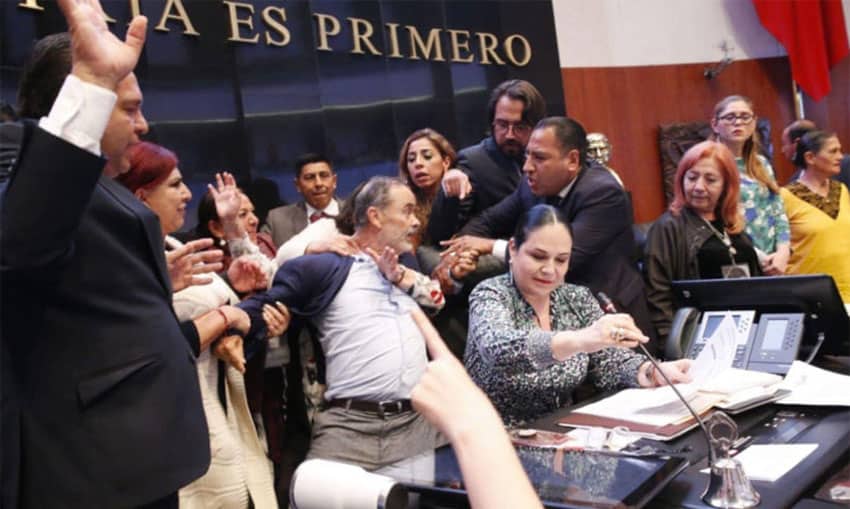
PAN Senator Gustavo Madero attempted to physically stop Piedra from being sworn in on Tuesday while other lawmakers shouted their disapproval and held up signs that read: “No to fraud in the CNDH.”
There were also accusations that the voting was rigged in Piedra’s favor.
Source: El Sol de México (sp), El Financiero (sp), Animal Político (sp), Proceso (sp)