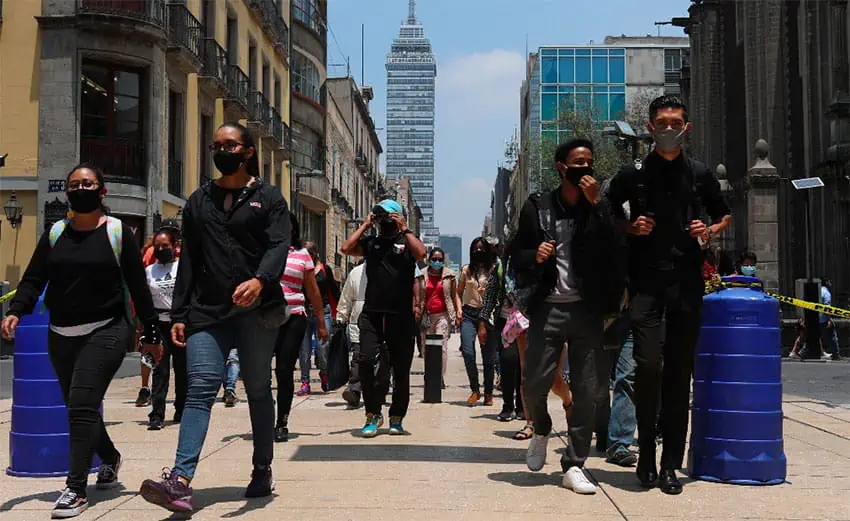
The Mexico City government announced on Sunday that 34 neighborhoods and towns in the capital will be given special attention in order to reduce their high number of active coronavirus cases.
High-risk “orange light” coronavirus restrictions will remain in place in most of Mexico City this week but the 34 areas where 20% of the capital’s active coronavirus cases are located will be painted maximum risk red on the “stoplight” map as of Wednesday.
The Covid-19 hotspots are located across 13 of Mexico City’s 16 boroughs. They are:
- The colonias (neighborhoods) of Olivar del Conde Section 1, Olivar del Conde Section 2 and San Bartolo Ameyalco in the western borough of Álvaro Obregón.
- Aldana in the northern borough of Azcapotzalco.
- Ajusco, Pedregal de Santo Domingo, Pedregal de Santa Úrsula and Adolfo Ruiz Cortines in the southern borough of Coyoacán.
- Doctores and Guerrero in the central borough of Cuauhtémoc.
- Nuevo Atzacoalco in the northern borough of Gustavo A. Madero.
- Lomas de San Lorenzo in the eastern borough of Iztapalapa.
- Cuauhtémoc, San Bernabé Ocotepec, Barros Sierra, La Malinche, El Tanque and Las Cruces in the southwestern borough of Magdalena Contreras.
- Anáhuac and Tlaxpana in the northwestern borough of Miguel Hidalgo.
- The pueblos (towns) of San Salvador Cuauhtenco, San Pablo Oztotepec and San Antonio Tecómitl in the largely rural southeastern borough of Milpa Alta.
- San Francisco Tlaltenco in the southeastern borough of Tláhuac.
- San Miguel Topilejo, El Capulín and San Pedro Martir in the southern borough of Tlalpan.
- The neighborhood of 20 de Noviembre in the eastern borough of Venustiano Carranza.
- The pueblos of San José Zacatepec, San Gregorio Atlapulco, Santa María Nativitas, Santa Cruz Acalpixca, Santiago Tepalcatlalpan and San Lucas Xochimanca in the southern borough of Xochimilco.
The three boroughs with no identified hotspots are Benito Juárez, Cuajimpalpa and Iztacalco.
The Mexico City government said there will be an “intervention” in the 34 “red light” areas aimed at reducing economic and everyday activities, providing support that allows people to stay at home and ensuring that citizens have access to health care.
City officials will go house to house in the identified colonias and pueblos to provide medical advice, carry out health checks and perform Covid-19 tests, while health “kiosks” will be set up in the maximum risk areas for the same purposes.
The government will also carry out information campaigns, including by loudspeaker, that seek to educate residents about coronavirus prevention measures and encourage them to stay at home.

Families with a member who has tested positive for Covid-19 will be provided with food, medical and financial aid and doctors will offer medical advice to patients in home quarantine.
Street markets will be prohibited in the “red light” areas, with stallholders to be offered financial assistance, and authorities will carry out a deep clean of public spaces.
The identified hot spots will keep their designation for at least 15 days, and new entries and omissions to the “red light” list will be announced on Sundays.
Mexico City has recorded 57,674 confirmed coronavirus cases since the start of the pandemic, according to official data, of which 4,477 cases are considered active.
The capital has also recorded 7,657 confirmed Covid-19 deaths although the real number of fatalities is widely believed to be much higher.
Source: El Universal (sp)