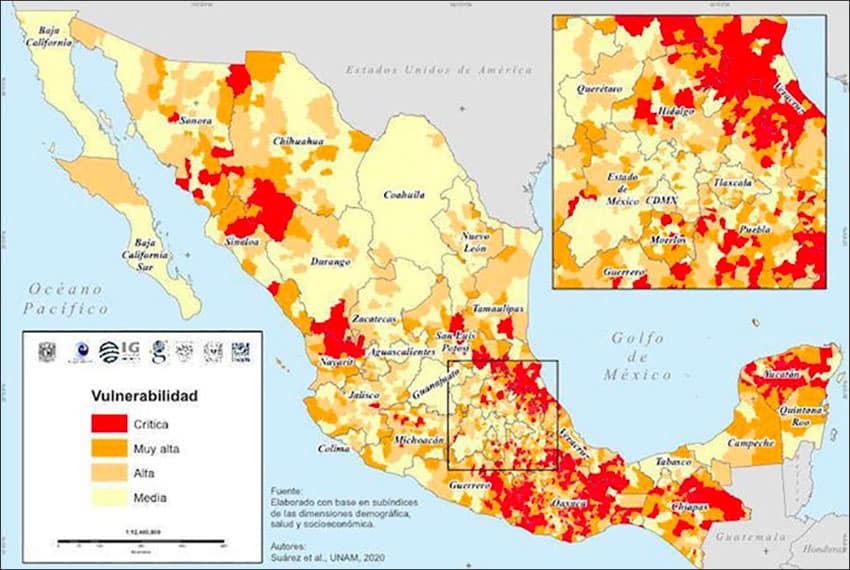
Almost 44 million people live in municipalities that are particularly vulnerable to the coronavirus pandemic, according to a study by academics at the National Autonomous University (UNAM).
Entitled Vulnerability to Covid-19 in Mexico, the study found that 1,837 of the country’s 2,457 municipalities – 75% of the total – are critically, very highly or highly vulnerable to an outbreak of Covid-19 because they have a high percentage of residents aged over 60, have large indigenous populations, lack hospital services and medical personnel and/or are economically disadvantaged.
There are 607 municipalities considered critically vulnerable, of which 71 have already reported coronavirus infections; 611 municipalities with very high vulnerability, of which 131 have confirmed Covid-19 cases; and 619 highly vulnerable municipalities, of which 188 have at least one resident who has tested positive.
The most vulnerable municipalities are in Oaxaca, Guerrero, Chiapas, Yucatán, the Huasteca region of Puebla and Veracruz, southern Durango and the Sierra Tarahumara region of Chihuahua, the UNAM study found.
“The greatest vulnerability is concentrated in the country’s most marginalized municipalities, where access to health services is also limited,” said Manuel Suárez, a researcher at the UNAM Institute of Geography who contributed to the study.
“Infections must be prevented at all costs in these municipalities because … health services are practically non-existent,” he said.
While the majority of Covid-19 cases are currently concentrated in large urban areas such as Mexico City and Tijuana, the UNAM academics fear that the virus will also spread to vulnerable rural municipalities that have not yet been directly affected.

“It’s important to locate them and acknowledge them, to understand that they are particularly vulnerable,” said Samuel Ponce de León, a medical doctor and coordinator of the UNAM health research program.
The consequences of Covid-19 outbreaks in sparsely-populated municipalities with “very fragile economies” could be “particularly serious,” he said.
The academics said that maintaining and/or increasing measures to prevent the spread of Covid-19 to the country’s most vulnerable municipalities is imperative even if they have not yet recorded any cases.
They said that the possibility of lifting restrictions in municipalities with very few or no cases before the end of the health emergency period currently scheduled to run through May 30 – as Deputy Health Minister Hugo López-Gatell indicated could occur – must be carefully evaluated because such municipalities could remain vulnerable to new infections originating outside their borders.
Publication of the UNAM study comes as confirmed Covid-19 cases and coronavirus-related deaths continue to increase at a steady rate.
The federal Health Ministry reported 852 new cases on Monday, taking the total to 15,529, and 83 new fatalities, lifting Mexico’s coronavirus death toll to 1,434.
Director of Epidemiology José Luis Alomía said that there are also 8,614 suspected Covid-19 cases across the country and that more than 71,000 people have now been tested for the disease.
Of the more than 15,000 confirmed cases, 5,009 are considered active, meaning that those infected presented with symptoms in the last 14 days.
Alomía said that 20% of just over 16,000 hospital beds across the country that have been set aside for Covid-19 patients are currently occupied. However, the occupancy level in the three states with the highest number of cases – Mexico City, México state and Baja California – is much higher at 56%, 42% and 55%, respectively.
Mexico City, where more than 4,000 people have now tested positive for Covid-19 since the first case was detected at the end of February, has also recorded the highest number of coronavirus-related deaths with 328.
Baja California follows with 167 and México state and Sinaloa with 122 deaths each.
Source: El Universal (sp), Milenio (sp)