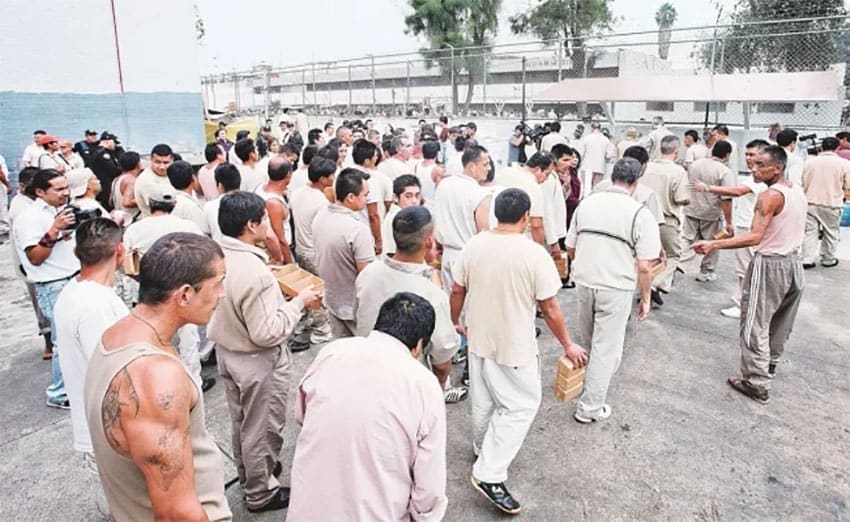
President López Obrador on Wednesday urged the Senate to approve his amnesty law so that prisoners aged over 60, those with chronic diseases, incarcerated pregnant women and others who didn’t commit serious crimes can leave jail to reduce prison populations amid the coronavirus pandemic.
López Obrador called on ruling party Senate leader Ricardo Monreal to schedule a vote on the law, which was passed by the lower house of Congress in December.
“It’s urgent that the amnesty law be approved because it will benefit older adults, among others … because they didn’t commit serious crimes,” he said.
López Obrador said last September that the law was designed to benefit people of modest means who were incarcerated without having access to an adequate legal defense. Women imprisoned for having an abortion, perpetrators of minor drug offenses and people who committed crimes that didn’t involve violence could be eligible for release if the law is passed.
Monreal said later on Wednesday that the legislative majority in the Senate – a coalition of parties led by Morena – will propose that the upper house sit to approve the amnesty law and help to reduce the possibility of large outbreaks of Covid-19 in the nation’s jails. Many of Mexico’s penitentiaries are severely overcrowded.
In a video message, Monreal pledged that the Senate will “find the legal mechanisms” to pass the amnesty law. However, if the law is not promptly approved, the president has the option to pardon prisoners and order their early release, he said.
Interior Minister Olga Sánchez said in December that some 6,200 prisoners in Mexico’s 17 federal and 292 state prisons would be eligible for release in accordance with the amnesty law. An additional 2,600 inmates were under consideration to receive a presidential pardon, she said.

The total number of prisoners that could be released if the amnesty law is passed would be 8,800 or approximately 4% of Mexico’s prison population, which was 211,000 in 2016, according to the national statistics institute.
María Sirvent Bravo, head of the social justice organization Documenta, said the government should already be making use of the pardon and early release provisions to reduce prison populations as Mexico’s coronavirus outbreak worsens.
She said there are 3,500 prisoners in Mexico City alone who are not incarcerated for serious crimes and are among cohorts of the population considered more vulnerable to Covid-19.
Héctor Carreón Herrera, an academic at the National Institute of Criminal Sciences, agreed that inmates who are more vulnerable to developing serious Covid-19 symptoms and who are not imprisoned for serious crimes should be released. He added that indigenous people and those with disabilities should also be considered for release.
Carreón explained that those released would still have to comply with other aspects of their sentences such as the payment of compensation to victims.
The National Human Rights Commission (CNDH) said on Wednesday night that six inmates in Mexican prisons have tested positive for coronavirus. Five are imprisoned in México state and one is in a Yucatán jail.
The CNDH also said that there are 24 suspected cases of Covid-19 among inmates in a Tamaulipas prison.
Source: El Universal (sp), El Imparcial (sp)