Coronavirus cases among young, unvaccinated people are driving the resurgence of the pandemic in Mexico as the more contagious Delta strain circulates among the population.
Deputy Health Minister Hugo López-Gatell said last week that Mexico had entered a third wave of the pandemic, and state and federal authorities say that a majority of new cases have been detected among young people, most of whom are not only unvaccinated but are also more likely to have relaxed their observance of virus mitigation measures.
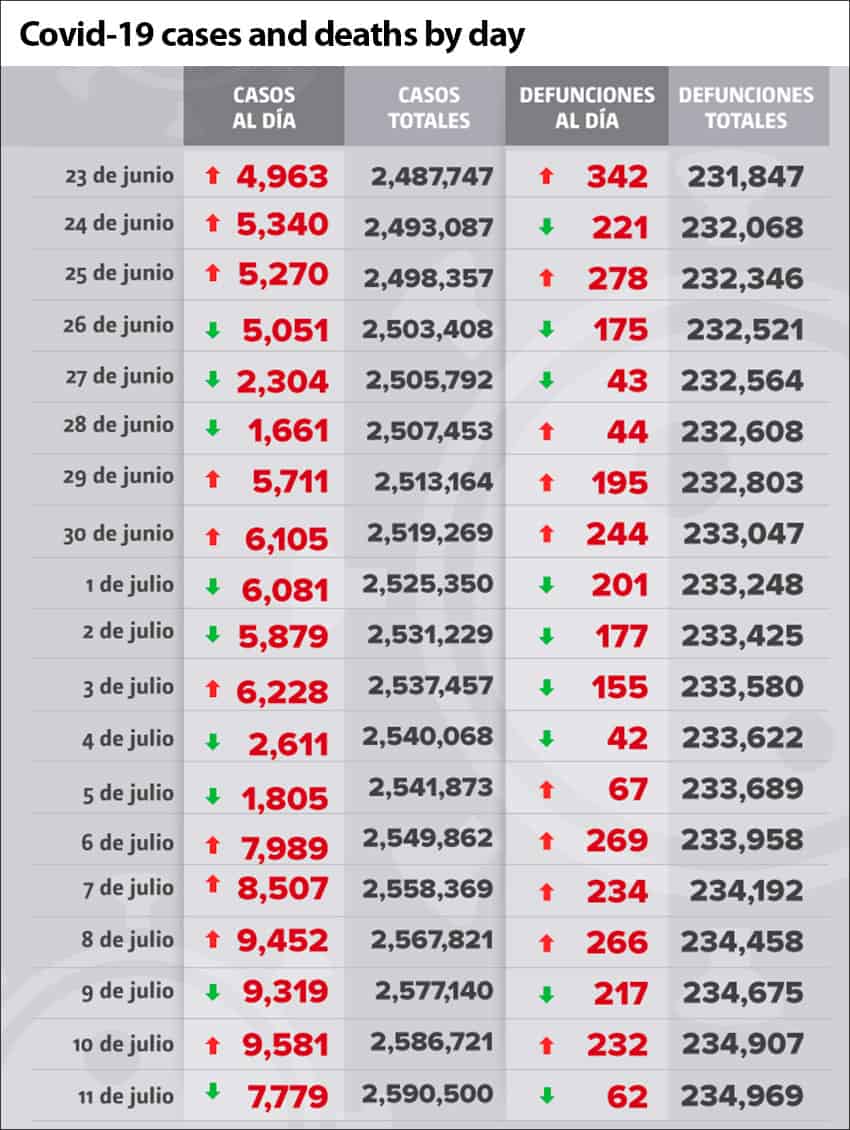
Mexico recorded 71,231 new cases in the first 11 days of July for an average of 6,475 cases per day, an increase of 84% compared to the daily average in June. However, reported Covid-19 deaths are down almost 45% to an average of 175 per day this month from 316 in June.
The reduction in the daily death toll comes at a time when the majority of older, more vulnerable Mexicans are fully vaccinated against Covid-19.
With the exception of young people in some northern border cities – where inoculation of the entire adult population has been prioritized in order to expedite the opening of the border to nonessential travel – the vast majority of those in the 18-39 age bracket are either unvaccinated or have only received one of two required doses.
The coronavirus, including the highly transmissible Delta strain, has consequently found a happy hunting ground among young, unvaccinated Mexicans, who are less susceptible to severe disease but who are nevertheless driving an increase in the hospitalization rate in some states.
According to data from the Mexican Consortium for Genomic Surveillance, 222 of 3,925 virus samples — or 5.65% — that were sequenced between May 1 and June 16 corresponded to the Delta variant, with Baja California Sur – which has recently seen an extremely steep increase in case numbers – Mexico City and México state recording the highest number of cases of that strain.

Authorities in Michoacán reported Sunday that a Delta strain coronavirus outbreak had been detected in Zinapécuaro, a municipality 50 kilometers northeast of the state capital Morelia, and the variant, which first emerged in India late last year, has also been identified in many other states.
Jaime Sepúlveda, executive director of the Institute for Global Health Sciences at the University of California in San Francisco, predicted that the Delta strain will soon become the most prevalent variant in Mexico, as is already the case in the United States and many other countries.
“We know that it’s circulating in Mexico, it will surely be the predominant [strain] soon and it’s a more aggressive variant with regard to its transmission – it’s 40% to 60% more transmissible than previous variants,” he told the news website Animal Político.
Sepúlveda urged the Mexican government to take up the fight to Delta by speeding up the vaccination process.
“Vaccination is individual protection but it’s also collective protection because it prevents the circulation of the virus. The chain of transmission declines substantially with vaccination and it also prevents the emergence of new, even more transmissible and virulent variants,” he said.
At least 70% of the population needs to be vaccinated against Covid-19 in order to achieve herd immunity, according to World Health Organization chief scientist Soumya Swaminathan, but only 28% of the Mexican population have had at least one shot, according to The New York Times vaccinations tracker and just 16% are fully immunized.
Sepúlveda urged people to get vaccinated no matter which Covid-19 vaccine – the Pfizer, AstraZeneca, CanSino, SinoVac, Sputnik V and Johnson & Johnson shots have all been used in Mexico – is on offer.
“All the vaccines offer protection against serious disease and death, all of them; and all of them help to fight against [the emergence] of new variants of the virus,” he said.
The total number of Mexicans who have had the opportunity to get vaccinated but decided not to is unknown but about 4 million of approximately 15 million people aged 60 or over opted out, government data suggests, although some of them were likely vaccinated in the United States.
The 4 million figure, accounting for about 27% of seniors, appears credible because more than 34% of people in the 60+ age bracket who responded to last year’s National Health and Nutrition Survey said they intended to reject the vaccine while another 11.7% said they were unsure whether they would get inoculated.
More than a quarter of respondents in younger age brackets also said they wouldn’t get vaccinated. Anecdotal evidence suggests that much of the vaccine hesitancy is due to fear of having an adverse reaction after receiving a shot. One 60-year-old woman who spoke with Animal Político said she had decided against getting a jab after reading about people developing blood clots as a result of being vaccinated with AstraZeneca.
(Clotting cases and deaths following vaccination have been reported in many countries around the world but the risk of developing thrombosis after inoculation with the AstraZeneca or Johnson & Johnson vaccines remains exceedingly low.)
Despite vaccine hesitancy, reaching a vaccination rate of 70% of adults looks achievable – 39% of the adult population has had at least one shot, according to the Health Ministry – albeit challenging, but in order to obtain that level of immunity among the entire population (not considering immunity gained through infection), children will also need to be inoculated.
The Pfizer vaccine has been approved in Mexico for the inoculation of children aged 12 and older but it is unclear when vaccination of minors will begin.
With reports from Animal Político and El Universal