Mexico will have eight green light low risk states during the next two weeks after the federal Health Ministry presented an updated coronavirus stoplight map on Friday.
Nuevo León and Oaxaca will switch to green on Monday, joining Campeche, Chiapas, Coahuila, Nayarit, Tamaulipas and Veracruz.
In Campeche, which was the first state in the country to turn green, all primary and middle school teachers have been vaccinated against Covid-19 with a view to resuming in-person classes soon.
Jalisco switched to green two weeks ago but will regress to medium risk yellow on Monday due to the Health Ministry’s assessment that the coronavirus situation has worsened.
There are 19 yellow light states on the updated map, an increase of one compared to the map currently in effect.
Puebla, Hidalgo and Querétaro will switch from high risk orange to yellow on Monday, joining Baja California, Sonora, Sinaloa, Zacatecas, Durango, Aguascalientes, San Luis Potosí, Guanajuato, Colima, Michoacán, Tlaxcala, Guerrero, Morelos, Tabasco and Quintana Roo.
The number of orange states declines to five on the new map from seven on the one currently in force.

Mexico City, México state, Chihuahua and Yucatán are already orange and will remain that color for the next two weeks while Baja California Sur, which received a large number of tourists during the Easter vacation period, will switch from yellow.
For the fourth consecutive fortnight there will be no red light maximum risk states between April 12 and 25.
Each stoplight color, determined by the Health Ministry using 10 different indicators including case numbers and hospital occupancy levels, is accompanied by recommended restrictions to slow the spread of the virus but it is ultimately up to state governments to decide on their own restrictions.
Presenting the map at Friday night’s coronavirus press briefing, Health Ministry Director of Epidemiology José Luis Alomía said the intensity of Mexico’s pandemic has been on the wane for 10 weeks but warned citizens to continue observing virus mitigation measures. He noted that the risk of infection could be higher now due to the likely spread of the virus at gatherings during the Easter holidays.
“If mobility increases [again] as was seen over the Easter weekend in the 32 states, we can expect an increase in the case load,” Alomía said.
Hospitalizations and Covid-19 deaths have also declined recently – the latter fell 36% in March compared to February and 46% compared to January – but the Health Ministry continues to report hundreds of fatalities on a daily basis.
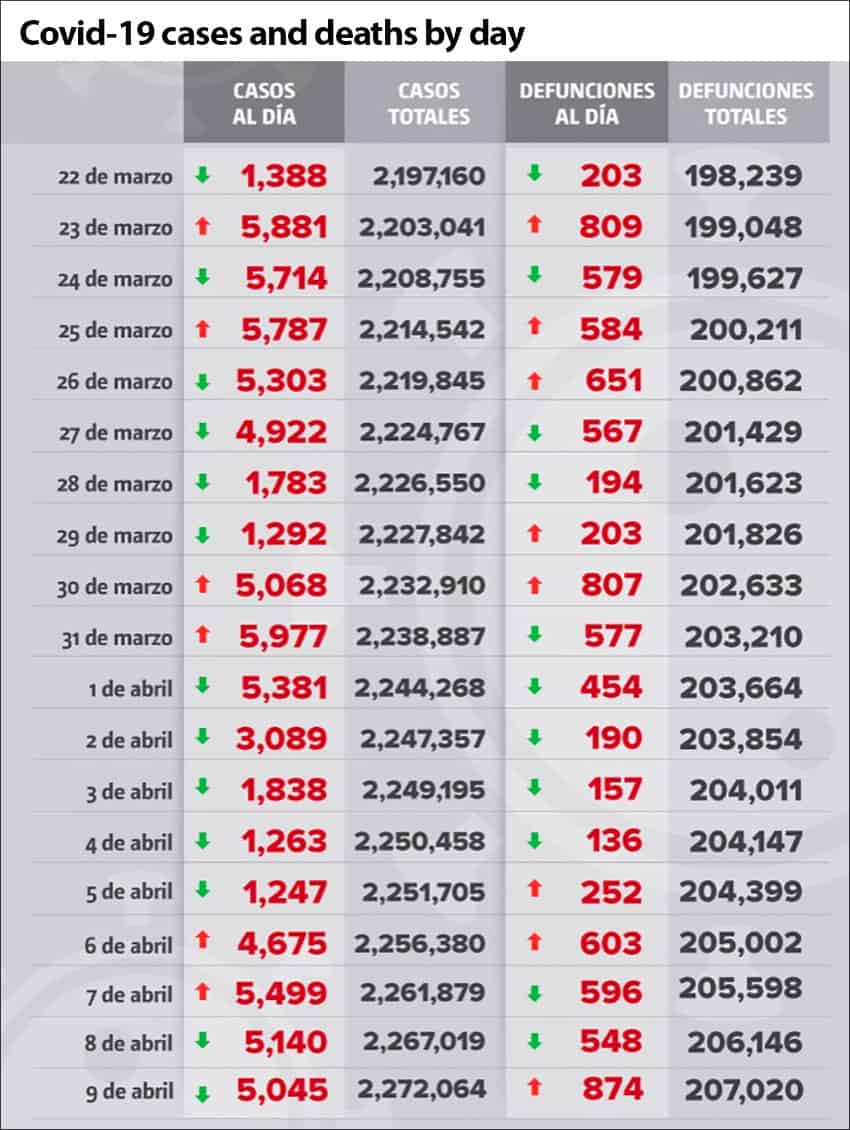
The official death toll increased by 874 on Friday – the highest daily total in more than a month – to 207,020, while the accumulated case tally rose 5,045 to 2.27 million.
Just under 11 million vaccine doses had been administered in Mexico by Friday night, according to Health Ministry data. Mexico is currently in the second of five stages of the national vaccination plan, which includes the inoculation of seniors as well as non-frontline health workers. Frontline health workers were vaccinated in stage 1.
Citing the delay in the delivery of Pfizer vaccines earlier this year, the federal government this week modified its Covid-19 vaccination schedule, pushing back by one month the start date of stages 3,4 and 5 of the vaccination plan.
Source: Infobae (sp)