The coronavirus pandemic continued to wreak havoc on Mexico’s tourism industry in November, new data shows.
International arrivals declined 54.3% in November compared to the same month of 2019, while visitors’ total expenditures dropped by an even higher amount, the national statistics agency Inegi reported Monday.
Inegi said that just under 3.92 million visitors entered Mexico in the penultimate month of last year, 4.66 million fewer than in November 2019.
The visitors spent US $856.6 million while in the country, a 54.8% decline compared to November 2019 when the total outlay was just under $1.9 billion.
Of the 3.92 million visitors, 2.09 million were classified as international tourists. That figure represents a 45.6% decline compared to November 2019.
Airport arrivals declined 55% to 726,258 while land border crossings into Mexico fell 33% to 258,645. Visits by “border tourists” – people entering Mexico for a short period of time from the United States, Guatemala and Belize – declined 40.1% in November to just over 1.1 million.
The Mexico-United States border is supposedly closed to nonessential travel but U.S. tourists have reportedly had few problems traveling south.

Spending by the 2.09 million international tourists totaled $248.4 million, a 69.2% annual decline. Spending on an individual tourist basis by passengers who arrived by air was down 4.9% in November to $878.
Inegi data also shows that the number of Mexicans traveling abroad decreased significantly in November. There were just under 2.25 million departures, a 68.9% decline compared to November 2019.
The decline in international arrivals is a double-edged sword for Mexico. While fewer tourists is in one respect welcome because it inevitably means fewer cases of the coronavirus are imported, the reduction in visitor numbers also means lower or no income for the millions of people who work in the tourism sector, which before the pandemic contributed to almost 10% of GDP.
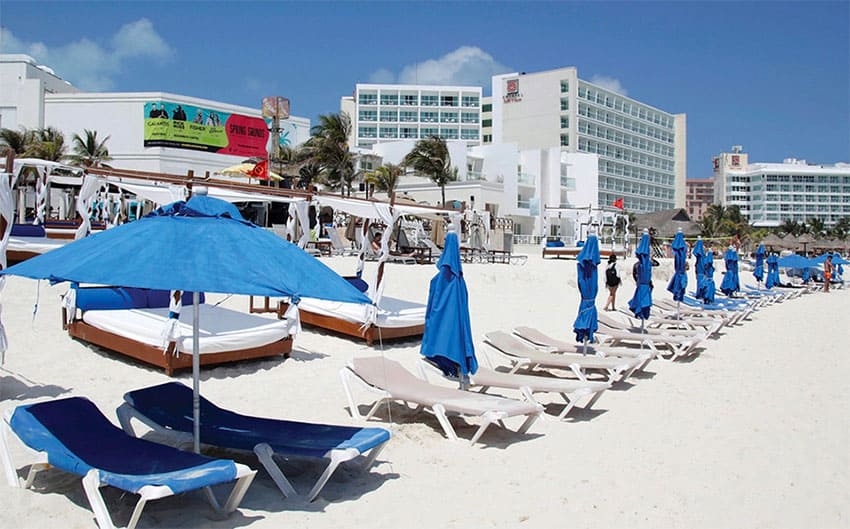
The reduction in tourist numbers has not affected Mexico’s tourism destinations equally. Quintana Roo, for example, has recently experienced an influx of visitors as U.S. tourists, locked out of European countries and other popular tourism destinations around the world due to the raging coronavirus pandemic at home, flock to the Caribbean coast state.
Mexico’s tourism industry began to reopen in June after shutting down for over two months due to a nationwide suspension of nonessential economic activities.
Quintana Roo, home to popular destinations such as Cancún, Playa del Carmen and Tulum, and Baja California Sur, where Los Cabos is located, are currently “medium” risk yellow on the coronavirus stoplight map. Both states are open for tourism although limits on capacity at hotels and restaurants remain in place.
Two other states, Veracruz and Aguascalientes, are yellow while two, Campeche and Chiapas, are “low” risk green. There are five “maximum” risk red light states – Mexico City, México state, Baja California, Morelos and Guanajuato – while the 21 other states are “high” risk orange.
Mexico is currently going through its most difficult time of the pandemic, with daily case numbers and Covid-19 deaths at or near record levels in recent days. The accumulated case tally is 1.53 million, the 13th highest total in the world, while the official death toll is 133,706, the fourth highest total behind those of the United States, Brazil and India.
Mexico News Daily